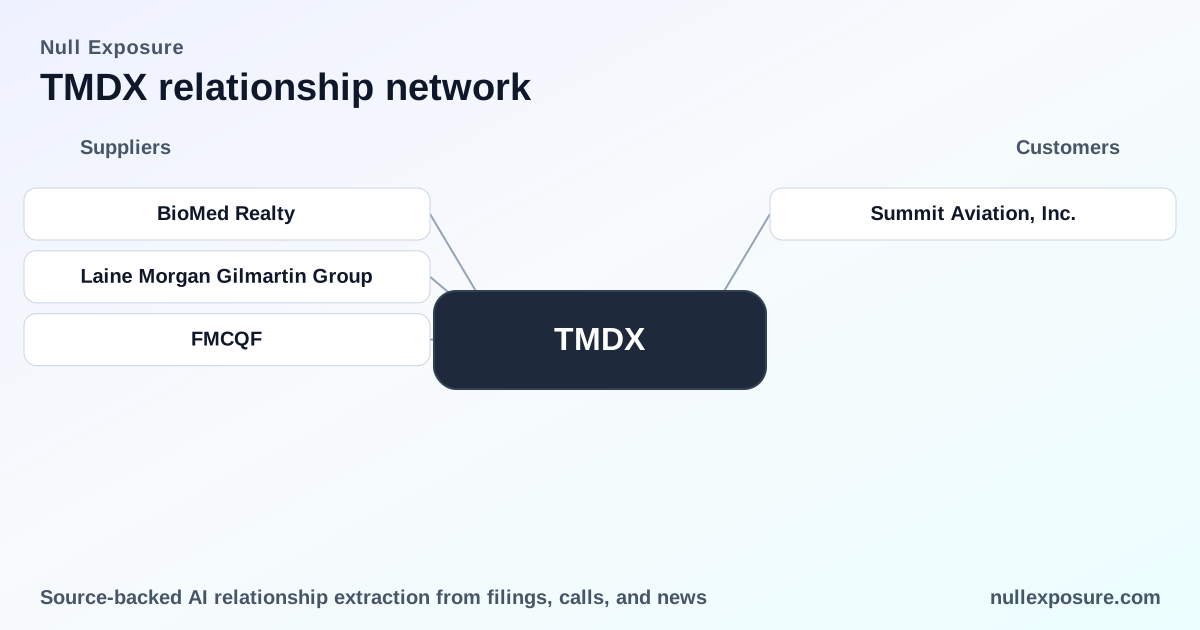
TransMedics (TMDX) — How customer ties drive recurring revenue and logistics control
TransMedics monetizes a two‑pronged organ-transplant ecosystem: high-margin recurring sales of single‑use, organ‑specific disposable sets paired with a growing services business — the Network Organ Procurement (NOP) — that provides outsourced procurement, perfusion management and logistics. The firm captures revenue both as a seller of disposables and as a service provider/buyer of logistics inputs, using ownership of transport capabilities to internalize mission-critical supply chain steps and increase procedure throughput. For investors, TMDX’s customer relationships should be evaluated for concentration at major transplant centers, recurring per‑procedure unit economics, and the strategic value of in‑house logistics. Learn more at https://nullexposure.com/.
Quick read: the commercial logic investors should track
TransMedics converts installed consoles into annuity-like revenue by selling single‑use disposables required for every transplant, while the NOP converts operational control into service revenue and better capture of the downstream economics of organ delivery. This combination creates a structural moat around procedure-based recurring revenue and a lever to grow utilization via logistics offerings.
What the public record shows about customer relationships
Below I cover every customer relationship found in the latest search results and the specific public evidence that supports each connection.
Summit Aviation, Inc.
TransMedics acquired Summit Aviation in August 2023 to add aircraft transportation services to its NOP, enabling the company to offer dedicated flight logistics for organ procurement and delivery across the United States. This acquisition is presented in TransMedics’ Form 10‑K for the fiscal year ended December 31, 2024. According to the 2024 10‑K, adding Summit allowed TransMedics to become “a comprehensive national provider of donor organ procurement and delivery” by integrating charter flight capabilities into the NOP (10‑K, FY2024).
Montreal Heart Institute
The Montreal Heart Institute publicly debuted the TransMedics Organ Care System (OCS) Heart in collaboration with TransMedics on May 2, 2026, representing a clinical/commercial rollout in Canada and evidence of international adoption of the OCS Heart product. A news item on Simply Wall St reported the Montreal Heart Institute’s May 2026 event showcasing the OCS Heart (news report, Simply Wall St, May 2, 2026).
Chu Sainte‑Justine
Chu Sainte‑Justine joined the Montreal Heart Institute in the May 2, 2026 debut of the TransMedics OCS Heart, indicating adoption by pediatric or academic medical centers in Quebec and strengthening TransMedics’ presence in Canadian transplant programs. The joint debut was also reported on Simply Wall St on May 2, 2026 (news report, Simply Wall St, May 2, 2026).
How these relationships map to TransMedics’ operating model
TransMedics runs a hybrid product + services model with clear implications for contracting posture, counterparty concentration, and revenue profile:
-
Contracting posture — usage‑based with recurring billing: The company invoices customers for disposable OCS sets on a per‑transplant basis; this creates predictable, recurring revenue tied directly to procedure volume. The 10‑K describes disposables and NOP services as the primary recurring revenue drivers (10‑K, FY2024).
-
Counterparty concentration and counterparty type: The transplant ecosystem is concentrated in leading academic medical centers and organized non‑profit Organ Procurement Organizations (OPOs). The 10‑K explicitly notes that transplant activity is concentrated in major academic centers and that OPOs and transplant centers (often non‑profit) are the primary buyers.
-
Geographic footprint and expansion: The business is firmly U.S.‑centric for revenue today, with small but growing international revenue; the company discloses that only a small percentage of revenue comes from outside the U.S. in recent years while maintaining distribution operations in Europe and commercial activity globally (10‑K, FY2024).
-
Relationship roles are multi‑faceted: TransMedics is both a seller of disposable product and a service provider through NOP; it also acts as a buyer in situations where it reimburses customers for clinical trial materials or pays for trial‑related costs, which the company accounts for as reductions to revenue.
-
Maturity and spend scale: Evidence in filings indicates sizable per‑customer procedure-level economics consistent with spend bands in the low hundreds of thousands annually for centers with significant OCS utilization; the company’s reconciliation of product revenue recognizes clinical trial payments and similar adjustments, implying meaningful per‑institution flows.
Risks and advantages embedded in customer dynamics
-
Advantage — built‑in recurring revenue: The requirement for a disposable set for every transplant converts installed base into dependable revenue, improving visibility into revenue per console and supporting higher gross margins on disposables.
-
Advantage — logistics verticalization: Ownership of Summit Aviation and dedicated NOP resources reduces external vendor risk, accelerates mission response times, and lets TransMedics capture a larger share of per‑procedure economics.
-
Risk — customer concentration and repayment cycles: Reliance on high‑volume academic centers and OPOs concentrates revenue exposure; reimbursement and clinical trial arrangements introduce direct financial interactions that can reduce short‑term net product revenue.
-
Risk — international scale remains limited: International revenue is small relative to U.S. revenue today, so global adoption is necessary to materially diversify geographic risk.
What investors should watch next
- Procedure volume trends at leading transplant centers and the growth in console install base — these drive disposable unit sales and NOP utilization.
- NOP utilization rates and gross margin on services as Summit Aviation integration matures; this will determine how much incremental revenue and margin the logistics business contributes.
- International commercial rollouts and distributor adoption in Europe and APAC; early Canadian deployments reported in May 2026 show proof of concept for non‑U.S. expansion.
Final read: investment implications
TransMedics’ customer relationships validate a sell‑and‑service model that turns single‑use disposables into recurring annuity revenue while using logistics ownership to accelerate adoption and capture more downstream value. The company’s control of air and ground transport through the NOP reduces friction for customers and creates a structural advantage in scaling procedures. For investors, the primary monitorables are console install growth, per‑procedure disposable volume, and NOP service margins — each directly tied to the customer relationships described above.
If you want a concise package of relationship intelligence and how it maps to procurement and revenue risk, visit the Null Exposure homepage: https://nullexposure.com/.
For ongoing monitoring of TransMedics’ customer network and how strategic logistics moves like the Summit Aviation acquisition change revenue capture, see https://nullexposure.com/.