Tencent Music Entertainment (TME): Customer Relationships that Drive Reach and Retention
Thesis — Tencent Music Entertainment monetizes a multi-sided music and live-entertainment platform in China by combining subscription streaming, social features (karaoke, live streaming), and strategic content partnerships that lock in user engagement and feed advertising and in-app purchase revenue. TME’s commercial model leverages exclusive content and embedded distribution partnerships — notably in automotive and gaming — to create recurring, captive listening environments that translate into predictable monetization and incremental ad/commerce channels. For a closer look at TME’s relationship map, visit https://nullexposure.com/.
Market positioning and where value is created TME operates as both a rights aggregator and consumer engagement engine. The company sells subscriptions and virtual goods to users while licensing music and co-producing promotional content with rights holders and platform partners. The combination of proprietary music experiences and distribution hooks into other Tencent ecosystem properties (and third-party OEMs) is the principal economic moat: exclusive releases drive incremental subscriptions and engagement; embedded audio in vehicles and games converts that engagement into long-duration, low-churn usage.
Why the customer relationships matter
- Content exclusives (artist releases, co-produced anthems) drive short-term user acquisition spikes and long-term retention through catalog differentiation.
- Platform embedding (automotive OEMs, gaming integrations) turns TME from an app choice into a default audio provider, increasing time-in-app and advertising inventory value.
- Live and tour partnerships extend monetization beyond streaming into ticketing, virtual events, and branded experiences.
Read more about how we map these relationships at https://nullexposure.com/.
How to read the relationship signals Below I detail every customer relationship flagged in the recent coverage set. Each entry is a concise, investor-oriented description followed by the source referenced for that signal.
H2: Content partnerships that convert fans into subscribers
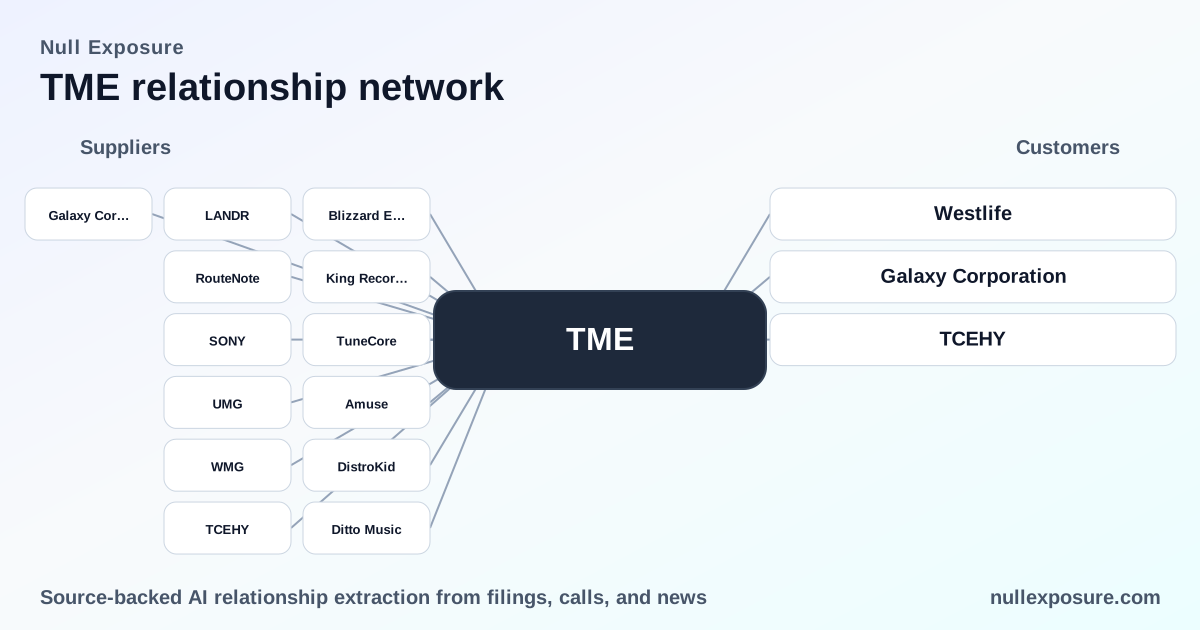
H3: Westlife — exclusive China release TME secured exclusive China distribution for Westlife’s Mandarin cover of Jason Zhang’s “Love + Courage,” positioning the platform as the go-to place for high-profile Western-Asia crossover releases; exclusivity supports incremental streaming and PR-driven subscription lifts. Source: Music Business Worldwide, March 10, 2026 (https://www.musicbusinessworldwide.com/this-ai-tech-lets-users-sing-in-10-languages-and-15-chinese-dialects-westlife-have-used-it-to-release-a-song-in-mandarin-via-tencent-music/).
H3: Galaxy Corporation — regional K‑pop tour collaboration Galaxy Corporation’s Greater China World Tour contract with TME signals deeper collaboration on K‑pop content and live experiences across the region, which strengthens TME’s live-event monetization and cross-sells digital engagement (song premieres, fan interactions) to its platform audience. Source: Simply Wall St., March 2026 (https://simplywall.st/stocks/us/media/nyse-tme/tencent-music-entertainment-group/news/is-tencent-music-tme-quietly-turning-kpop-partnerships-into).
H2: Embedding audio where users spend time: automotive and gaming
H3: Nio — in-vehicle default audio partner TME is cited as becoming the default audio provider for China’s EV ecosystem, including Nio, creating a “captive” listening environment inside vehicles that drives habitual usage and ad/retention revenue for the platform. Source: FinancialContent analysis, March 17, 2026 (https://markets.financialcontent.com/stocks/article/finterra-2026-3-17-the-audio-architect-a-deep-dive-into-tencent-music-entertainment-group-tme-in-2026).
H3: XPeng — embedded audio in EV dashboards XPeng is included alongside peers as part of TME’s strategy to supply in-car audio services to EV manufacturers, converting vehicle users into long-duration listeners and expanding monetizable impressions beyond smartphones. Source: FinancialContent analysis, March 17, 2026 (https://markets.financialcontent.com/stocks/article/finterra-2026-3-17-the-audio-architect-a-deep-dive-into-tencent-music-entertainment-group-tme-in-2026).
H3: BYD — scale in China’s largest EV seller BYD’s inclusion in the cited cohort is significant: integrating TME across mass-market vehicles like BYD’s models scales active listening hours materially and embeds TME as a default channel for in-car audio advertising and subscription upsells. Source: FinancialContent analysis, March 17, 2026 (https://markets.financialcontent.com/stocks/article/finterra-2026-3-17-the-audio-architect-a-deep-dive-into-tencent-music-entertainment-group-tme-in-2026).
H2: Cross-promotions inside the Tencent ecosystem
H3: Tencent Games (TCEHY) — co-produced IP and promotional scale TME co-produced the Honor of Kings 10th-anniversary theme “Atlas of Tomorrow” with Tencent Games, a campaign that generated over 600 million social mentions within two weeks and demonstrates how in‑ecosystem promotions drive enormous awareness and streaming volume. Source: Variety coverage of Tencent Music Q3 2025 revenue, reported 2025 (https://variety.com/2025/music/news/tencent-music-q3-revenue-2025-1236577827/).
H3: TCEHY (ticker-cited) — the same commercial dynamic The entry labeled TCEHY reiterates the Tencent Games partnership and the promotional magnitude of co-produced music tied to Tencent’s gaming franchises, reinforcing TME’s role as the music arm of a broader entertainment ecosystem. Source: Variety, 2025 (https://variety.com/2025/music/news/tencent-music-q3-revenue-2025-1236577827/).
H2: Company-level operating posture and business-model constraints
Operational posture and commercial concentration
- Contracting posture: TME operates as both licensee and co-producer — it negotiates exclusive distribution deals and joint-productions that commit rights and marketing dollars up-front and generate recurring revenue through subscriptions and virtual goods.
- Concentration: The company benefits from deep integration with Tencent ecosystem partners and a handful of strategic OEMs; this creates concentrated channel exposure but also high leverage—loss of a major OEM embed or a key Tencent cross-promotion would be materially disruptive.
- Criticality of relationships: Partnerships with automakers and Tencent Games are strategically critical because they convert passive users into persistent, monetizable listeners and provide scale for advertising inventory.
- Maturity: With over $32.9B revenue TTM and institutional ownership north of 65%, TME is a mature platform in China’s digital music market; the business mixes steady subscription cash flows with episodic spikes from promotional partnerships.
Note: No explicit contractual constraints were supplied in the relationship feed; the bullets above are company-level operating signals derived from the combination of public financials and relationship activity.
H2: Investment takeaways and risk checklist
- Positive: Exclusive artist releases and Tencent-internal IP co-productions provide scalable promotional reach and predictable engagement uplifts. Automotive embeds offer long-duration listening that boosts ARPU and advertising yield.
- Risk: High reliance on Tencent ecosystem synergies and a small set of large distribution partners creates concentration risk; regulatory shifts or changes in OEM preinstalls could reduce scale quickly.
- Valuation context: With a trailing P/E ~8.8 and EV/EBITDA ~5.0, the market prices TME as a value-growth streaming platform with solid profitability metrics versus growth optionality from embedded audio channels.
If you want a structured map of TME’s customer relationships and how they impact contract exposure and revenue cadence, explore our detailed relationship dashboards at https://nullexposure.com/.
Conclusion TME’s customer relationships are not standalone marketing wins; they form an integrated monetization stack—exclusive content drives acquisition, Tencent ecosystem promos amplify scale, and automotive embeds convert engagement into long-duration monetizable inventory. For investors, the question is whether TME can continue converting partner scale into sustained ARPU gains while managing concentration and regulatory risks.