Tompkins Financial (TMP): Customer relationships after the divestiture — who matters and why
Tompkins Financial is a community-based regional bank that monetizes through deposit and lending spread, wealth and trust fees, leasing income, and insurance and advisory services (until the company’s recent divestiture). The sale of its insurance subsidiary and an ongoing focus on locally concentrated banking and wealth-management relationships now define the company’s customer profile and counterparty risk. For investors evaluating customer concentration, contractual posture, and downstream revenue durability, these relationship signals are the most relevant. Learn more about how we source and structure these customer insights at https://nullexposure.com/.
Quick take: the mechanics that drive the customer picture
Tompkins runs a service-oriented model: community banking (deposits, commercial loans, standby letters of credit), wealth and trust management, and previously insurance brokerage. Contracts with customers skew short-term and cancellable, interaction density is local to Upstate New York and Pennsylvania, and the firm operates as a service provider to individuals and SMEs. The business is operationally mature and concentrated regionally, so customer migration or a change in local economic conditions would have material effects on deposit and lending flows.
Customer relationships uncovered — the shortlist investors need
Below I cover every relationship pulled from public reporting and press coverage. Each entry includes a plain-English description and a concise source citation.
Arthur J. Gallagher & Co. (AJG)
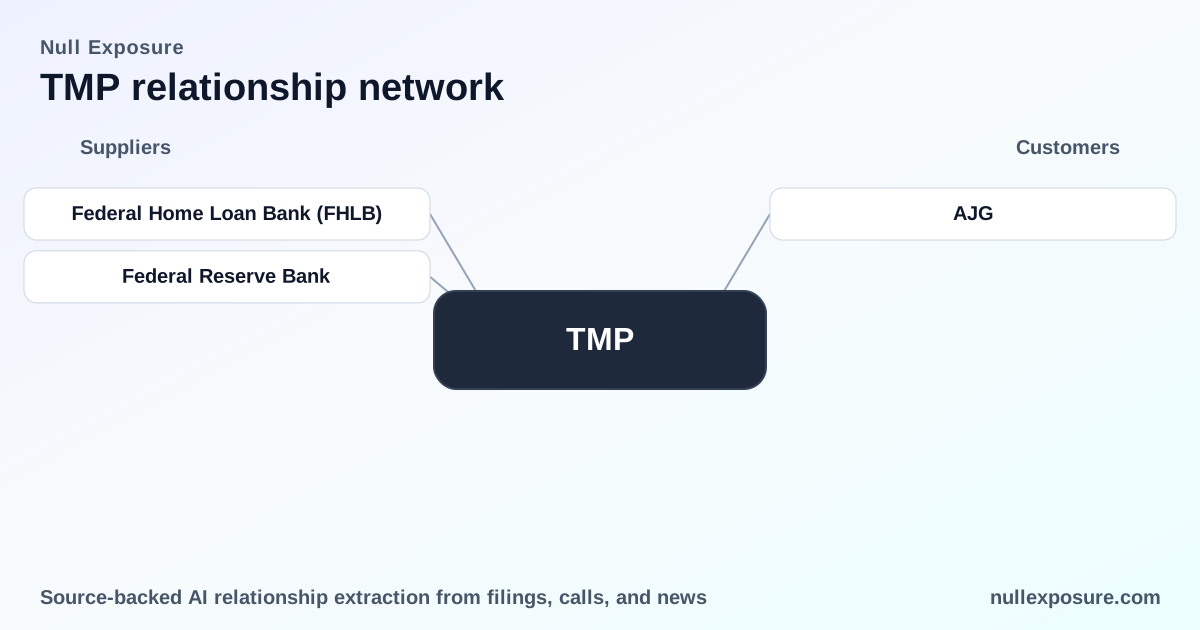
Tompkins sold all issued and outstanding shares of its wholly owned insurance subsidiary, Tompkins Insurance Agencies, Inc., to Arthur J. Gallagher & Co. for approximately $223.0 million in cash, subject to customary purchase price adjustments; the sale is reflected in FY2025–FY2026 reporting. This is a completed asset sale that materially repositions Tompkins away from insurance brokerage revenue and converts an operating line of business into liquidity.
Source: CityBiz report on Tompkins results (March 10, 2026) — https://www.citybiz.co/article/800474/tompkins-financial-corp-reports-record-earnings-per-share-for-the-fourth-quarter-of-2025/
Arthur J. Gallagher Risk Management Services, LLC
Company filing disclosures likewise state that Tompkins’ wholly owned insurance arm was sold to Arthur J. Gallagher Risk Management Services, LLC (a Gallagher affiliate) for roughly $223.0 million in cash, cited as a strategic initiative in the Tompkins 10‑K/SEC commentary. The counterparty here is an acquirer, not a continuing customer; the transaction converts recurring fee income into a one-time cash inflow and reduces Tompkins’ segment diversification.
Source: Tompkins 10‑K coverage via TradingView (March 2026) — https://fr.tradingview.com/news/tradingview%3Ab232c7558f37b%3A0-tompkins-financial-corp-sec-10-k-report/
AJG (alternate listing / nomenclature)
Press and trade coverage use the Arthur J. Gallagher ticker (AJG) and corporate name interchangeably when reporting the TIA acquisition; the financial effect—recognition of sale proceeds and the removal of insurance segment results—appears across Tompkins’ quarterly commentary and media write-ups. For practical analysis treat these mentions as the same commercial relationship: a strategic, one‑time divestiture to a large national broker.
Source: Insurance Journal (November 3, 2025) reporting on the closed sale — https://www.insurancejournal.com/news/east/2025/11/03/846230.htm
FERG (Ferguson PLC)
Ferguson identifies Tompkins as its distribution and fulfillment center design company, indicating a vendor-client engineering/consulting relationship for logistics and fulfillment infrastructure. This positions Tompkins as a specialist service provider in supply-chain design to corporate clients, separate from its banking and wealth operations and representing a fee-for-service relationship.
Source: Logistics Viewpoints article referencing Ferguson’s use of Tompkins for distribution and fulfillment center design (April 29, 2024) — https://logisticsviewpoints.com/2024/04/29/fergusons-commitment-to-supply-chain-excellence-drives-customer-satisfaction/
What the relationships collectively tell investors
- Strategic simplification: The sale to Gallagher converts a full operating segment into cash and reduces Tompkins’ revenue diversification. Investors should view the insurance divestiture as a shift from recurring brokerage fees to a more bank/wealth-centric revenue base.
- Counterparty type and reach: Tompkins’ customers continue to be local households and commercial clients, with some corporate fee engagements (e.g., fulfillment design). Geography is materially regional—primarily Upstate New York and Pennsylvania—so customer concentration risk is geographic as well as sectoral.
- Contracting posture: Contracts are generally short-term and cancellable, consistent with retail and commercial banking products and many fee-for-service engagements. This creates higher turnover sensitivity but also flexibility to repricing and cross-selling in a rising-rate environment.
- Spend and contingent exposure: The firm reports standby letters of credit with a maximum potential obligation of $38.5 million and mortgage sale commitments around $4.73 million as of December 31, 2024—amounts that show contingent exposure but remain modest relative to overall balance sheet scale. These are company-level disclosures that affect liquidity and contingent liability assessments.
Operational constraints that matter for relationship risk
Treat these as company-level signals that define how Tompkins manages and monetizes customer relationships:
- Short-term contracts dominate, which reduces locked-in revenue but allows rapid re-pricing and customer churn management.
- Customer mix includes individuals and commercial clients in a community-banking footprint; the bank acts as a service provider (trust, wealth, lending) rather than as a captive supplier.
- Geographic concentration (Upstate NY and Pennsylvania) amplifies local macro risk and credit-cycle exposure.
- Segment focus on services (banking, wealth management, insurance historically) means revenue sources are fee- and credit-sensitive rather than capital-intensive manufacturing contracts.
- Spend bands and contingent liabilities: standby capacity and mortgage sale commitments are material enough to track ($38.5M and ~$4.7M respectively) but do not represent single-customer catastrophic exposure on the public record.
Investment implications and what to watch next
- Earnings composition: Expect higher banking and wealth-management contribution to reported EPS going forward, with insurance-related recurring fees absent post-sale; the $223 million inflow is a one-time bolt to capital and liquidity.
- Capital redeployment: Monitor regulatory capital ratios and management commentary for how sale proceeds are used—balance-sheet paydown, M&A, buybacks, or reinvestment in fee businesses will materially change return profiles.
- Customer retention and cross-sell: Given short-term contracting and local concentration, the bank’s ability to cross-sell wealth and lending products to retained customers will determine sustainable revenue growth.
- Contingent exposure: Keep standby letters of credit and mortgage-sale commitments in modelled stress cases; they are non-trivial but not dominant.
Bottom line
Tompkins has traded an insurance operating segment for liquidity and strategic focus. For investors, the immediate story is balance-sheet recapture of value and a pivot to an asset- and fee-driven banking franchise concentrated in a defined geography. The transaction to Gallagher and existing fee-client relationships like Ferguson shift the company’s counterparty map from brokers and insurance clients toward depositors, borrowers, and wealth-management clients—conditions that reward close monitoring of local credit trends and cross-sell execution.
For ongoing monitoring of customer-level signals and to integrate these relationship insights into your diligence workflow, visit https://nullexposure.com/.