How T‑Mobile Monetizes a Network of Strategic Customers and Partners
T‑Mobile is a U.S. wireless and broadband operator that generates recurring service revenue from monthly consumer and business subscriptions while capturing incremental margin through device sales and multi‑year equipment installment plans. The company sells postpaid and prepaid service plans, finances devices through 24‑month installment programs, and leverages wholesale, MVNO and enterprise partnerships to expand reach and lock in network traffic and value‑added services.
For investors, two headline conclusions matter: services are the core revenue engine and postpaid customers drive the majority of margin, and an ecosystem of MVNOs, enterprise partners and device/service vendors amplifies scale but concentrates commercial exposure in the U.S. market. Learn more at https://nullexposure.com/ if you want a deeper feed of relationship signals and primary excerpts.
The operating model in plain terms: contract posture, counterparty mix and commercial gravity
T‑Mobile’s customer economics combine short‑duration billing with embedded longer‑dated device finance obligations. Most service contracts are billed monthly, creating a high‑frequency revenue stream and predictable churn mechanics, while device installment plans create deferred revenue and 24‑month recognition windows that lengthen customer economics and retention. The company’s reported figures show the business is heavily U.S.‑centric and service‑led: postpaid customers represent the largest single source of service revenue.
Key company‑level signals:
- Contracting posture: predominantly short‑term monthly service arrangements paired with 24‑month EIP device finance arrangements that extend economic commitment. (Company filings, FY2025).
- Counterparty mix: mix of individual consumers and small/enterprise business customers; wholesale and MVNO relationships are active channels. (Company filings and related disclosures).
- Geographic concentration: substantially all revenue and long‑lived assets are U.S.‑based, increasing regulatory and competitive exposure to domestic market dynamics.
- Materiality and criticality: core business is critical—the majority of service revenue is generated from postpaid wireless customers, making network availability and pricing pivotal to earnings stability.
- Segment mix: revenue is primarily services (voice/data/broadband) with hardware sales (handsets, tablets, gateways) and device financing as important margin enhancers.
These signals point to a scale‑driven utility business with short billing cycles, moderate contract tenor via device financing, and concentrated U.S. exposure—factors that shape cash flow predictability and competitive risk.
How partners and customers show up in the business — relationship map and implications
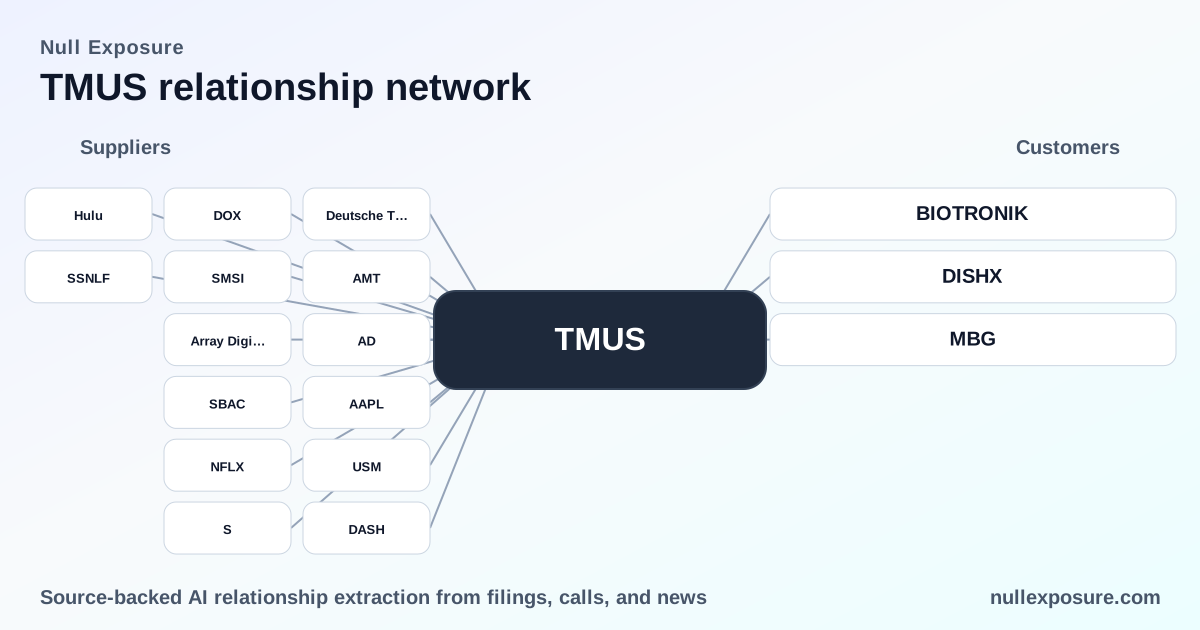
Below is a concise, source‑anchored read of every relationship found in the corpus. Each entry is a plain‑English summary with the originating reference.
-
CHTR (Charter) — Charter told investors in its 2025 Q4 earnings call it will launch an additional MVNO for business customers with T‑Mobile in the next six months, signalling another wholesale channel for T‑Mobile network capacity. (Charter 2025 Q4 earnings call; first seen 2026‑03‑07).
-
OPTU (Altice USA / Optimum Mobile) — Multiple Light Reading articles note Altice’s Optimum Mobile leverages an MVNO agreement with T‑Mobile and has added hundreds of thousands of mobile lines, reflecting substantial MVNO volume and growth through 2024–2025. (Light Reading, FY2022–FY2025 coverage; reported March–May 2026).
-
AD — In a 2025 Q2 earnings call excerpt, AD states a master lease agreement (MLA) with T‑Mobile will strengthen its tower business and drive long‑term revenue, indicating T‑Mobile as a significant customer for infrastructure leasing. (AD 2025 Q2 earnings call; first seen 2026‑03‑08).
-
SERV (Serve Robotics) — Serve announced a partnership utilizing T‑Mobile’s 5G Advanced and edge computing to power its “Maggie” conversational robot, highlighting T‑Mobile’s role as a low‑latency connectivity and edge compute enabler. (Serve press releases / GlobeNewswire, Apr 2026).
-
ARAI (Arrive AI) — Arrive AI’s demonstrations are using T‑Mobile’s 5G network to provide low‑latency connectivity for ground‑based robots and drones, a commercial validation of T‑Mobile’s robotics connectivity play. (Press releases and StockTitan coverage, Mar 2026).
-
Horizon Air — Public communications note Horizon Air aircraft are equipped with Starlink Wi‑Fi “thanks to T‑Mobile”, linking T‑Mobile into inflight connectivity bundles. (Alaska Air / Horizon Air press release, FY2026).
-
ALK (Alaska Air Group) — Alaska’s announcements state its Dreamliner fleet will offer complimentary Starlink Wi‑Fi “thanks to T‑Mobile”, suggesting T‑Mobile is a component in airline connectivity arrangements. (Alaska Air news, FY2026).
-
MSI (Motorola Solutions) — Motorola Solutions and T‑Mobile announced collaborations to add satellite connectivity and T‑Priority certification to APX NEXT radios for first responders, expanding mission‑critical use cases for T‑Mobile services. (Industry coverage, Apr–May 2026).
-
MH (McGraw Hill) — McGraw Hill and T‑Mobile teamed to combine digital learning tools with 5G‑enabled devices powered by T‑Mobile, creating an education sector offering to address the digital divide. (McGraw Hill/T‑Mobile press coverage, Mar–May 2026).
-
BIOTRONIK — A corporate statement references reliance on T‑IoT infrastructure and global connectivity, indicating IoT/SaaS integrations where T‑Mobile plays a telecom infrastructure role for medical device connectivity. (HelpNetSecurity coverage, FY2026 context).
-
CCOI (Cogent Communications) — Cogent noted in transcripts that T‑Mobile’s billing system processed customers under a transition services agreement following an acquisition, evidencing T‑Mobile’s role as an interim billing and transition partner. (Cogent earnings/10‑K disclosures, FY2024–FY2026).
-
Figure AI — T‑Mobile publicly connected its 5G Advanced network to Figure AI’s F03 humanoid robots, representing enterprise robotics customers leveraging core connectivity. (T‑Mobile Q1 2026 earnings transcript coverage, May 2026).
-
Major League Baseball — T‑Mobile’s network underpins MLB’s automated ball‑strike system and challenge infrastructure, illustrating sports and event technology integrations that depend on network performance. (T‑Mobile Q1 2026 commentary / earnings transcript, May 2026).
-
CMCSV / CMCSA (Comcast variants) — Comcast investor calls referenced adding T‑Mobile as a network partner for business customers, underlining multi‑carrier convergence strategies in cable operators’ enterprise offers. (Comcast/CMCSV/CCZ 2025 Q4 earnings calls; March 2026).
-
OOMA — Ooma listed T‑Mobile among its largest relationships, implying T‑Mobile is a major channel or wholesale customer for connected voice/connectivity services. (Ooma 2026 Q1 earnings call, Mar 2026).
-
DISH / DISHX — T‑Mobile’s 2025 10‑K notes a recognized gain related to a $100 million extension fee paid by DISH under a license purchase arrangement, evidencing financial settlements and legacy commercial terms with DISH. (T‑Mobile 2025 10‑K, Dec 31, 2025).
-
MBG / Mercedes‑Benz Group AG — Mercedes‑Benz statements referenced reliance on T‑IoT (T‑Mobile/Deutsche Telekom IoT) for global connected‑car coverage, indicating automotive OEM IoT partnerships. (HelpNetSecurity/press excerpts, FY2026 context).
-
RCI (Rogers Communications) — Industry coverage described combining Rogers Satellite with T‑Mobile’s T‑Satellite offering to extend coverage across Canada and the U.S., showing cross‑border satellite partnerships. (Sahm Capital / industry report, Apr 2026).
-
AIRG (Airgain) — Airgain announced its 5G vehicle gateway achieved T‑Mobile T‑Priority certification, reflecting T‑Mobile’s device certification and ecosystem gating for in‑vehicle connectivity. (Airgain press release, 2025/Mar 2026).
-
NSSC (Napco Security Technologies) — Napco introduced T‑Mobile into a triple‑carrier radio strategy and noted the need to buy minutes to support the T‑Mobile connection, signaling operational procurement exposure. (Napco earnings transcript, FY2025/2026).
-
LBRDA — Charter’s 10‑K commentary references competition from MNOs including T‑Mobile, confirming T‑Mobile’s role as a national competitor and wholesale partner in the cable operator landscape. (Charter/LBRDA 2025 10‑K, Feb 2026).
-
CCZ — Similar to CMCSA/CMCSV entries, CCZ’s earnings call reiterates the strategic addition of T‑Mobile as a network partner for business customers, reinforcing the operator’s wholesale reach. (CCZ 2025 Q4 earnings call, Mar 2026).
Investment implications and risks
- Revenue predictability is strong from high‑frequency billing, but device financing spreads recognition over 24 months, which both improves customer lifetime value and introduces deferred revenue sensitivity to churn.
- MVNO and wholesale customers (Altice, Charter, Comcast variants) deliver incremental scale but concentrate commercial exposure on a handful of channel partners; changes in MVNO pricing or migration economics would be meaningful to growth assumptions.
- Enterprise and edge use cases (robotics, first‑responder radios, in‑flight connectivity, automotive IoT) diversify TAM and lift ARPU potential, but they also increase capex and service SLAs that are critical to execution.
For an ongoing stream of relationship intelligence and primary excerpts that drive these conclusions, visit https://nullexposure.com/.
Bold takeaway: T‑Mobile’s core business is a U.S. service franchise with layered monetization — monthly subscriptions for recurring cash flow, device finance to lengthen economics, and MVNO/enterprise partnerships to scale network utilization. Investors should value both the revenue stability of postpaid services and the optionality in enterprise 5G/edge and satellite extensions when modeling long‑term growth.