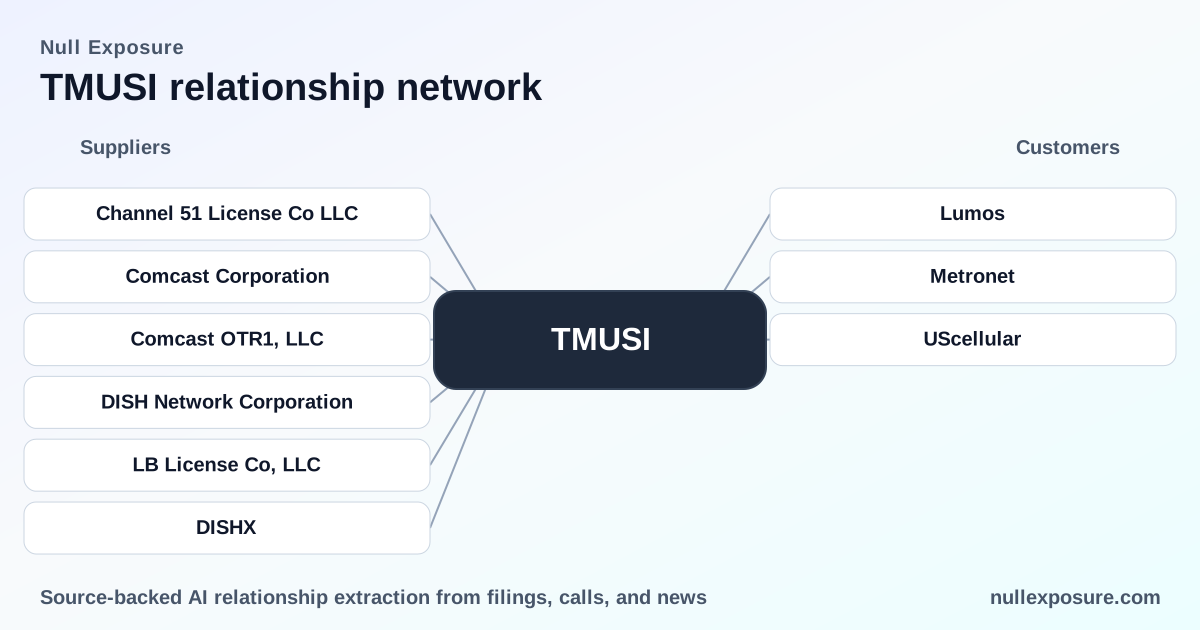
How TMUSI Monetizes Customer Relationships: Anchor-tenant wholesale plus scale in services
T-Mobile US funds its operations by selling wireless and broadband services and devices to a broad base of postpaid and prepaid consumers and small businesses, while increasingly acting as an anchor tenant for acquired regional networks and wholesale partners. The company recognizes service revenue from direct retail subscribers and from wholesale arrangements where it owns the customer relationship and sells connectivity under the T‑Mobile brand — a dual monetization model that combines subscription economics with device and wholesale service margins. For a tailored briefing on these relationship dynamics visit https://nullexposure.com/.
What the FY2025 filing makes plain about customer strategy
T‑Mobile’s FY2025 10‑K frames customer relationships as a strategic lever: the company operates both as a retail seller to 142.4 million postpaid and prepaid customers and as a wholesale owner of customer contracts where joint ventures or acquisitions convert third‑party retail operations into T‑Mobile customer relationships. Revenue is driven primarily by services, and T‑Mobile positions itself to capture recurring cash flow via subscriptions while extracting device and installation revenue at onboarding.
Key operating characteristics drawn from the filing:
- Contracting posture: T‑Mobile acts as a seller and, in specific M&A or joint venture outcomes, as an anchor tenant that assumes ownership of customer relationships — shifting some partners from retail sellers to wholesale providers.
- Concentration: Business activity and virtually all revenue are U.S.-centric (including Puerto Rico and the U.S. Virgin Islands), which concentrates regulatory and market risk geographically.
- Criticality: Services are material to financial performance; the company states that the majority of service revenues derive from providing wireless communications and broadband.
- Maturity and scale: The customer base and the company’s single-operating‑segment structure (Wireless) indicate mature, active service relationships that generate recurring revenue.
The three customer relationships called out in the filing
Lumos — anchor-tenant for residential and small business customers
Following a joint acquisition, Lumos transitioned to a wholesale model in which T‑Mobile is the anchor tenant owning residential and small business customer relationships; Lumos now functions primarily as the wholesale network provider while T‑Mobile owns the customer-facing contracts. This is stated in T‑Mobile’s FY2025 10‑K filing and reflects the company’s strategic shift to owning customer revenue streams while outsourcing parts of network delivery to local partners.
Source: According to T‑Mobile’s FY2025 10‑K filing (referencing the post‑acquisition arrangement), the company is now the anchor tenant for Lumos‑originated residential and small business relationships.
Metronet — wholesale provider after customer transition to T‑Mobile
As described in the FY2025 10‑K, Metronet became a wholesale services provider after a joint acquisition, and its residential fiber retail operations and customers transitioned to T‑Mobile; Metronet continues to provide network services while T‑Mobile owns and monetizes the retail customer relationships. This arrangement mirrors the Lumos pattern and shows T‑Mobile’s playbook for scaling fiber customer count via acquisition‑driven wholesale partnerships.
Source: T‑Mobile’s FY2025 10‑K documents the transfer of Metronet’s retail customers to T‑Mobile concurrent with Metronet’s conversion to a wholesale services role.
UScellular (reference to Ka’ena/wholesale partner) — wholesale revenue recognition history
The FY2025 disclosure notes that prior to the Ka’ena acquisition, Ka’ena operated as a wholesale partner for which T‑Mobile recognized service revenues within Wholesale and other service revenues, indicating precedent for recognizing wholesale-derived revenue and folding third‑party customer relationships into T‑Mobile’s reporting. The filing lists UScellular in its customer relationships section; the referenced language underscores how wholesale partnerships have translated into recognized service revenue for the company.
Source: T‑Mobile’s FY2025 10‑K describes prior wholesale partner arrangements (notably Ka’ena) and the treatment of those service revenues under Wholesale and other service revenues.
How these relationships change the economics and risk profile
The Lumos and Metronet arrangements convert regional retail customer bases into recurring service revenue streams for T‑Mobile while retaining local network operators as wholesale vendors. That structure delivers several clearly positive economic effects for investors:
- Higher revenue visibility and churn control by owning the customer relationship and standardizing offers under the T‑Mobile brand.
- Capital efficiency through leveraging existing regional network investments rather than building entirely new fiber footprints.
- Device and installation revenue capture at migration points, enhancing near‑term cash realization.
At the same time, the model introduces operational and counterparty risks:
- Integration risk and vendor dependence as T‑Mobile relies on wholesale providers to deliver network functionality after converting customers to its contracts.
- Geographic concentration because substantially all revenue and long‑lived assets are located in the U.S., Puerto Rico and the U.S. Virgin Islands, focused exposure to U.S. macro and regulatory cycles.
- Execution risk on migrations when converting retail customers to branded T‑Mobile service plans, with potential short‑term churn or incremental costs.
Company‑level signals from the filing investors should prioritize
The FY2025 filing provides constraint‑style signals that inform diligence and operational assessment:
- Customer mix: Evidence supports a mix of individual consumers and small business customers in the customer base, including relationships won via acquisitions like Lumos. This underpins the company’s broad addressable market across consumer and small enterprise segments.
- Materiality of services: Services generate the majority of service revenues, so service performance is the central driver of financial outcomes, not one-off device sales.
- Active, seller role: T‑Mobile operates as an active seller to its installed base with a large, active customer population, supporting stable recurring revenue.
- Segment focus: The company manages operations as a single Wireless segment, emphasizing integration of wireless and broadband service economics under one operating model.
- Geographic concentration: Substantially all revenues and long‑lived assets are U.S.-based; investors must view regulatory, competitive, and economic shifts in the U.S. as first‑order risks.
For a concise analytics brief and additional relationship mapping, visit https://nullexposure.com/.
Investment takeaways and watching items
- Positive: The anchor‑tenant wholesale model accelerates customer roll‑up and secures recurring revenue while outsourcing capital‑intensive network builds to local providers. That should support margin expansion if integration and vendor contracting are managed tightly.
- Watchlist: Monitor vendor performance and service quality post‑migration, churn trends among acquired customers, and exposure to U.S. regulatory developments that could affect wholesale or retail pricing.
- Valuation implication: The shift toward owning acquired customer relationships increases revenue predictability but also shifts operational risk onto T‑Mobile’s integration and contract management functions.
T‑Mobile’s FY2025 disclosures make clear that the company is executing a deliberate strategy: capture customer relationships at scale, monetize via services and devices, and manage network delivery through wholesale partners. For investors and operators evaluating counterparty and contract risk, the emphasis should be on integration capability, vendor governance, and the U.S. market environment.