T-Mobile (TMUSZ) — what the company’s customer relationships tell fixed-income investors
T-Mobile generates cash flow primarily by selling wireless voice, data and broadband services and by distributing devices and accessories; it also operates wholesale and fiber-retail channels after targeted acquisitions. The company monetizes through recurring postpaid subscription revenue (often under multi-month device arrangements), prepaid plans, and a smaller but strategically relevant wholesale/business segment — all of which underpin the credit characteristics of its 5.500% Senior Notes due March 2070 (TMUSZ). For investors evaluating counterparty exposure and customer concentration, the company’s public filings make clear that postpaid subscribers drive the business, while wholesale relationships are smaller but governed by long-term and usage-linked contracts that affect revenue stability and downside protection. Read more at https://nullexposure.com/.
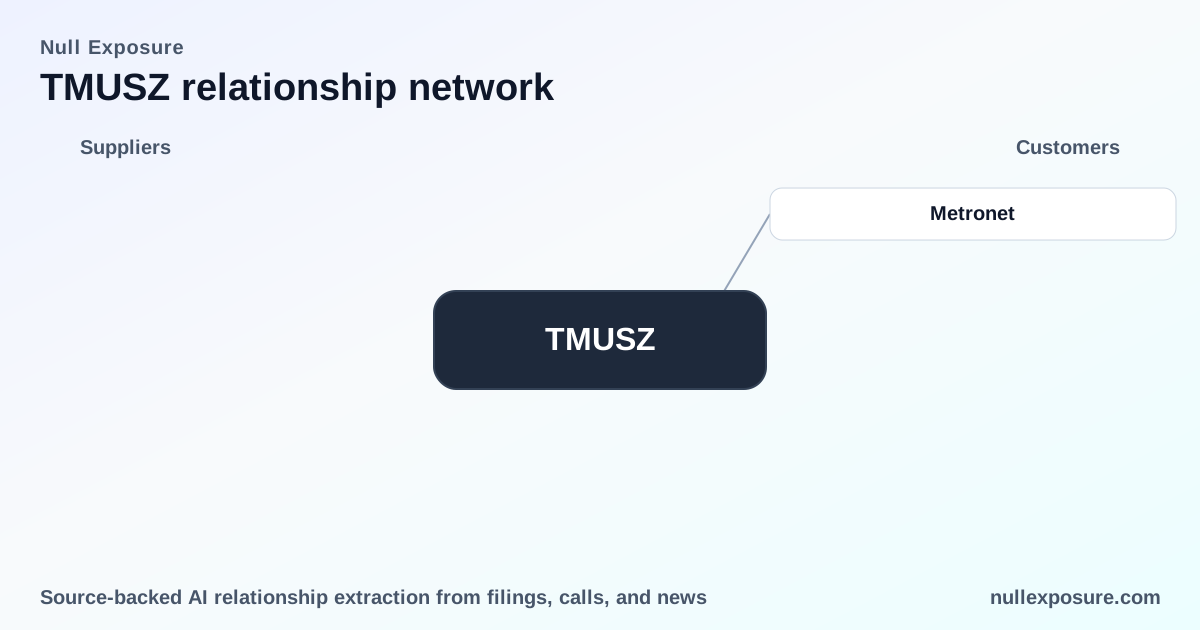
Metronet: a wholesale conversion after a joint acquisition
Following a joint acquisition, Metronet converted into a wholesale services provider while its residential fiber retail operations and customers transitioned to T‑Mobile. This shift indicates T‑Mobile absorbing customer-facing fiber assets while contracting Metronet for wholesale connectivity or services, a common post‑deal allocation of roles. According to T‑Mobile’s FY2025 Form 10‑K, “Following the joint acquisition, Metronet became a wholesale services provider, and its residential fiber retail operations and customers transitioned to us.” (T‑Mobile 10‑K, FY2025).
What the contract signals in filings reveal about how T‑Mobile runs the business
T‑Mobile’s public disclosures present several consistent operating model signals that matter for assessing counterparty risk, revenue predictability, and contract enforceability.
- Long‑term revenue recognition for device-subsidized postpaid customers: T‑Mobile specifically allocates remaining transaction price for postpaid contracts with subsidized devices and promotional credits, and recognizes that revenue generally over a 24‑month period from origination. This is a company-level statement about contract duration and revenue timing and implies predictable near-term cashflow tied to device installment programs (T‑Mobile 10‑K, FY2025).
- Usage‑linked elements in wholesale and roaming contracts: Wholesale, roaming and certain service agreements include variable consideration tied to usage and performance, exposing the company to demand volatility in some counterparty segments (T‑Mobile 10‑K, FY2025).
- Framework and master agreements with large partners: T‑Mobile operates under framework contracts such as the Master Network Services Agreement dated July 1, 2020 with DISH, establishing an ongoing supplier/customer structure that defines service levels and commercial terms at scale (T‑Mobile 10‑K, FY2025).
- Multi‑role commercial posture: The company explicitly operates as a seller of services to end customers, but also sells devices to dealers and third‑party distributors for resale and functions as a service provider under wholesale arrangements; financial exposure therefore spans direct subscriber receivables and wholesale counterparty credit (T‑Mobile 10‑K, FY2025).
- Geographic concentration in North America: Substantially all revenues in 2023–2025 were earned in the United States (including Puerto Rico and the U.S. Virgin Islands), making revenue resilience highly dependent on the U.S. macro and regulatory environment (T‑Mobile 10‑K, FY2025).
How material are wholesale relationships like Metronet?
T‑Mobile discloses its 2025 service revenue mix as 81% postpaid, 15% prepaid and 4% wholesale and other services, which places wholesale relationships in a relatively small revenue bucket compared with the core postpaid base. That said, wholesale and acquired fiber retail assets still play a strategic role in network densification, distribution economics and margin capture post‑close. These are company-level facts from the FY2025 filing that speak to low revenue concentration risk from any single wholesale partner but non‑negligible operational importance for network reach (T‑Mobile 10‑K, FY2025).
Commercial maturity, counterparty scale and criticality — the practical read for investors
From the disclosures, investors should derive these disciplined conclusions about credit exposure and contract risk:
- Contracting posture is mixed but tilted to stability. The combination of multi‑month postpaid device contracts recognized over ~24 months and framework master agreements for wholesale/service provision indicate predictable revenue in the near term and negotiated dispute resolution/SLAs at the wholesale layer (T‑Mobile 10‑K, FY2025).
- Wholesale is smaller but operationally strategic. With wholesale and other services representing roughly 4% of service revenues in 2025, default by a single wholesale partner is unlikely to imperil service revenue, but loss or degradation of wholesale access or acquired fiber assets could affect marginal profitability and local market penetration (T‑Mobile 10‑K, FY2025).
- Variable consideration increases exposure to traffic swings. Usage‑based contract elements mean that wholesale receipts can be volatile in downturns or when roaming/traffic materially declines, introducing cyclical sensitivity into a portion of revenues (T‑Mobile 10‑K, FY2025).
- U.S. concentration raises macro/regulatory sensitivity. The company’s revenue footprint is essentially North America only, concentrating macroeconomic and regulatory risk in a single jurisdiction (T‑Mobile 10‑K, FY2025).
Named examples in the filings that illuminate partnership mechanics
The filing identifies specific partners and post‑deal arrangements that offer useful comparables for underwriting counterparty exposure:
- The Master Network Services Agreement with DISH (dated July 1, 2020) is a framework contract that defines long‑form provisioning and could be referenced as a model for large, ongoing wholesale relationships (T‑Mobile 10‑K, FY2025).
- T‑Mobile describes situations where previously retail operators such as Lumos transitioned to a wholesale model, leaving T‑Mobile as the anchor tenant for residential and small‑business customer relationships — an explicit example of how post‑acquisition role allocation is executed in practice (T‑Mobile 10‑K, FY2025).
Investment implications and what to monitor next
- Credit cushion is supported by recurring postpaid cashflow: With 81% of service revenues from postpaid customers, the company’s cashflow base is structurally robust relative to the smaller wholesale channel (T‑Mobile 10‑K, FY2025).
- Wholesale counterparties matter more for network strategy than immediate liquidity: Monitor contract renewals (especially framework agreements), usage trends under wholesale arrangements, and any concentration in a small set of wholesale customers.
- Watch variable revenue lines and device financing exposure: Changes in device subsidy behavior, promotional bill credits, and customer churn will transmit through the 24‑month recognition window into revenues and leverage metrics.
- Regulatory and macro developments in the U.S. will have outsized impact given near‑complete geographic concentration.
If you want a consolidated view of all disclosed customer relationships and their contract characteristics for TMUSZ, Nullexposure maintains concise, investor-oriented summaries and primary‑document links — visit https://nullexposure.com/ to explore further.
Bold takeaway: Metronet represents a tactical wholesale conversion post‑acquisition; it is operationally relevant but not material to consolidated service revenue, while the broader portfolio is anchored to predictable postpaid cashflows and governed by a mix of long‑term, usage‑based and framework contracts (T‑Mobile 10‑K, FY2025).