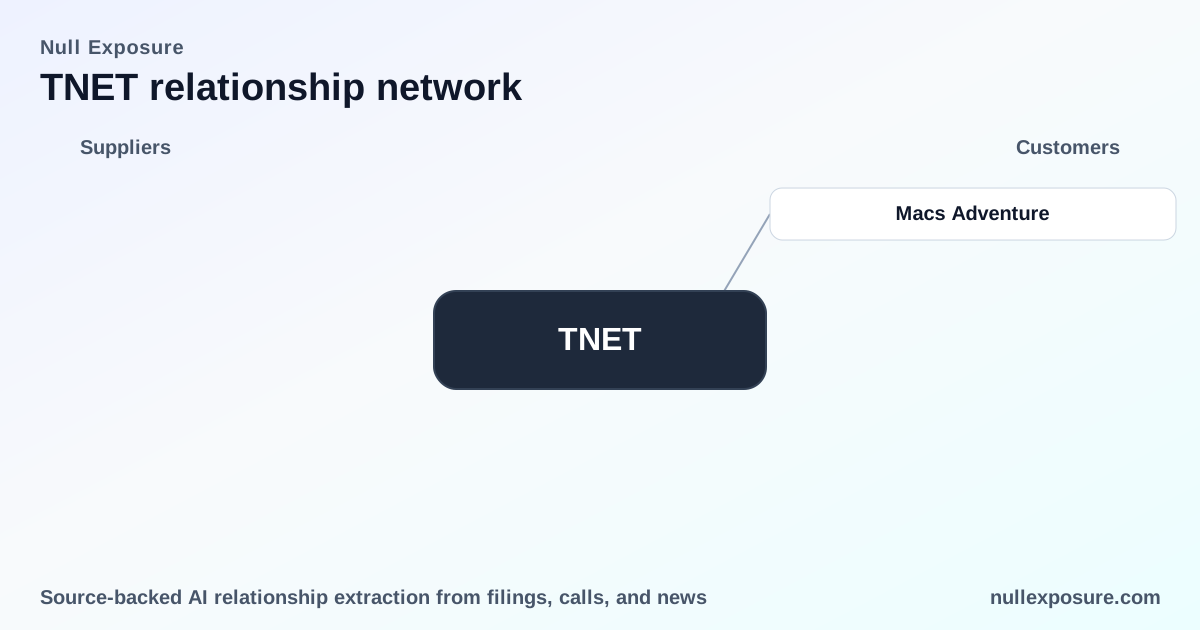
TriNet (TNET) — Customer Relationship Profile and What Macs Adventure Tells Investors
TriNet operates as a bundled HR outsourcer and cloud HCM provider for small and mid-market employers, monetizing through a mix of per-employee usage fees under its PEO model and recurring subscription-style fees for ASO/SaaS services. Its revenue base is highly U.S.-centric, driven by recurring payroll, benefits and compliance services that create durable cash flows but expose the company to employment cycles and pricing pressure on per-WSE fees. For investors, TriNet’s customer disclosures are less about concentration than about product positioning — services-first PEO revenue with an expanding software layer and targeted acquisitions that broaden leave and workforce-management capabilities. For additional context and relationship-level research tools, visit https://nullexposure.com/.
Executive snapshot — how TriNet makes money and why customer mentions matter
TriNet’s business model combines three revenue drivers:
- Usage-based PEO fees (fee per WSE) that scale with client headcount and payroll activity, producing variable but sticky revenue.
- Subscription-like ASO/SaaS revenue for HR Plus and cloud-based HCM, which increases gross margins and supports cross-sell.
- Services and consulting (training, benefits administration, leave management), often bundled with software to increase client retention.
These mechanics generate recurring top-line visibility while leaving margins exposed to mix (PEO vs ASO) and the U.S. labor cycle. TriNet’s marketing and press materials—where customers such as Macs Adventure are frequently featured—function as qualitative evidence of customer success and product-market fit.
Operating model and company-level constraints investors should track
TriNet’s public materials and filings reveal a clear set of operating characteristics that shape customer relationships and revenue quality:
- Contracting posture: The company bills predominantly on a usage-based fee per WSE in its PEO business and maintains a subscription-like posture in ASO/HCM products, combining transactional scale with recurring SaaS-style attachments.
- Customer mix: TriNet targets small and mid‑market businesses, positioning itself as a one-stop HR and benefits partner rather than a large enterprise vendor; this drives many low-to-mid ARPU accounts but broad diversification.
- Geographic concentration: Nearly all revenue is U.S.-sourced, making TriNet sensitive to domestic employment trends and regulatory shifts.
- Role and delivery: TriNet is a service provider and seller—PEO co-employment and ASO administration are core capabilities, supplemented by software and consulting services.
- Segment balance: Services (PEO) remain the core cash engine while software (ASO/HCM) is the strategic margin-expander.
- Relationship maturity and stage: TriNet’s customer base is active and long-standing, reflecting decades of SMB focus.
These signals collectively indicate a business with recurring, employment-driven revenue and product-led efforts to increase margin through software and targeted acquisitions.
For detailed relationship-level references and how TriNet frames customers publicly, see https://nullexposure.com/.
What TriNet’s public corpus lists — every customer mention in the sample
Below are the relationship results provided in TriNet’s public materials. Each entry is presented with a plain-English summary and a concise source citation.
-
TriNet’s insight page “Data Reveals United States Ranks Last in Worker Benefits” features Macs Adventure as a customer and includes a testimonial about TriNet’s relationships and support, illustrating how TriNet uses customer stories to demonstrate service intimacy (TriNet insights, March 10, 2026; https://www.trinet.com/insights/data-reveals-united-states-ranks-last-in-worker-benefits).
-
A TriNet press release announcing the acquisition of Cocoon (enhancing leave management) references Macs Adventure as a featured customer, signaling TriNet’s strategy to link product acquisitions with concrete SMB customer needs (TriNet press release, May 4, 2026; https://www.trinet.com/about-us/news-press/press-releases/trinet-completes-acquisition-of-cocoon-enhancing-leave-management-solutions-for-smbs).
-
The TriNet HR statistics page reprints a fuller Macs Adventure testimonial from Alex Fitterer describing TriNet as “an extension of our own team,” underscoring client-perceived service integration—useful qualitative evidence for retention and satisfaction metrics (TriNet insights — HR statistics, March 10, 2026; https://www.trinet.com/insights/hr-statistics).
-
TriNet’s training and consulting program overview lists Macs Adventure among featured customers, which indicates TriNet’s intention to market its consulting/training services to SMBs as an extension of payroll/benefits offerings (TriNet insights — Training and Consulting, May 4, 2026; https://www.trinet.com/insights/trinet-training-and-consulting-programs).
-
The “Wisdom Worker Era” insight includes Macs Adventure as a highlighted customer, showing TriNet’s use of customer examples across thought-leadership content to support adoption of its HCM frameworks (TriNet insights — Wisdom Worker Era, May 4, 2026; https://www.trinet.com/insights/wisdom-worker-era-individual-contributors-agent-managers).
-
TriNet’s content on Multiple Employer Plans (MEP) features Macs Adventure, demonstrating how TriNet references customers when discussing retirement and benefits pooling strategies for SMBs (TriNet insights — MEP, March 10, 2026; https://www.trinet.com/insights/multiple-employer-plan-mep).
-
In a growth-focused article “Small Business Growth Factors: Scale 200 Percent,” Macs Adventure is again a featured customer, serving as an example of how TriNet frames growth narratives when pitching HR solutions to expanding SMBs (TriNet insights — Small Business Growth Factors, May 4, 2026; https://www.trinet.com/insights/small-business-growth-factors-scale-200-percent).
-
A compensation strategy piece lists Macs Adventure among customer examples, aligning TriNet’s compensation design and alignment services with real client stories to illustrate outcomes (TriNet insights — Compensation Strategy, May 4, 2026; https://www.trinet.com/insights/compensation-strategy-business-alignment).
-
A second press release describing TriNet’s plan to acquire Cocoon again names Macs Adventure as a featured customer, reinforcing the association between the acquisition and TriNet’s existing SMB client base (TriNet press release — acquisition announcement, May 4, 2026; https://www.trinet.com/about-us/news-press/press-releases/trinet-to-acquire-cocoon-expanding-leave-management-solutions-for-smbs).
Each of these citations is hosted on TriNet’s site and collectively shows consistent reuse of the same SMB customer example across multiple product and thought-leadership channels, which is an intentional marketing pattern.
Investment implications and risk factors from customer signals
- Marketing-to-product alignment: TriNet leverages customer testimonials (Macs Adventure) across product, M&A and thought-leadership content to validate cross-sell of consulting, leave management and ASO software—this supports upsell economics and retention.
- Revenue quality mix: The documented combination of usage-based PEO billing and subscription-style ASO indicates a revenue base that will grow with payroll exposure while margins improve as software adoption increases. Watch PEO/ASO mix for margin inflection points.
- Geographic concentration risk: Nearly all revenue is U.S.-derived, so regulatory or labor-market shocks in the U.S. materially affect results.
- Customer concentration: Public materials emphasize many SMBs rather than a few large accounts; this reduces single-client concentration risk but increases dependence on broad SMB hiring cycles.
- M&A strategy: The Cocoon acquisition signals active product-line expansion into leave management, improving competitive positioning but requiring integration execution.
Bold takeaway: TriNet is a services-first, recurring-revenue HR platform that systematically uses SMB customer endorsements to drive software and services adoption; investors should focus on PEO vs ASO mix, US employment trends, and execution on recent product acquisitions.
For deep dives into TriNet customer dynamics and structured relationship intelligence, visit https://nullexposure.com/.