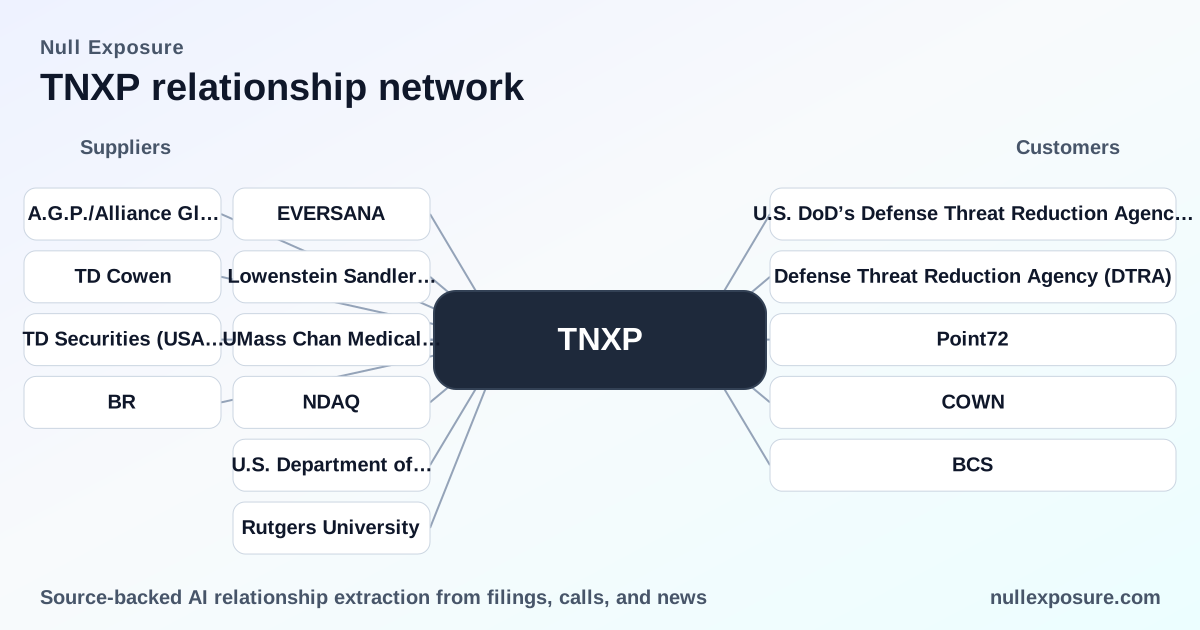
Tonix Pharmaceuticals (TNXP): Customer relationships that determine the commercial and programmatic runway
Tonix Pharmaceuticals monetizes through a dual model: commercial sales of approved small-molecule and specialty products (Zembrace SymTouch, Tosymra) distributed through wholesalers and pharmacies, and contracted development programs with government and institutional counterparties for pipeline assets such as TNX‑4200. Revenue today is driven by product sales routed through distributors; strategic upside and funding come from government contracts and capital raises that de‑risk specific programs. For a concise map of customer exposure and counterparties, see the company intelligence at Null Exposure.
How Tonix makes money — a concise investor view
Tonix is a commercial-stage biotech with three revenue levers: 1) retail/wholesale product sales of approved therapies, 2) government R&D contracts that fund targeted development programs, and 3) equity financings that institutional investors execute to support operations. Commercial sales are typically short‑term, single‑performance obligations fulfilled through distributors; government contracts such as the DTRA agreement create multi‑year program funding and greater revenue visibility for specific assets. The company also uses registered offerings to secure capital from institutional buyers.
Key takeaway: Tonix combines recurring distributor-driven product revenue with episodic, higher-dollar government contracts that materially change funding and development cadence.
Constraints that shape customer relationships and revenue predictability
- Contracting posture — mixed: Tonix explicitly disclosed a multi‑year, long‑term contract with the U.S. Department of Defense’s Defense Threat Reduction Agency (DTRA) for TNX‑4200 valued at up to $34 million over five years, which is a program-level, long‑term commitment (company press releases, FY2025–FY2026). At the same time, product sales to commercial customers are generally short‑term, single‑obligation transactions, limiting recurring revenue predictability.
- Counterparty type — government and commercial: The DTRA engagement establishes Tonix as a government contractor for biodefense work; the broader revenue base flows through commercial wholesalers, pharmacies, and specialty distributors.
- Concentration risk — material: The company reports that five customers accounted for large shares of product revenue (24%, 23%, 22%, 16%, 10% for the year ended December 31, 2024), which signals meaningful concentration across a small number of buyers.
- Relationship roles — distributor-driven commercial model: Accounts receivable language and product channel descriptions indicate Tonix sells primarily through third‑party distributors and wholesalers with standard 30–90 day payment terms.
- Relationship stage — active commercialization with ongoing development programs: Tonix lists commercial products available for sale while also executing active development contracts and investor engagement.
Customer and counterparty breakdown — what each relationship contributes
Below are the counterparties highlighted in recent filings and news; each item is a concise plain‑English summary with sourcing.
-
U.S. DoD’s Defense Threat Reduction Agency (DTRA)
Tonix holds a development contract with the U.S. Department of Defense’s DTRA for TNX‑4200 worth up to $34 million over five years to develop a broad‑spectrum antiviral targeting CD45 for force medical readiness in high‑lethality environments. This program is explicitly presented in company press releases in December 2025 and January–February 2026 (GlobeNewswire, Dec 2025; GlobeNewswire, Jan–Feb 2026). -
Defense Threat Reduction Agency (DTRA) (duplicate reference)
Multiple company and media releases repeat the same DTRA engagement, underlining that the DTRA contract is a recurring, highlighted program across FY2025–FY2026 (CityBiz and Sahm Capital reporting on December 2025 announcements). -
Point72
Tonix completed a registered direct offering with Point72 on December 29, 2025, raising capital through the sale of common stock and pre‑funded warrants, with a $20.0 million tranche cited in the FY2026 results release; this establishes Point72 as a financing counterparty rather than a product customer (GlobeNewswire, Mar 12, 2026; Sahm Capital, Dec 29, 2025). -
TD Cowen (COWN)
Management scheduled participation in the TD Cowen 46th Annual Healthcare Conference in March 2026, indicating investor engagement and roadshow relationships that support capital markets access and visibility (GlobeNewswire, Feb 25, 2026). -
Barclays (BCS)
Tonix management listed Barclays’ 28th Annual Healthcare Conference as a forthcoming investor event in March 2026, signaling routine sell‑side engagement and investor outreach (GlobeNewswire, Feb 25, 2026). -
BCS (ticker reference for Barclays)
Barclays appears in the results with its market ticker reference; the market participation is the same conference engagement previously noted (GlobeNewswire, Feb 25, 2026). -
COWN (ticker reference for TD Cowen)
The COWN ticker appears as the inferred symbol for TD Cowen conference participation; this duplicates the TD Cowen relationship and confirms sell‑side investor engagement in FY2026 (GlobeNewswire, Feb 25, 2026). -
Medicare
Tonix is actively pursuing payer contracts and discussions with Medicare as it seeks to expand reimbursement for its chronic‑pain product; management cited ongoing payer engagement in March 2026 communications reporting prescription uptake since launch (Benzinga, Mar 2026). -
Medicaid
Tonix is progressing discussions with Medicaid programs to secure broader coverage for commercial products, consistent with the company’s stated priority to expand payer engagement and contracting (Benzinga, Mar 2026).
What investors should focus on next
- Revenue visibility will be bifurcated. Commercial revenues will continue to reflect distributor payment cycles and concentration among a few customers, while the DTRA contract creates discrete multi‑year funding for TNX‑4200 that de‑risks development cash needs for that program.
- Reimbursement traction is a gating factor for commercial scale. Management’s stated push into Medicare and Medicaid is critical: better payer coverage materially expands addressable demand for the company’s pain therapies (Benzinga, Mar 2026).
- Capital markets and institutional backers matter. The Point72 direct offering demonstrates that institutional financing provides bridge capital; continued sell‑side engagement at TD Cowen and Barclays supports access to these investors (GlobeNewswire, Feb–Mar 2026).
Bottom line: commercial engine plus targeted program funding
Tonix operates a hybrid commercial and contract‑funded development model. The DTRA engagement is the single largest programmatic customer relationship disclosed, providing explicit multi‑year funding for TNX‑4200, while commercial sales rely on a distributor network and concentrated buyer base. Investors should weigh the upside from government funding and payer expansion against concentration and the operational realities of distributor payment cycles.
For a structured view of Tonix’s counterparties and the contracts that shape valuation and runway, visit Null Exposure for TNXP coverage.
If you want a tailored brief on how these customer relationships affect cash runway and valuation scenarios, review our research portal at Null Exposure.