Tenaya Therapeutics (TNYA): What the Alnylam collaboration tells investors about commercialization optionality
Tenaya Therapeutics is a clinical-stage biotech that monetizes scientific expertise through negotiated collaborations—validating disease targets and out-licensing therapeutic development to partners in exchange for upfront fees, cost reimbursement and milestone pools tied to development, regulatory and sales outcomes. The company’s model generates near-term non-dilutive cash (modest upfronts and cost reimbursements) while preserving upside via large, milestone-driven payout schedules that activate if partners advance programs to approval and commercialization. For readers evaluating customer relationships, the recent Alnylam partnership is the clearest live example of how Tenaya converts R&D capability into optionality and working capital. Visit our homepage for more coverage and deal-level signal tracking: https://nullexposure.com/
A single, strategic customer relationship — big optionality, small early cash
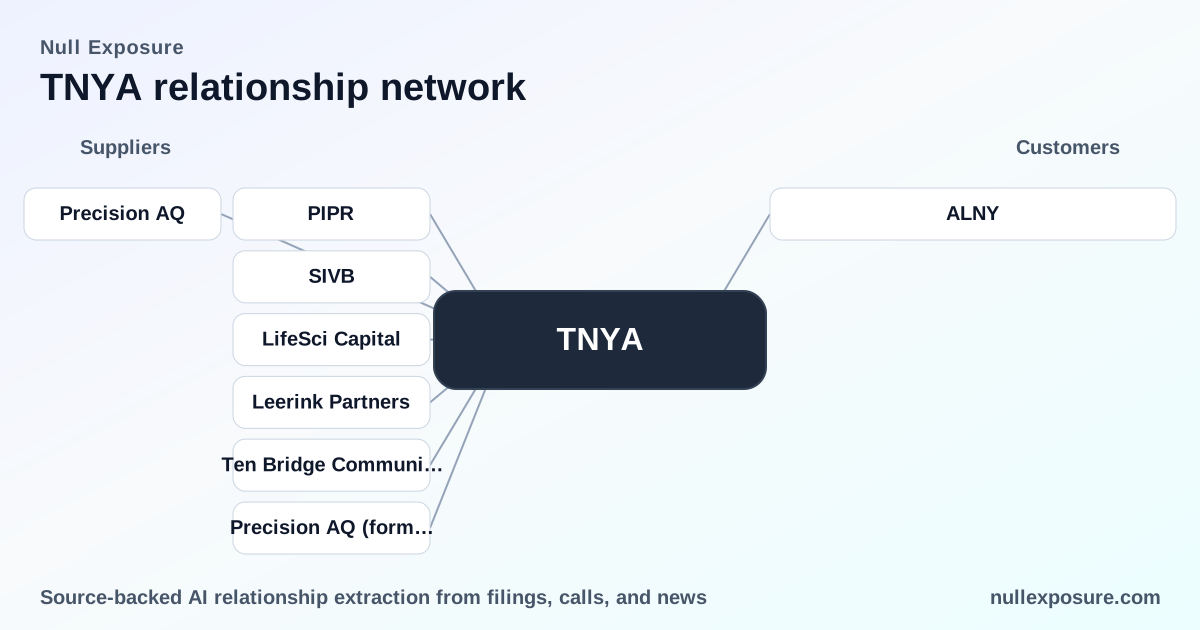
Tenaya’s disclosed customer interactions in the coverage set all point to one major commercial counterparty: Alnylam Pharmaceuticals (ALNY). The partnership is structured as a multi-target research collaboration where Tenaya will validate up to 15 genetic targets; Alnylam pays an upfront of $10.0 million, reimburses research costs, and takes responsibility for development, manufacturing, regulatory and commercialization. The agreement includes up to ~$1.1–1.13 billion in potential development, regulatory and sales-based milestones, creating high long-term upside while leaving near-term revenue modest and concentrated with one partner. Sources: Tenaya press release and company financial update (GlobeNewswire, Mar 5 & Mar 11, 2026); industry coverage in Fierce Biotech and Pharmaceutical-Technology (Mar 2026).
All reported customer mentions — source-by-source breakdown
- GlobeNewswire (Mar 5, 2026): Tenaya entered a research collaboration with Alnylam to identify and validate novel cardiovascular genetic targets, and the release states the company could receive up to $1.13 billion in milestone payments if targets progress to approved therapeutics.
- GlobeNewswire (Mar 5, 2026) — duplicate mention: Same GlobeNewswire announcement highlighting the collaboration terms and the $10 million upfront and milestone pool.
- Cardiovascular Business (Mar 10, 2026): Reporting noted that Tenaya will validate up to 15 gene targets for Alnylam in exchange for a $10 million upfront payment.
- Cardiovascular Business (Mar 10, 2026) — duplicate mention: Reiterates the 15-target validation scope and the upfront consideration.
- GlobeNewswire (Mar 11, 2026): In Tenaya’s FY2025/FY2026 financial release, the company confirmed the Alnylam multi-target collaboration, $10.0M upfront, reimbursement of research costs, and up to $1.1B in milestones, with Alnylam owning downstream development and commercialization.
- Bitget news (Mar 10, 2026): Coverage summarized deal mechanics — up to $10M upfront plus reimbursement, two-year validation term, and up to $1.13B in milestone potential.
- Bitget news (Mar 10, 2026) — duplicate mention: Repeats the summary of structure and financial caps.
- Fierce Biotech (May 4, 2026): Industry write-up described the Alnylam collaboration as a $10M upfront deal with significant milestone upside for Tenaya; coverage emphasized market reaction and strategic fit.
- GlobeNewswire (Mar 5, 2026) — repeated feed: The press release language that frames the milestone total at roughly $1.13B recurs in multiple GlobeNewswire feeds.
- GlobeNewswire (Mar 5, 2026) — repeat: Another instance of the same release in a different GlobeNewswire feed.
- InvestingNews (May 4, 2026): Tenaya’s financial report highlighted the Alnylam agreement alongside year-end numbers, confirming the $10M upfront and up to $1.1B milestone structure.
- Pharmaceutical-Technology (Mar 9, 2026): Coverage summarized that Alnylam committed $10M upfront to secure access to 15 novel cardiovascular targets from Tenaya.
- GlobeNewswire (Mar 5, 2026) — repeated feed: The GlobeNewswire announcement appears multiple times across regional feeds, all restating the same financial structure.
- GlobeNewswire (Mar 5, 2026) — repeated feed: Additional instance restating the agreement terms.
- SahmCapital (Mar 10, 2026): Market commentary noted Tenaya’s stock moved higher following the Alnylam research collaboration announcement.
- Citeline (Mar 10, 2026): Deal bulletin described the arrangement as Tenaya evaluating genetic cardiovascular targets for Alnylam, underscoring the target-validation role.
- Citeline (Mar 10, 2026) — duplicate mention: Repeats the same deal bulletin language.
- SimplyWall (May 4, 2026): Analysis tied Tenaya’s FY2025 results to the Alnylam partnership and called out the $1.13B milestone pool as long-term optionality while flagging modest near-term cash.
- SimplyWall (May 4, 2026) — AMP version: Same commentary emphasizing the partnership’s optionality and immediate cash impact.
- GlobeNewswire (Dec 11, 2025): An earlier GlobeNewswire item that appears in the results set references Tenaya’s operations and cross-references the later Alnylam collaboration language included in corporate communications.
- GlobeNewswire (Dec 11, 2025) — duplicate: Repeats the corporate release text included in the dataset.
- GlobeNewswire (Mar 11, 2026) — repeated: Tenaya’s Q4 and FY2025 financial report again confirming the collaboration terms.
- SahmCapital (Mar 10, 2026) — duplicate: Market reaction note repeated in the feed.
- GlobeNewswire (Mar 2, 2026): A conference participation release that cross-references the Alnylam collaboration in corporate investor communications.
- GlobeNewswire (Mar 2, 2026) — duplicate entry: Repeats the conference notice that referenced the collaboration.
Each item in the result set reiterates the same core customer relationship: a focused, target-validation engagement with Alnylam that pays Tenaya a modest upfront, reimburses research costs, and carries a large milestone pool should partnered targets be advanced by Alnylam (GlobeNewswire, Mar–May 2026; industry press Mar–May 2026).
What the dataset-level constraints tell you about Tenaya as an operator
Tenaya’s extracted constraints include signals about employee share purchases under an ESPP: the model flags counterparty_type = individual and relationship_role = buyer, citing the ESPP language that employees can purchase shares at a discount (85% of fair market value). That is a company-level signal indicating employee participation in equity ownership programs, not a customer counterparty. From an operational perspective this implies:
- Contracting posture: Tenaya operates through negotiated, partner-facing contracts that emphasize validation services and IP handoffs to larger developers rather than direct commercialization.
- Concentration: Public reporting on customers in this set shows concentration around a single strategic partner (Alnylam) for recorded customer activity.
- Criticality: The relationship is strategic but non-commercially critical to Alnylam’s ability to develop drugs—Alnylam retains development/commercial responsibility while Tenaya supplies validated targets.
- Maturity: The engagement fits a pre-revenue biotech profile: modest upfront cash and reimbursements today, significant milestone-dependent upside conditioned on partner-driven development.
Investor takeaways and next steps for allocators and operators
- Positive optionality with low near-term revenue: The Alnylam deal injects $10M upfront plus cost reimbursement and frames a $1.1–1.13B upside that is contingent on partner-led advancement; that is classic biotech option-style value creation rather than immediate earnings expansion.
- Single-partner concentration risk: All customer mentions in the coverage point to Alnylam as the principal commercial collaborator, so forecasts should treat partner progress as a major value driver and risk lever.
- Model works for cash management: The structure reduces Tenaya’s need to fund later-stage development, transferring capital-intensive activities to Alnylam while generating modest near-term cash.
- Monitor readouts, milestones and partner commitments: Catalysts that move value from optionality to realized revenue will be clear program milestones and Alnylam’s development decisions.
For ongoing tracking of deal-level customer signals and to monitor how partnerships like the Alnylam collaboration affect TNYA’s commercial profile, visit our research hub: https://nullexposure.com/
Bold headline takeaway: Tenaya’s Alnylam relationship converts proprietary target-validation capability into significant milestone optionality while leaving commercialization responsibility with the partner—a high-upside, low near-term revenue profile that is typical of pre-revenue biotech outsourcing models.