The Oncology Institute (TOI): How payer deals underpin a value‑based oncology roll‑out
The Oncology Institute operates and monetizes a hybrid oncology services business by combining fee‑for‑service clinical care and dispensary revenue with value‑based, capitated contracts and delegated risk arrangements where TOI manages oncology populations for payors. Revenue flows from clinic services, in‑house drug dispensing and management services, while growth is driven by expanding capitation partnerships that convert patient lives into recurring, population‑level payments. For a concise corporate risk view and customer mapping, see Null Exposure’s platform: https://nullexposure.com/.
Why payor partnerships are the growth lever
TOI’s strategy is to convert local oncology volume into predictable, managed‑care revenue streams. Capitation and delegated risk contracts transfer financial incentives to TOI — aligning throughput, care coordination, and drug margin management to improve outcomes and lower total cost of care. Management consistently frame these partnerships as the primary route to scale: the company reported that more than 46% of 2024 revenue came from value‑based contracts, a material share that converts clinical capacity into contracted revenue rather than one‑off visits.
A second operational lever is the dispensary and clinic economics: in‑house dispensing captures drug margin and tightens unit economics on therapies delivered at TOI clinics. The company reports three operating segments — dispensary, patient services and clinical trials & other — which give diversified revenue exposure while keeping capitation at the center of long‑term upside.
(Explore a mapped view of TOI’s partner relationships at Null Exposure: https://nullexposure.com/.)
Constraints that shape customer economics and contracting posture
These are company‑level operating characteristics drawn from TOI disclosures and public commentary:
- Contracting posture: TOI runs two distinct contracting models — long‑term capitation agreements (capitation contracts generally have legal terms of one year or longer) and short‑duration fee‑for‑service (FFS) arrangements (FFS term lengths are short and tied to service episodes). TOI also uses subscription‑style population arrangements where payments are regular per‑member amounts and upside/downside settlements are measured over defined periods.
- Counterparty mix: Payors include commercial insurers, PBMs, Medicare (CMS), state Medicaid programs and individual patients, creating exposure to both government and private payor reimbursement dynamics.
- Geographic concentration: TOI operates across the U.S. with a footprint concentrated in five states and 16 markets, creating regional concentration risk tied to state Medicaid and MA program rules.
- Materiality and maturity: Value‑based contracts are material (over 46% of revenue from such contracts in 2024) and the business is evolving from pilot to mature scale in certain markets, where payors have made TOI an exclusive or preferred oncology provider.
- Role and service model: TOI functions as both a direct clinical service provider and a management services organization (MSO) that consolidates variable interest entities under MSAs, collecting management fees and directing operations at affiliated clinics.
- Revenue segments: The business blends distribution (dispensary) and services (physician services, infusion, radiation and clinical trials), which balances drug margin exposure with procedural and professional service income.
The partner map — each customer relationship you need to know
Below are the relationships surfaced in public releases and transcripts. Each entry is a plain‑English summary with the publicly available source.
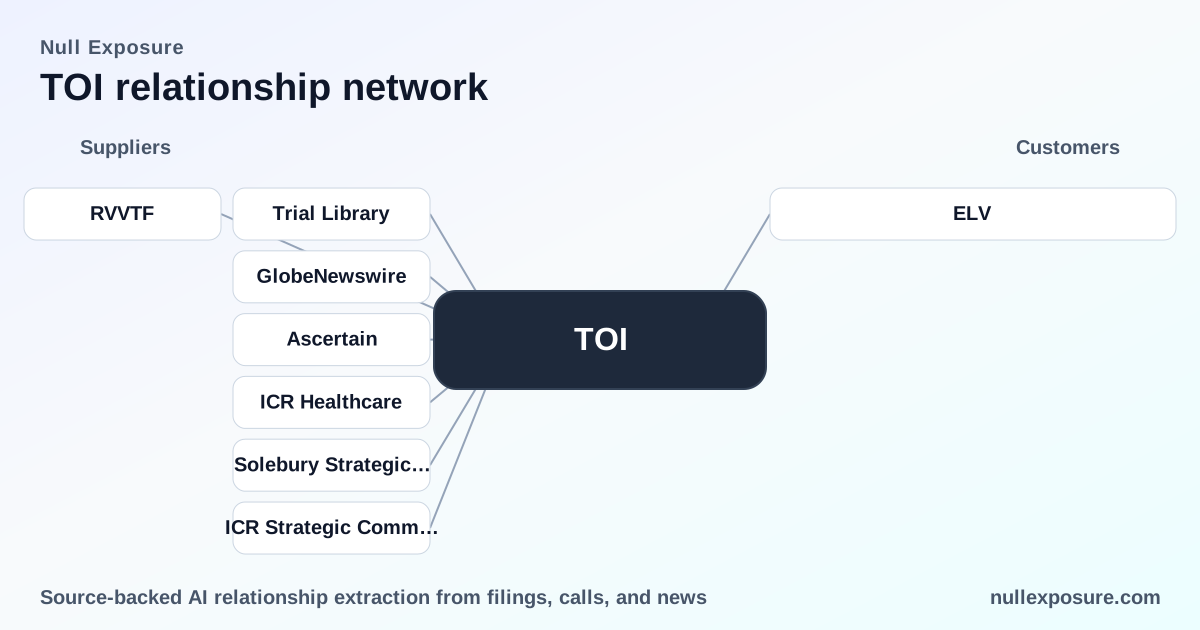
Elevance / Elevance Health (ELV)
TOI reports a delegated capitation partnership with Elevance in Florida that began with an initial ~40,000 lives and is actively ramping; management states the program is on track to more than double across the state in 2026. This relationship is presented as a core scaling vehicle for TOI’s value‑based model. Source: TOI Q4 2025 earnings commentary and GlobeNewswire press release (March 12, 2026) and Q3/Q4 2025 call transcripts (InsiderMonkey, March–May 2026).
Humana (HUM)
TOI initiated capitation agreements with Humana (including CarePlus as part of Humana’s Florida footprint) during Q4 2025, adding approximately 22,000 Medicare Advantage lives in South Florida and expanding TOI’s MA exposure. Source: Q4 2025 earnings call transcript and GlobeNewswire release (March 12, 2026; InsiderMonkey May 2026).
CarePlus
CarePlus — referenced as part of the Humana/MA expansion — entered capitation agreements with TOI in Florida, contributing to the ~22,000 MA lives added in Q4 2025. Source: GlobeNewswire press release (March 12, 2026) and earnings call excerpts (InsiderMonkey, May 2026).
SilverSummit Healthplan
TOI announced a partnership with SilverSummit Healthplan to provide oncology care to Medicaid members in Nevada, a relationship positioned to cover more than 80,000 Medicaid members in the state and expand TOI’s Medicaid footprint. Source: GlobeNewswire coverage cited on Finviz (press release referenced by Finviz, May 2026).
Doctors Healthcare Plans
TOI partnered with Doctors Healthcare Plans to enhance oncology care management in South Florida, a regional collaboration that broadens TOI’s MA and commercial managed‑care access in that market. Source: GlobeNewswire coverage referenced via Finviz (May 2026).
MaxHealth
TOI expanded a value‑based care partnership with MaxHealth, positioning TOI as a managed oncology provider within MaxHealth’s value network and extending TOI’s managed care reach. Source: GlobeNewswire press release referenced on Finviz (May 2026).
Carrum Health
TOI and Carrum Health formed a partnership to create a breast cancer treatment model, signaling TOI’s engagement with bundled‑care vendors and specialty care design partners that focus on outcome‑driven treatment pathways. Source: GlobeNewswire coverage referenced on Finviz (May 2026).
WellBe Senior Medical
WellBe Senior Medical partnered with TOI to extend high‑value oncology services across Illinois and Ohio, indicating TOI’s strategy of working with regional senior‑care and care‑management organizations to scale delegated oncology care. Source: GlobeNewswire coverage referenced on Finviz (May 2026).
Investment implications and an operational risk checklist
TOI’s business converts clinical capabilities into contracted, recurring revenue through capitated payor relationships. That model drives multiple investment themes:
- Upside: If capitation ramps as guided — particularly with Elevance and Humana in Florida — TOI converts variable clinic throughput into predictable per‑member revenue, improving margin durability and scaling dispensary economics.
- Margin drivers: In‑clinic drug dispensing and management services capture incremental margin; success depends on drug margin management and utilization control under value‑based contracts.
- Concentration risk: Geographic concentration in five states and heavy exposure to Florida MA programs concentrates regulatory and reimbursement risk.
- Contract risk profile: The company runs both long‑term capitation and short‑term FFS arrangements; financial performance will depend on cadence of capitation rollouts and the transition of lives from FFS to subscription‑style population arrangements.
- Governance & operational risk: As an MSO and service provider, TOI’s ability to direct affiliated clinics and manage care integration is critical to delivering on capitation promises.
Key checklist for due diligence:
- Track net new MA/Medicaid lives converted to capitation and payer mix shifts.
- Monitor dispensary margins and CODM commentary on drug margin compression.
- Assess regulatory or state Medicaid changes in TOI’s top states.
- Evaluate MSAs and the extent of delegated authority under value‑based contracts.
Bottom line
TOI’s customer relationships are strategically focused on scaling delegated capitation partnerships with large insurers and regional plans while retaining fee‑for‑service and dispensary revenue streams. Elevance and Humana are the most consequential payor wins in Florida, while Medicaid and regional partners like SilverSummit and WellBe diversify population exposure. For a consolidated map and ongoing signal monitoring of TOI’s partner rollouts, visit Null Exposure: https://nullexposure.com/.