Toll Brothers: customer relationships that shape margin stability and optionality
Toll Brothers is a luxury residential homebuilder that monetizes primarily through the design, construction and sale of detached and attached homes, supplemented by ancillary services—mortgage origination, title, landscaping, apartment living and other community businesses—that generate recurring fee income and improve return on landed capital. For investors, the company's value derives from scale in high-margin home sales, an active backlog that converts to revenue, and optionality created by monetizing non-core platforms such as apartment living. Learn more about how we map these customer ties at https://nullexposure.com/.
Why Toll Brothers’ customer mix matters to credit and equity holders
Toll Brothers operates with a classic residential-construction commercial posture: home buyers are individual retail counterparties and the company is the principal seller. Company filings show Toll targets luxury first-time, move-up, empty-nester, active-adult and second-home buyers across 24 states and DC, giving it broad geographic diversification within North America but concentrated exposure to U.S. housing cycles (fiscal 2025 operations spanned five regional segments). Backlog is material and conversion-driven—Toll reported a backlog of $5.49 billion (4,647 homes) at October 31, 2025—so revenue realization is tied to delivery cadence and interest-rate dynamics that influence buyer closings.
Operational signals that matter:
- Counterparty type: predominantly individual home buyers, so sales volume and margins correlate to retail demand and local affordability.
- Contracting posture: Toll is principally a seller of completed homes and arranger of financing; its mortgage subsidiary sells loans to outside investors at rate lock.
- Segment mix: core product (home sales) drives the P&L, while services (mortgage, title, apartment living, landscaping, smart-home) provide margin diversification and customer retention.
- Spend band and price points: average contracted price near $990k in FY2025 indicates exposure to the $500k–$2M+ buyer bracket, relevant for sensitivity to mortgage rates and luxury market health.
These are company-level signals derived from Toll’s fiscal disclosures (FY2024–FY2026) and public reporting.
Deal map: recent counterparties and what each transaction signals
Below are the recent customer and counterparty items surfaced in public reporting. Each entry is described in plain English with the primary source cited.
Pantzer Properties, Inc.
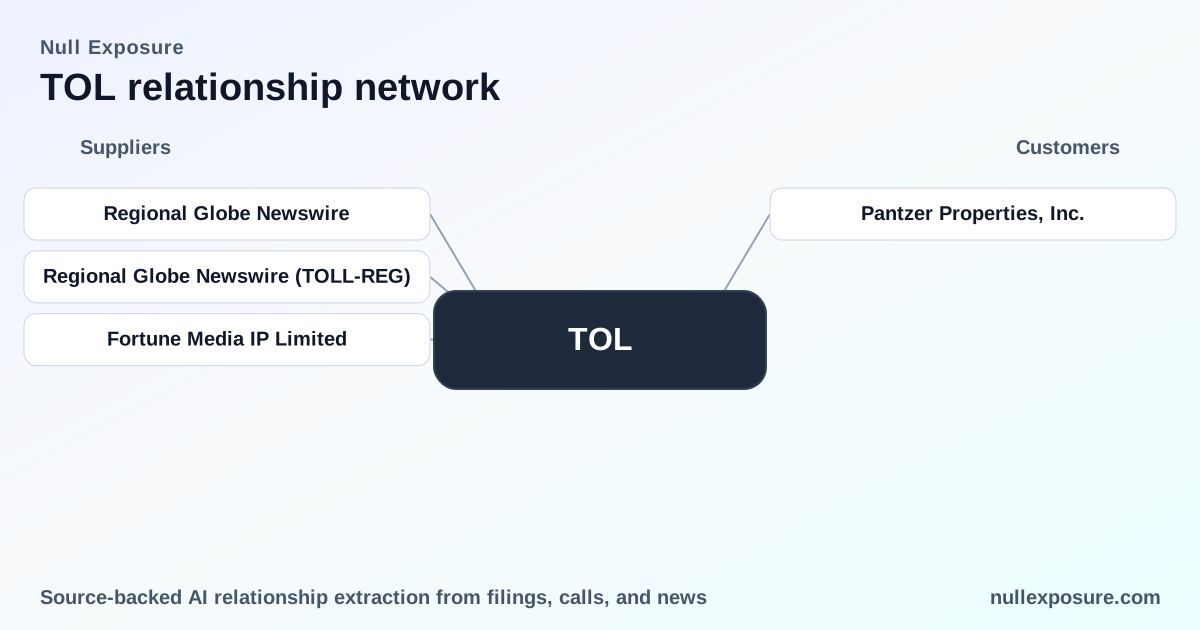
Pantzer Properties acquired a 289-unit apartment building in Woburn from Toll Brothers and an affiliate of The Carlyle Group for about $130 million, representing Toll’s execution of asset dispositions that convert real-estate holdings into cash. This sale underlines Toll’s willingness to monetize non-core or transitional assets to recycle capital into homebuilding (transaction reported January 2026 via Simply Wall St: https://simplywall.st/stocks/us/consumer-durables/nyse-tol/toll-brothers).
Kennedy Wilson (KW)
Kennedy Wilson agreed to acquire Toll Brothers Apartment Living for $347 million, a strategic sale that reduces Toll’s operating exposure to multifamily management while unlocking capital and simplifying the company’s operating footprint (reported in ReBusinessOnline, FY2025: https://rebusinessonline.com/kennedy-wilson-agrees-to-acquire-toll-brothers-apartment-living-platform-for-347m/). Subsequent reporting indicates KW integrated multiple properties and development sites from the platform, reinforcing that the transaction represented a broad transfer of assets and operations (Los Angeles Business Journal, FY2026: https://labusinessjournal.com/featured/kennedy-wilson-goes-private-in-1-7b-deal/).
JBG SMITH (JBGS)
JBG SMITH selected Toll Brothers to build 120 single-family townhome units on Landbay H in Potomac Yard, demonstrating Toll’s role as a contracted builder for institutional landowners and developers and highlighting a revenue stream where Toll acts as a seller/contractor on build-for-sale townhome projects (reported March 2026 by CityBiz: https://www.citybiz.co/article/783984/jbg-smith-secures-approval-for-diverse-new-housing-options-in-potomac-yard/).
What these relationships reveal about Toll’s operating model
The recent counterparty activity illustrates several core characteristics of Toll’s business model that investors and operators must evaluate:
- Capital recycling and optionality: Toll is executing strategic exits (Kennedy Wilson, Pantzer) that convert operating platforms and assets into liquidity and focus capital on core homebuilding. The pricing and timing of these sales materially affect net leverage and reinvestment capacity.
- Dual commercial posture: Toll functions both as a direct-to-consumer home seller and as a contracted builder/operator for institutional counterparties (e.g., JBG SMITH), diversifying revenue recognition pathways and smoothing cycle volatility.
- Backlog-driven revenue with rate sensitivity: A large backlog provides forward revenue visibility, but closings depend on financing conditions—Toll’s mortgage subsidiary hedges some exposure by selling loans at rate lock to investors. Interest-rate and mortgage-market dynamics remain primary operational risk drivers.
- Geographic scale with localized concentration: Operating in 24 states and five regions lowers single-market concentration risk, but local housing demand swings still produce materially different margin outcomes across communities.
- Price-point exposure creates sensitivity to affordability: With significant sales in the $500k–$2M+ brackets, home price elasticity and mortgage spreads directly influence absorption and margin.
Risks, mitigants and what investors should watch
Key risk vectors:
- Closing conversion: backlog converts to revenue only at delivery and successful closings; rate volatility can depress conversion rates and extend cycle times.
- Capital redeployment: proceeds from asset sales improve liquidity but require disciplined redeployment to sustain ROIC; monitor uses of proceeds and any buyback or deleveraging programs.
- Service divestitures: exiting apartment living reduces ancillary recurring revenue but sharpens focus on higher-margin home sales—assess the net margin and cash-flow trade-off.
Mitigants:
- Diversified revenue streams from mortgage/title/landscaping and developer-contracted build work provide fallback cash flows.
- Substantial institutional investor base (over 92% institutional ownership) brings scrutiny and access to capital.
Investor takeaways and next steps
- Toll Brothers is a luxury homebuilder with a clear core-profit engine in home sales, and recent transactions signal capital recycling and strategic simplification. The company’s mix of retail buyers and institutional counterparties provides both cyclical exposure and tactical optionality.
- Monitor conversion of backlog to closings, the deployment of proceeds from the apartment-living disposal, and mortgage-market conditions as the primary drivers of near-term earnings and balance-sheet health.
For a consolidated view of Toll’s counterparty landscape and to integrate these signals into your investment process, visit https://nullexposure.com/ for more intelligence and relational mapping.