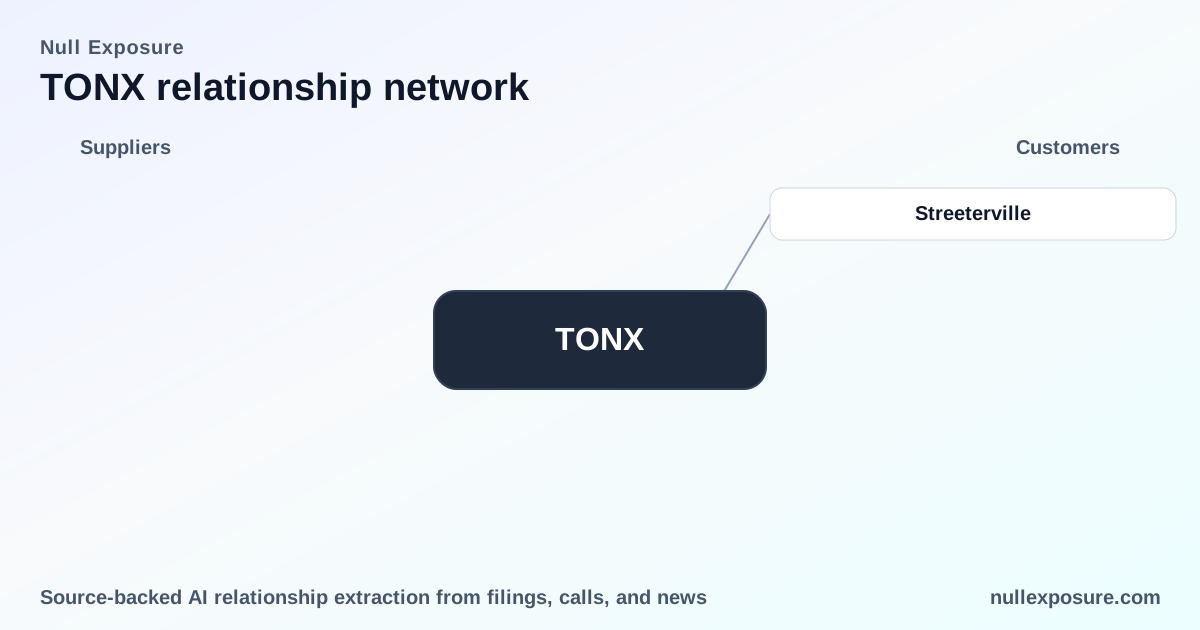
TON Strategy Co (TONX): Customer Relationships and Commercial Levers
TON Strategy operates an interactive, video-driven social commerce platform that monetizes through recurring subscription services, commission-based fees on live product sales, and packaged production/creative services. The company reported $12.78 million in trailing twelve‑month revenue and discloses significant customer concentration—one client represented 26% of 2024 revenue—making counterparty stability a primary investment consideration. For primary source reference and deeper commercial signals, see the company filing and related disclosures on the TON Strategy 10‑K.
Explore additional corporate relationship intelligence at https://nullexposure.com/.
How TON Strategy makes money and what that means for investors
TON Strategy’s revenue mix is a hybrid of subscription and usage-based economics. The 10‑K describes subscription pricing for recurring offerings and a commission model that charges up to 25% of gross sales for products sold during live show airings, creating a mix of predictable recurring revenue and performance-linked upside. The company also sells higher‑touch services—content production, onboarding and ongoing maintenance for social commerce storefronts—at package price points in the $15,000–$60,000 range, which drives lumpier but higher‑ticket revenue.
Key operating signals from the 10‑K:
- Recurring plus variable revenue model: subscription fees and up-to-25% take rate on live sales provide both stability and scaling leverage.
- Geographic concentration: revenues are substantially all U.S.-based, concentrating market exposure to the North American e‑commerce ecosystem.
- Customer concentration risk: one customer represented 26% of 2024 revenue, elevating revenue volatility should contract renewal or pricing change.
- Service positioning: packaged services (creative, production, influencer casting and store maintenance) are central to the go‑to‑market and command mid‑to‑high ticket pricing.
These signals indicate a growth business that combines SaaSlike recurring elements with agency-style, project-based revenue—a capital-intensive model that depends on success in a small number of meaningful relationships.
Financial context that matters
TON Strategy’s trailing revenue of $12.78M, a negative operating margin (operating margin TTM roughly -99.5%), and negative EPS reflect a company still investing to scale content-production and platform capabilities. Material customer concentration together with negative operating leverage is a structural risk that investors must monitor through contract renewals and client diversification metrics reported in future filings.
Customer relationship spotlight: Streeterville
In the 2024 Form 10‑K, TON Strategy discloses two discrete financial interactions with Streeterville: the company issued 57,422 shares of common stock to Streeterville to settle $1,720 of outstanding balance on November Notes, and it disclosed that on December 29, 2023, Streeterville purchased 3,000 shares of newly designated non‑convertible Series C Preferred Stock for $3,000. These entries are recorded in the company’s annual filing for fiscal year 2024. (Source: TON Strategy 2024 Form 10‑K.)
Streeterville’s transactions combine an equity purchase and a small debt reduction through share issuance, signaling a capital relationship that includes both investment and note settlement rather than a standard supplier/customer revenue arrangement. (Source: TON Strategy 2024 Form 10‑K.)
How Streeterville fits into the operational picture
The Streeterville disclosures are small in absolute dollars relative to the company’s market capitalization and revenue, but they are material as a documented counterparty in the 10‑K. The equity purchase in December 2023 and the subsequent issuance of common shares in 2024 reflect capital management and stakeholder engagement; these moves also illustrate the company’s willingness to use equity as a tool to resolve liabilities. (Source: TON Strategy 2024 Form 10‑K.)
Commercial scale and pricing mechanics investors should track
TON Strategy’s product pricing and client engagement model create distinct levers for margin expansion and top‑line growth:
- Subscription revenue provides baseline predictability and improves gross margin when utilization and churn are managed tightly.
- The up to 25% commission on product sales during live events offers high variable margin and scales with merchant success on the platform.
- Service packages priced between $15k and $60k deliver higher immediate contribution but increase customer concentration and sales cycle risk.
- The company specifically references partnerships that drive service contracts—for example, referral and onboarding services tied to TikTok Shop via MARKET.live arrangements—positioning TON Strategy in the influencer and social‑commerce ecosystem. (Source: TON Strategy 2024 Form 10‑K.)
These mechanics produce a revenue profile that benefits from both transaction growth (higher GMV on live shows) and client expansion into recurring services.
Risk synthesis and operational constraints
Concentration, U.S. market dependence, and mix of subscription and high-ticket services form the principal operational constraints for TON Strategy:
- Concentration risk is acute: one customer = 26% of revenue, which elevates downside if that relationship softens. (Company 2024 Annual Report.)
- Geographic risk: revenues are substantially domestic, exposing TONX to U.S. platform dynamics and regulatory changes. (Company 2024 Annual Report.)
- Contracting posture: the business uses both subscription contracts and usage-based fee arrangements (explicit in the filing), producing mixed revenue durability. (Company 2024 Annual Report.)
- Spend band realities: service packages in the $15k–$60k range indicate a mid-market target that requires continuous lead flow and higher-touch account management. (Company 2024 Annual Report.)
Investors should frame these constraints as strategic priorities: reduce counterparty concentration, expand merchant GMV on live shows to raise commission revenue, and scale recurring subscriptions to improve operating leverage.
Explore a deeper relationship map and filings at https://nullexposure.com/ for investor due diligence and ongoing monitoring.
Investment implications and what to watch next
For investors and operators evaluating TONX:
- Monitor customer concentration trends in quarterly filings and disclosures; a single large client loss would materially impact revenue.
- Track GMV and take‑rate evolution from investor presentations and quarterly commentary; commission growth is the most direct path to margin improvement.
- Watch service revenue cadence and client acquisition cost given the $15k–$60k package pricing—repeatability of these engagements will determine scalability.
- Assess capital strategy and shareholder mix as the company uses equity to settle obligations and attract investors, which influences dilution risk and balance sheet flexibility.
Final takeaway: TON Strategy offers a differentiated social‑commerce play with compelling variable economics, but current execution is paired with concentrated customer risk and negative operating leverage. Investors should prioritize contract renewal data, GMV growth, and client diversification as the clearest indicators of durable value creation.