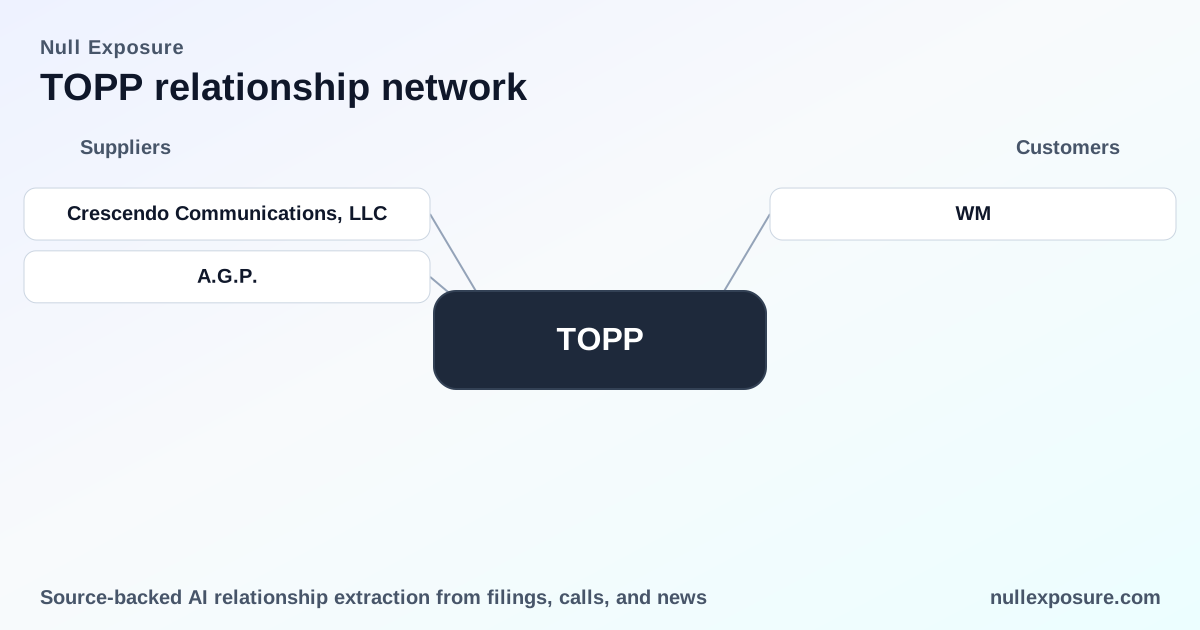
Toppoint Holdings (TOPP): Customer map and what it means for investors
Toppoint Holdings operates as a regional truckload services and recycling logistics provider that monetizes by charging for point-in-time delivery of truckloads—primarily waste paper and other recyclable commodities—into export terminals and container ports. Its revenue is derived from discrete transport contracts with mostly large waste and recycling companies, with recent contract expansions generating identifiable incremental annual revenue. For investors, the business is highly service-driven, geographically concentrated in the Northeastern U.S., and materially dependent on a handful of large customers, creating both predictable route-level cash flow when volumes hold and concentration risk if load volumes compress. For a concise view of Toppoint’s customer relationships and implications, see NullExposure’s research hub (https://nullexposure.com/).
How its customers fit together and why that matters
Toppoint’s commercial model is straightforward: the company sells a single performance obligation—delivery of truckload services—and recognizes revenue at the point of delivery. That structure produces a transactional, spot-oriented contracting posture and ties revenue directly to volumes and port schedules rather than multi-year recurring billing. The customer list is dominated by large waste and recycling operators, which creates leverage in pricing but also concentration risk: the company reported its ten largest customers accounted for roughly 58% of revenue in 2024. This concentration and the spot nature of its contracts should be front of mind for investors modeling cash flow volatility.
Below I cover every customer relationship flagged in the source material and provide the citation investors will use to verify the claims.
Waste Management (WM)
Toppoint expanded a long-standing partnership with Waste Management to include 1,000 additional annual loads, a move projected to add up to $2 million in incremental annual revenue to Toppoint. TheTrucker reported this expansion in a March 2026 article describing Q1 revenue drivers, and a GlobeNewswire release summarized the same expansion earlier (press picked up by CNN markets).
Source: The Trucker (Mar 10, 2026) and GlobeNewswire press release reported via CNN (Jan 30, 2025).
Casella Waste Systems (CWST)
Toppoint provides recycling logistics services for Casella Waste Systems in the Eastern U.S., positioning Toppoint as a regional execution partner for Casella’s recycling exports. The arrangement was announced via GlobeNewswire and captured in market feeds in early 2025.
Source: GlobeNewswire press release (Feb 4, 2025) reported via CNN markets.
Fr. Meyer’s Sohn
Toppoint enhanced supply chain efficiency for Fr. Meyer’s Sohn—one of the world’s largest forwarding companies—by providing truckload logistics that support export operations, according to a 2025 GlobeNewswire release. This relationship reflects Toppoint’s role serving forwarders and freight handlers in the export logistics chain.
Source: GlobeNewswire press release (Mar 4, 2025) reported via CNN markets.
Bravion Global Limited
A corporate transaction recorded in SEC filing coverage shows an executive share sale agreement where 500,000 shares of Toppoint common stock were to be sold to Bravion Global Limited, signaling an investor or strategic counterparty relationship rather than a classic customer contract. The story surfaced in SEC-filing reporting in May 2026.
Source: SEC filing coverage reported by Investing.com (May 4, 2026).
Business-model constraints that shape revenue and risk
Treat the following constraints as company-level signals that define how Toppoint operates and how investors should underwrite future cash flow:
- Contracting posture — spot: Contracts reflect single delivery obligations with point-in-time revenue recognition; Toppoint is paid per completed load rather than on a subscription or retainer basis. This produces direct exposure to volume fluctuations and port throughput.
- Customer profile — large to very large enterprises: The customer mix skews toward large and very large waste and recycling companies and commodity traders, which provides scale but concentrates counterparty exposure.
- Geographic footprint — North America concentrated: Operations are primarily in the Northeastern U.S. (PA/NJ/NY and nearby states), with selective expansion into Florida export markets. This geography concentration amplifies regional macro and port-specific risk.
- Materiality — high concentration: The ten largest customers accounted for roughly 58% of 2024 revenue, a material concentration that makes each large contract renewal or expansion a meaningful P&L event.
- Relationship roles — service provider and buyer context: Toppoint functions as a hands-on service provider delivering “white glove” logistics; its customers act as buyers who require strict on-time delivery to sync with shipping schedules.
- Segment focus — core product and services: Waste paper export transport is the core commodity and the services delivery model is the company’s revenue engine.
These constraints imply revenue is volume-sensitive, contract renewal and pricing cadence are critical, and customer concentration is the primary single-failure risk for the equity.
What investors should watch next
- Track announced load expansions and contractions with major customers (Waste Management is the key current signal following the 1,000-load expansion). Upside occurs if Toppoint converts pilot volumes into multi-year committed lanes; downside if port slowdowns or commodity price shifts cut export volumes.
- Monitor renewals and the composition of the top ten customers; any loss among the largest customers will have outsized revenue impact given the 58% concentration.
- Watch balance-sheet health versus working capital needs: the business is operationally intensive and requires liquidity to scale or cover seasonal pauses.
- Keep an eye on insider and strategic share movements—sales to Bravion Global Limited alter ownership dynamics and could presage strategic or financial repositioning.
Bold takeaway: Toppoint is a route-execution specialist with clearly monetizable load expansions but faces pronounced concentration and regional exposure that investors must price into forward scenarios.
If you want a streamlined investor-ready summary and continuous monitoring of TOPP customer developments, visit NullExposure for consolidated alerts and portfolio signals (https://nullexposure.com/).
Final read: trade-off and edge
Toppoint offers investors a clear commercial model: charge for discrete, executed truckloads for large waste and recycling customers, capture incremental revenue as loads increase, and leverage regional specialization into operational efficiency. The edge is operational execution in export logistics; the trade-off is high customer concentration and spot-volume sensitivity. For active investors focused on micro-cap logistics plays, Toppoint’s near-term upside will be driven by load growth with major customers and sustained port throughput. For risk-averse holders, the concentration and geography profile justify tighter position sizing until multi-year contractual stability is demonstrated.