TOP Ships (TOPS): Customer Relationships and Commercial Risk Profile
TOP Ships Inc. owns and operates modern Suezmax and MR tanker vessels and monetizes them by entering multi-year time charters and tactical asset sales that convert vessel value into cash. The company’s revenue mix combines long-term charter contracts that stabilize cash flow and one-off sale transactions that reduce fleet exposure and generate liquidity; this dual model creates predictable earnings during charters while leaving upside (and downside) tied to spot market cycles and opportunistic disposals. For active investors, the counterparty mix—including affiliated charterers and a small set of repeat counterparties—defines both the upside of secured rates and the governance and concentration risks that accompany related-party deals. For deeper context on commercial counterparties and document-level evidence, visit https://nullexposure.com/.
Operational snapshot: TOP Ships executes time charters (multi-year fixes at daily rates) and occasional vessel sales; the business relies on a compact set of counterparties, frequent contract renewals or extensions, and occasional related-party arrangements that materially influence near-term revenue. Key takeaway: charters provide revenue certainty, but counterparty concentration and related-party transactions raise governance and counterparty risk.
How TOPS’s chartering model drives cash and valuation
TOP Ships’s core monetization mechanism is straightforward: the company deploys ECO-design tankers under time charters to charterers who pay daily rates, typically fixed for several years. These contracts convert asset utilization into predictable day-rate revenue and underpin vessel valuation metrics used by markets and lenders. When needed, TOPS sells vessel-owning companies or newbuilding contracts to third parties to crystallize value and reduce capital commitments.
This combination produces two characteristics investors should value and monitor:
- Revenue stability during charters: multi-year time charters lock in daily rates and reduce spot exposure.
- Asset-liability optionality: asset sales accelerate liquidity and can deleverage balance sheets or shift fleet composition.
If you want a concise, source-linked dossier for TOP Ships’s counterparties and recent deals, Null Exposure has compiled the relevant press filings and news reports at https://nullexposure.com/.
What the relationship set says about TOPS’s operating posture
There are no formal constraints logged in the underlying record for this customer-scope extraction; treat that absence as a company-level signal that no additional red-flag constraints were captured by the source feed. From the relationship evidence itself we can infer practical operating characteristics without asserting formal constraints:
- Contracting posture: TOPS favors multi-year time charters and charter amendments, signaling a preference for contractually locked day rates rather than pure spot exposure.
- Concentration: A small number of counterparties repeatedly appear in public notices, and one counterparty is affiliated with senior management—this concentrates counterparty risk.
- Criticality: Charter contracts are revenue-critical; amendments that increase day rates have immediate P&L impact.
- Maturity: Contracts are often extended or amended for several years, indicating medium-term commercial visibility.
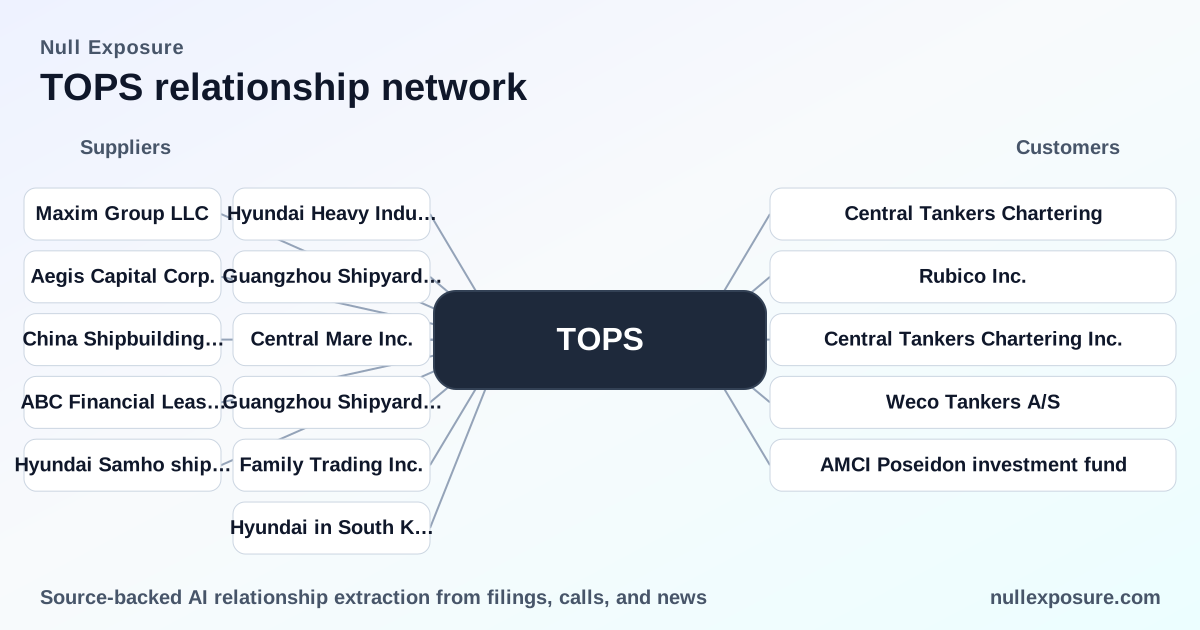
Below I catalogue every counterparty relationship captured in the public results and provide source-level evidence.
Counterparty relationships — what investors need to know
Central Tankers Chartering / Central Tankers Chartering Inc.
TOP Ships amended the time charter for its Suezmax M/T Eco Oceano with Central Tankers, increasing the daily rate from $24,500 to $30,000 and extending the arrangement from January 1, 2026 for five years, enhancing near-term revenue visibility. Several press releases and news outlets note that Central Tankers is affiliated with TOP Ships’s CEO and major shareholder, Evangelos J. Pistiolis, making this a related-party commercial arrangement with governance implications. According to a GlobeNewswire press release (Jan 6, 2026) and corroborating industry coverage (ShippingTelegraph; Yahoo Finance), the amendment materially raises the vessel’s revenue potential. (Sources: GlobeNewswire Jan 6, 2026 — https://www.globenewswire.com/news-release/2026/01/06/3213751/0/en/TOP-Ships-Announces-Amendment-of-Time-Charter-at-a-Higher-Daily-Rate.html; ShippingTelegraph — https://shippingtelegraph.com/freight-news/top-ships-amends-suezmax-tanker-charter-at-higher-rate/; Yahoo Finance — https://sg.finance.yahoo.com/news/top-ships-announces-amendment-time-141500583.html)
Weco Tankers A/S
TOP Ships extended the time charter for its 50,000 dwt MR product tanker M/T Eco Marina Del Ray with Weco Tankers by three years at a daily rate of $18,250, preserving a multi-year revenue stream for that asset. The extension was announced in late 2025 and reported to investors in company news distributions (FY2025), underscoring TOPS’s reliance on long-term fixes for MR tonnage. (Source: company announcement as reported on Nov 20, 2025 — https://www.globenewswire.com/news-release/2025/11/20/3192427/0/en/Top-Ships-Inc-announces-extension-of-Time-Charter-for-its-MR-Tanker.html; secondary repost — https://www.sahmcapital.com/news/content/top-ships-inc-announces-extension-of-time-charter-for-its-mr-tanker-2025-11-21)
Rubico Inc.
TOP Ships entered into a sale agreement to transfer a vessel-owning company that is party to a newbuilding contract for the M/Y Sanlorenzo 1150Exp to Rubico Inc. for $38.0 million, with delivery expected in Q2 2027. This transaction is an example of TOPS monetizing non-core or newbuilding exposure via outright sale rather than operating the asset, and was disclosed in year-end press releases (FY2025) and follow-on news coverage. (Source: GlobeNewswire Dec 31, 2025 — https://www.globenewswire.com/news-release/2025/12/31/3211929/0/en/Top-Ships-Inc-Announces-Sale-of-Newbuilding-Mega-Yacht.html; related press recap — https://intellectia.ai/news/stock/top-ships-amends-charter-for-mt-eco-oceano-increases-daily-rate-to-30000)
AMCI Poseidon investment fund (affiliate)
Historical reporting records a 2013 transaction where an affiliate of the AMCI Poseidon investment fund agreed to acquire six shipowning subsidiaries from TOP Ships in a cash-and-debt assumption deal, moving most of the company’s six vessels off its balance sheet for an aggregate cash consideration referenced in contemporaneous coverage. This older relationship illustrates TOPS’s willingness to use structured asset sales to reshape its fleet and balance sheet. (Source: gCaptain coverage of the FY2013 sale — https://gcaptain.com/top-ships-sells-fleet/)
Investment implications and risk checklist
- Revenue upside is visible and immediate when TOPS secures higher day rates or extends charters at improved pricing; the Eco Oceano amendment is a clear near-term earnings lever.
- Concentration and related-party exposure are material risks. Repeated reliance on a small set of counterparties and a known affiliated charterer require careful governance oversight and disclosure scrutiny.
- Asset-sale flexibility reduces capital intensity, but sales to third parties can also shrink future revenue potential if replacement charters are scarce.
- Contract maturity provides cash flow predictability for the contract durations disclosed, but watch renewals and expiries for re-exposure to spot markets.
Bottom line for investors
TOP Ships operates a hybrid commercial strategy: secure medium-term cash via multi-year charters, and manage balance sheet risk through selective asset disposals. The company’s current relationship set shows deliberate use of charter amendments and sales to stabilize and monetize assets, but investors must weigh the governance and concentration implications of related-party chartering alongside the cash-flow benefits. For a structured, source-linked monitor of TOPS counterparties and filings, visit Null Exposure: https://nullexposure.com/.
Bold positions in the capital structure should be supported by active monitoring of charter expiries, related-party disclosures, and any subsequent amendments that change day rates or counterparties.