Toast’s customer momentum: marquee rollouts, platform monetization, and what investors should price in
Toast operates a vertically integrated, cloud-native platform for restaurants that monetizes through multi-year SaaS subscriptions, integrated payment processing, hardware sales, and professional services. The company sells bundled solutions—software, payments, and restaurant-grade hardware—into both independent operators and large enterprise chains, driving recurring revenue and high gross payment volume that support cross‑sell and margin expansion. For investors, the strategic signal is straightforward: enterprise rollouts and delivery partnerships are the growth engine; integrated payments are the margin engine.
Explore deeper analysis at https://nullexposure.com/.
Why customer relationships matter more than press releases
Toast’s investor case is built on a combination of scale and sticky economics. The company reports ~134,000 Locations and roughly $159 billion of gross payment volume on a trailing‑12‑month basis, creating a platform where incremental product adoption lifts lifetime value materially. Large chain rollouts—where Toast acts as both software seller and payments processor—convert episodic wins into predictable recurring streams and deferred revenue. Partnerships with delivery and logistics providers extend the platform footprint off-premise and into adjacent commerce, increasing average revenue per location.
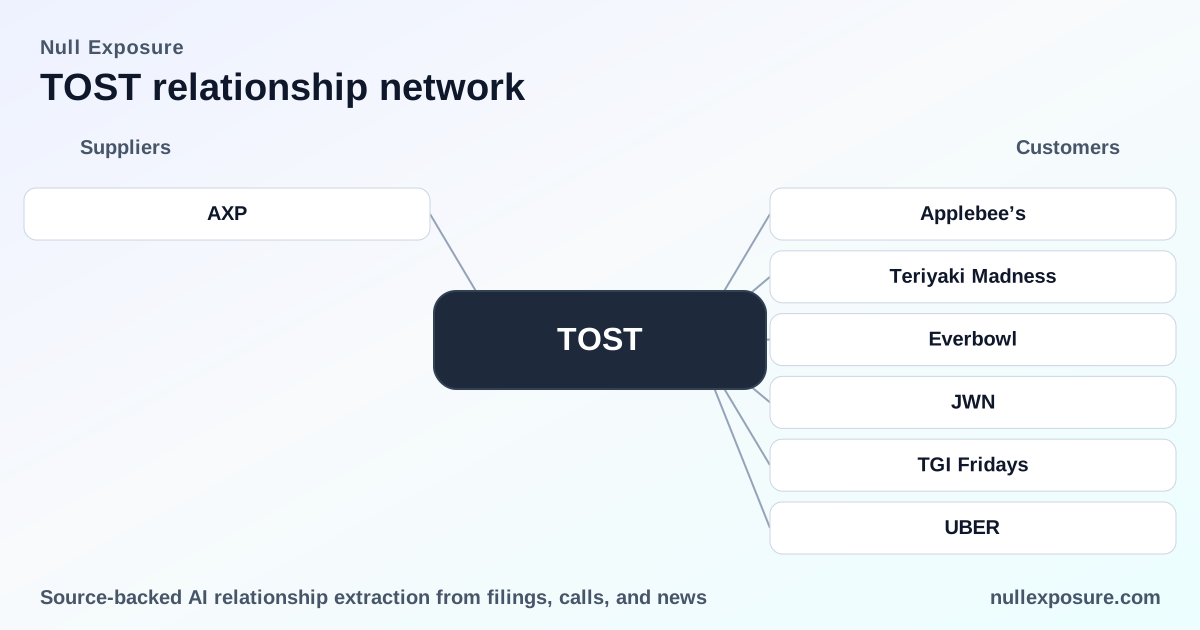
The customer roll call — who Toast is signing and why it matters
Below I summarize every customer relationship surfaced in the recent coverage and provide the reporting source for each.
Graze Craze
Toast secured its first Australian customer, Graze Craze, signaling the start of targeted international expansion beyond the U.S. market. According to a TipRanks company announcement (first seen May 4, 2026), this win represents a deliberate move to replicate the U.S. playbook in select overseas markets. (Source: TipRanks, May 2026)
Applebee’s
Applebee’s is cited as a large-chain rollout catalyst for Toast, underscoring the company’s focus on national franchise networks as growth drivers and recurring revenue anchors. A Sahm Capital analysis (January 31, 2026) identified Applebee’s rollouts and multi‑year contracts as key execution catalysts for the stock. (Source: Sahm Capital, Jan 2026)
CART (Instacart / Maplebear Inc.)
Toast announced a strategic partnership with Maplebear/Instacart (CART) to leverage same‑day delivery and streamline onboarding and procurement for Toast-powered restaurants, establishing Instacart as a supply and logistics partner for off‑premise fulfillment. Coverage in Bitget and InsiderMonkey (March 9, 2026) and a StockTitan note (Feb 10, 2026) describe the partnership as operationally accretive for restaurant partners and complementary to Toast’s off‑premise strategy. (Sources: Bitget and InsiderMonkey, Mar 2026; StockTitan, Feb 2026)
TGI Fridays
TGI Fridays is cited among marquee enterprise wins that validate Toast’s ability to serve national full‑service chains and scale enterprise features such as loyalty, guest engagement, and integrated payments. This was included in a Globe and Mail press release summarizing recent earnings commentary (March 10, 2026). (Source: The Globe and Mail, Mar 2026)
Uber
Toast expanded its partnership with Uber to drive guest demand and better manage off‑premise sales, integrating delivery orchestration with the Toast platform to capture off‑premise revenue and analytics. The expansion was described in the company press coverage and earnings commentary published by The Globe and Mail (March 10, 2026). (Source: The Globe and Mail, Mar 2026)
Nordstrom (JWN)
Nordstrom is listed as a marquee partnership, indicating Toast’s penetration into non‑traditional foodservice environments such as retail concessions and food halls, which diversifies addressable markets and upsells hardware and payments. The win was highlighted in corporate press materials summarized by The Globe and Mail (March 10, 2026). (Source: The Globe and Mail, Mar 2026)
Everbowl
Everbowl is another named customer in the company’s recent disclosures, representing success in the fast‑casual and quick‑service verticals where digital ordering and loyalty lift frequency. This customer was listed among recent marquee wins in Globe and Mail coverage of Toast’s results (March 10, 2026). (Source: The Globe and Mail, Mar 2026)
Teriyaki Madness
Teriyaki Madness tapped Toast for its next growth phase, reinforcing Toast’s penetration among regionally scaling fast‑casual brands. The Finviz news brief (March 9, 2026) reported Teriyaki Madness’s adoption of the platform to support growth and operations. (Source: Finviz, Mar 2026)
What the company‑level constraints tell investors about execution risks and levers
The collected constraint signals describe how Toast contracts and where value concentrates; treat these as firm‑level operating characteristics rather than attributes of any single customer.
- Subscription contracting posture: Contracts for SaaS products generally run 12–36 months, producing deferred revenue and predictable renewal cohorts that make LTV/CAC economics measurable.
- Seller posture and payment dependence: Toast typically sells subscriptions bundled with its payment services, and payment processing materially contributes to revenue and gross profit, making payments a critical margin lever.
- Customer maturity and activity stage: The majority of relationships are active and expanding—higher product adoption unlocks cross‑sell opportunities across software, hardware, and services.
- Geographic concentration: Revenue is primarily U.S.-centric, with only nascent international expansion (e.g., the Graze Craze Australian win), indicating limited near‑term geographic diversification risk.
- Segment breadth: Toast operates across software, hardware, and services, enabling multiple monetization vectors but also requiring integrated product delivery.
- Materiality and spend concentration: Reported remaining performance obligations and deferred revenue profiles imply meaningful multi‑year commitments, with at least $837 million referenced as expected revenue from remaining contract obligations—an indicator of large, material customer engagements.
Investment implications — what to watch and how to size conviction
- Upside driver: Large chain rollouts (Applebee’s, TGI Fridays, Nordstrom) serve as multipliers: enterprise contracts accelerate recurring revenue growth and raise average spend per location. Enterprise penetration is the highest‑leverage growth path.
- Margin compression risk: The bundling of payments with software increases revenue per customer but concentrates profit sensitivity on payment economics and interchange dynamics; monitor GPV trends and processing margins.
- Platform defensibility: Partnerships with delivery/logistics providers (Uber, Instacart/Maplebear) extend sticky utility for restaurant operators and increase switching costs by centralizing order, delivery, and payment flows.
- International expansion: The Graze Craze Australian entry is an early test of replicability abroad; success would broaden the TAM materially, but execution in new regions will be gradual.
For a concise, investor‑grade feed on customer developments and partnership signals, visit https://nullexposure.com/.
Bottom line
Toast’s recent customer disclosures and media coverage reinforce a repeatable enterprise sales playbook: sell bundled SaaS, payments, and hardware to scale operators and national chains while leveraging delivery partnerships to capture off‑premise revenue. Investors should assign valuation premium to successful enterprise rollouts and execution on payments profitability, while pricing in concentration of revenue in the U.S. and the operational complexity of simultaneous hardware, software, and fintech delivery.