TowneBank (TOWN): Customer Relationships Tell a Local-First Story with Sponsorship and Real‑Estate Anchors
TowneBank operates as a regional commercial and retail bank headquartered in Portsmouth, Virginia, monetizing through interest income on loans and deposits, fee income from banking services, and returns on bank-owned real estate. The franchise combines traditional community banking economics — reflected in $877.2 million in trailing revenues and a 19% profit margin — with ancillary activities that include sponsorships and property tenancy that reinforce local brand visibility and customer relationships. For investors assessing counterparty and customer exposure, the public record shows targeted community sponsorship and property-based customer linkage rather than material dependence on a small set of corporate customers. Learn more and explore structured relationship intelligence at https://nullexposure.com/.
A compact financial profile investors should register
TowneBank is a mid-cap regional bank (market cap roughly $3.15 billion) with return on equity of 6.56% and a dividend yield around 3.02%, trading at a trailing P/E of 16.14 and a forward P/E near 12.55. These metrics position TowneBank as a profitable regional operator with steady income generation and shareholder distribution. The franchise’s operating margin (35.8% TTM) and stable revenue per share indicate scalable retail/commercial margins typical of a mature regional bank.
What the customer relationships indicate about commercial posture
TowneBank’s visible customer relationships in the public record are local, marketing-oriented, and real-estate anchored rather than large, concentrated corporate banking relationships. This pattern supports a contracting posture characterized by:
- Transactional and brand-oriented agreements (sponsorships, naming/presentation rights).
- Low single-client concentration risk in the disclosed set of relationships.
- Non-critical but high-visibility engagements that support deposit and branch traffic growth.
- Mature relationship profile consistent with a long-standing community bank expanding into property management and local business support.
These are company-level signals derived from the absence of contract-level constraints in the relationship data; nothing in the dataset identifies material vendor-like dependencies or exclusive customer contracts.
How sponsorships and tenants serve strategic goals
TowneBank uses sponsorships and property tenancy as marketing tools and local-market retention levers. Sponsorships generate community goodwill and brand recognition among retail customers; property tenancy and co-location with small businesses support fee income and campus economics for bank-owned properties. Both relationship types are complementary to core deposit and lending businesses rather than standalone revenue drivers.
Relationship rundown: each recorded tie and what it means
Mid-Eastern Athletic Conference — community sponsorship and visibility
TowneBank presented the MEAC postseason football honors in November 2022, demonstrating a sports sponsorship strategy aimed at regional brand reinforcement and community engagement around college athletics. According to a Mid-Eastern Athletic Conference press release dated November 22, 2022, TowneBank was named presenter of the conference’s postseason football honors, a marketing relationship likely to support retail deposit and small-business visibility in key local markets.
Sera‑Brynn — tenant and advisory linkage inside bank-owned property
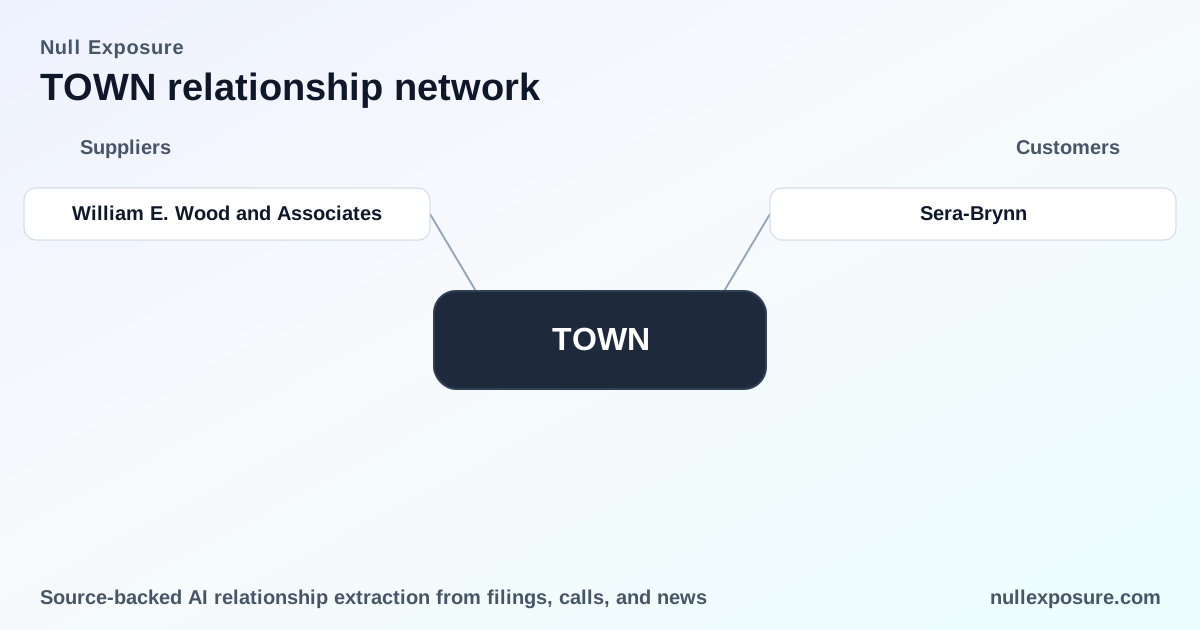
A 2014 Suffolk News-Herald profile described TowneBank’s expansion into co-locating businesses within its financial center properties, citing Sera‑Brynn, a cyber security firm, as a tenant at the Harbour View Financial Center and noting advisory/consulting interactions between TowneBank leadership and that company. That coverage indicates a property-anchored business mix where TowneBank hosts complementary enterprises in bank-controlled buildings, supporting cross-selling opportunities and non-interest income benefits related to real-estate management.
What missing constraints tell investors
The relationship dataset contains no explicit contractual constraints or exclusivity clauses disclosed across these customer records. As a company-level inference, the absence of constraint excerpts indicates TowneBank’s public relationship footprint in this sample is not characterized by critical, single-source dependencies. That absence is itself informative for risk assessment:
- Contracting posture: Emphasizes open-market, non-exclusive relationships.
- Concentration: Publicly visible customer links show low concentration risk.
- Criticality: Relationships are promotional/tenancy in nature — useful for marketing and property returns but not critical to core banking operations.
- Maturity: Relationships are stable and community-rooted rather than transient large-scale corporate arrangements.
Investment implications and risk checklist
- Positive: TowneBank’s customer-facing activities are consistent with a regional bank that strengthens market share through brand sponsorships and by activating bank-owned real estate to host local enterprises. This approach supports steady deposit flows and modest non-interest income while preserving diversified customer exposure.
- Watchlist: Sponsorships are discretionary and yield marketing value rather than contractual revenue; tenants in bank-owned buildings introduce modest landlord risk if local leasing markets soften. Monitor loan portfolio composition and commercial real estate exposure in filings to quantify any direct balance-sheet risk from property activities.
- Valuation context: With a forward P/E near 12.55 and a 3% dividend yield, the stock reflects income-oriented positioning; relationship-driven marketing benefits should be evaluated against credit-cycle sensitivity for regional banks.
Final takeaway and where to go next
TowneBank’s customer relationships as recorded are local, strategic, and low in concentration risk — a profile that aligns with a community-focused regional bank using sponsorships and property tenancy to reinforce its franchise. For investors conducting deeper counterparty diligence or mapping customer concentration across a broader universe, Null Exposure’s relationship intelligence provides structured, traceable signals and context. Explore further analysis at https://nullexposure.com/.
Bold reading: TowneBank sells banking, not dependency — its customer ties are promotional and property-based, not sole-source revenue engines.