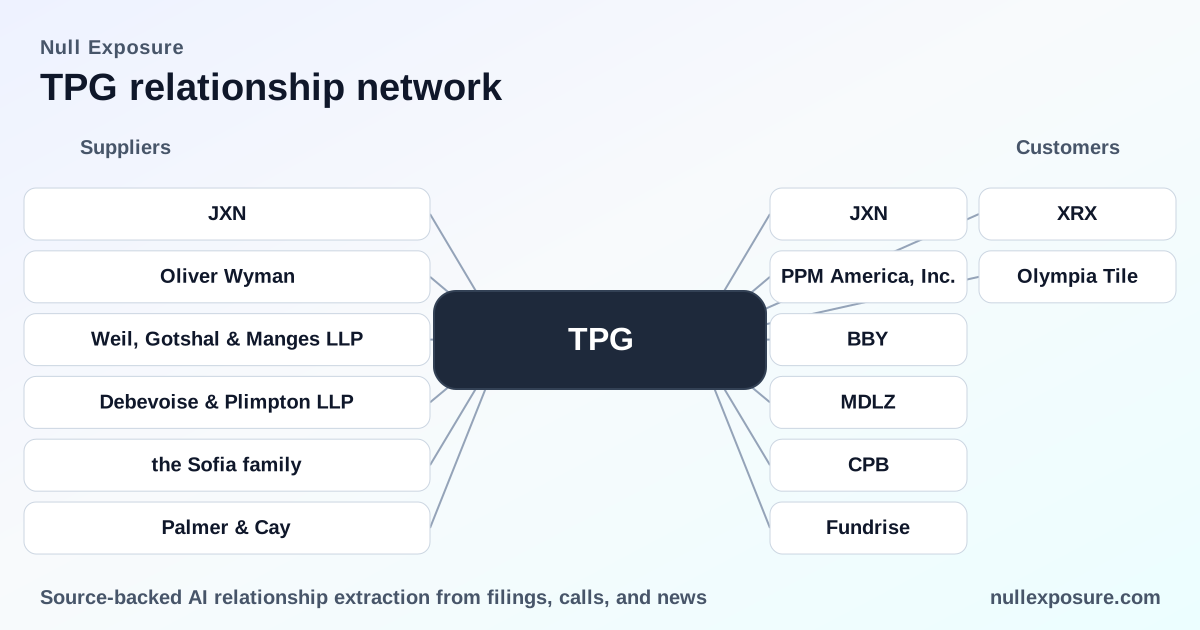
TPG’s customer map: monetization through asset management and credit origination
Thesis — TPG Inc. operates as a global alternative asset manager that earns recurring management fees, incentive fees and transaction-related income by running private equity, credit and real estate funds, plus external management mandates and capital markets services; the firm also monetizes through credit-led financing and structured equity solutions provided by its credit and real estate platforms. Investor returns are driven by fee-bearing AUM growth, selective minority investments and balance-sheet-led credit activity, making strategic long-term mandates and sponsor-level financing arrangements central to revenue durability. Learn more about relationship-driven risk and opportunity at https://nullexposure.com/.
How TPG wins and gets paid: the operating model in plain language
TPG’s business model is built on three revenue engines: (1) recurring management and incentive fees tied to fund AUM and performance, (2) capital markets and advisory fees from arranging financings and exits, and (3) balance-sheet deployment through credit and real estate platforms that generate interest, preferred returns and capital gains. Contracts are typically long-duration and subscription-style — fund terms stretch to the six-to-ten year range, with capital called over investment periods and subscription credit facilities supporting commitments. (Company disclosures, FY2024–FY2026.)
Key corporate signals for investors:
- Long-term contracting posture: fund economics and external mandates favor multi-year horizons and renewal mechanics.
- Global footprint with North America concentration: TPG runs large businesses in NA while maintaining significant APAC and EMEA platforms that support cross-border mandates.
- Service-provider and seller roles: TPG both provides investment management services to clients and sells capital solutions as a lender/investor, creating diversified fee and balance-sheet income.
- Ramping mandates and product expansion: several new mandates are structured to scale over time, implying front-loaded integration and backend fee upside.
If you evaluate partnership durability or counterparty concentration, TPG’s combination of long-term mandates and subscription-style capital commitments is a structural advantage for predictable fee streams and incremental AUM. For deeper relationship analytics, visit https://nullexposure.com/.
Material customer and partner relationships (plain-English summaries)
Below are every named relationship surfaced in recent coverage, each summarized with one or two sentences and a source pointer.
-
Jackson Financial Inc. (JXN) — TPG struck a long-term strategic partnership to provide investment-grade asset‑based finance and direct lending capabilities and to enter non‑exclusive investment management arrangements; the relationship includes a minimum of $12 billion AUM under TPG management with incentives to reach $20 billion. (TPG press release / BizWire, Jan–Mar 2026.)
-
JXN-P-A (Jackson Financial preferred/common security references) — As part of the transaction structure, reporting references indicate TPG’s investment included a $500 million common equity investment and issuance of TPG shares to Jackson, aligned with a 10‑year renewable investment management agreement. (Investor news coverage / SimplyWall.st & trading press, Feb–Mar 2026.)
-
PPM America, Inc. — Jackson’s subsidiary PPM is the incumbent asset manager whose capabilities will be complemented by TPG’s credit and asset-based finance offerings under the new non‑exclusive mandate. (LifeHealth and Jackson filings, Mar 2026.)
-
Franklin Street Properties Corp. (FSP) — An affiliate of TPG Credit provided a $320 million secured credit facility to FSP, showing TPG’s role as a private-credit lender to real‑estate owners. (Company release via FinancialContent, Mar 2026.)
-
TPGXL (TPG-related transaction disclosure) — TPG completed the acquisition of Angelo Gordon with multiple advisors; disclosure lists Ardea Partners as lead financial advisor and major law and banking advisors supporting transaction execution. (TPG corporate announcement, 2026.)
-
Full Truck Alliance (YMM) — TPG is an engagement point referenced in FTA investor Q&A, demonstrating TPG’s involvement as either investor or advisor in logistics and mobility clients. (Earnings call transcript coverage, InsiderMonkey, May 2026.)
-
TPG RE Finance Trust (TRTX) — TRTX is externally managed by TPG’s real estate investment platform; public filings and dividend notices identify TPG affiliates as manager and strategic provider of real‑estate financing expertise. (Yahoo Finance / Globe and Mail notices, 2023–2026.)
-
TRTX‑P‑C (preferred security references for TRTX) — Analyst and transcript commentary references TPG’s deep real‑estate relationships that underpin TRTX’s investment activity and liquidity profile. (Earnings call transcripts, Q1–Q4 2025–2026.)
-
MITT‑P‑A (AG Mortgage Investment Trust securities) — Market coverage credits MITT’s advantage to being managed by TPG, giving it access to capital, sourcing and sector expertise in residential mortgage finance. (MarketBeat coverage, Feb 2026.)
-
Allogene Therapeutics (ALLO) — TPG Capital BD, LLC acted as a co‑manager on a public offering for Allogene, reflecting TPG’s capital markets and underwriting activities through affiliated broker‑dealer entities. (SEC/press release coverage, Apr–May 2026.)
-
Best Buy (BBY) — As a tenant in industrial real‑estate assets acquired through a TPG joint venture with Oxford Properties, Best Buy is referenced as a high‑credit tenant in portfolios TPG owns. (Oxford Properties press release, FY2024 disclosure.)
-
Mondelez (MDLZ) — Mondelez appears among the roster of stable, long‑term tenants inside industrial properties acquired in the GTA JV with Oxford, supporting asset cash flows. (Oxford Properties release, FY2024.)
-
Campbells (CPB) — Campbell’s is cited similarly as a credit tenant in TPG‑sourced industrial portfolios acquired via the Oxford JV. (Oxford Properties, FY2024.)
-
Olympia Tile — Named among tenants in the GTA industrial portfolio that TPG acquired a majority interest in, contributing to the portfolio’s fully leased status. (Oxford Properties, FY2024.)
-
Google (GOOGL) — Reporting on TPG’s climate platform transactions shows TPG completed an exit that reshaped its exposure to data‑center and clean power infrastructure involving Google; this illustrates strategic secondary exits into major tech counterparties. (SahmCapital analysis, Mar–May 2026.)
-
Xerox Holdings Corporation (XRX) — Xerox formed a joint venture with TPG to hold and monetize select IP, with TPG Credit‑led senior secured loans and preferred equity raising about $450 million to support Xerox’s capital structure work. (SahmCapital reporting, Feb–Mar 2026.)
-
Fundrise — JLL arranged financing where a loan was secured from Goldman Sachs and TPG Real Estate Credit for Fundrise-affiliated funds, showing TPG’s participation in large institutional real‑estate financing. (JLL press release, 2025.)
Constraints and how they shape investment risk
TPG’s disclosures and market coverage produce company-level signals that matter for investors:
- Contracting: long-term and subscription-style fund economics create fee visibility but also lock-in of resources and reinvestment risk if deployment slows. (Corporate filings, FY2024–FY2026.)
- Geographic footprint: global with North America dominance — revenue generation centers on North America, while APAC and EMEA platforms offer growth levers and diversification.
- Counterparty mix includes government/sovereign relationships (pre‑IPO strategic investors and sovereign wealth involvement), which supports stability for large commitments.
- Role diversification: seller, service provider, and direct lender produces multiple revenue streams but increases exposure to credit cycles and asset‑level volatility.
- Relationship lifecycle: several mandates are ramping — expect integration costs and front‑loaded resource commitments ahead of fee maturation.
Bottom line for investors
TPG monetizes through durable fee streams and expanding credit/structured solutions, anchored by long, renewable management mandates such as the Jackson Financial partnership and a steady pipeline of real‑estate and credit financings. Key risks are credit exposure from balance‑sheet lending, successful ramp of new mandates, and concentration in large institutional relationships. For relationship-level intelligence and monitoring, explore our research hub at https://nullexposure.com/.