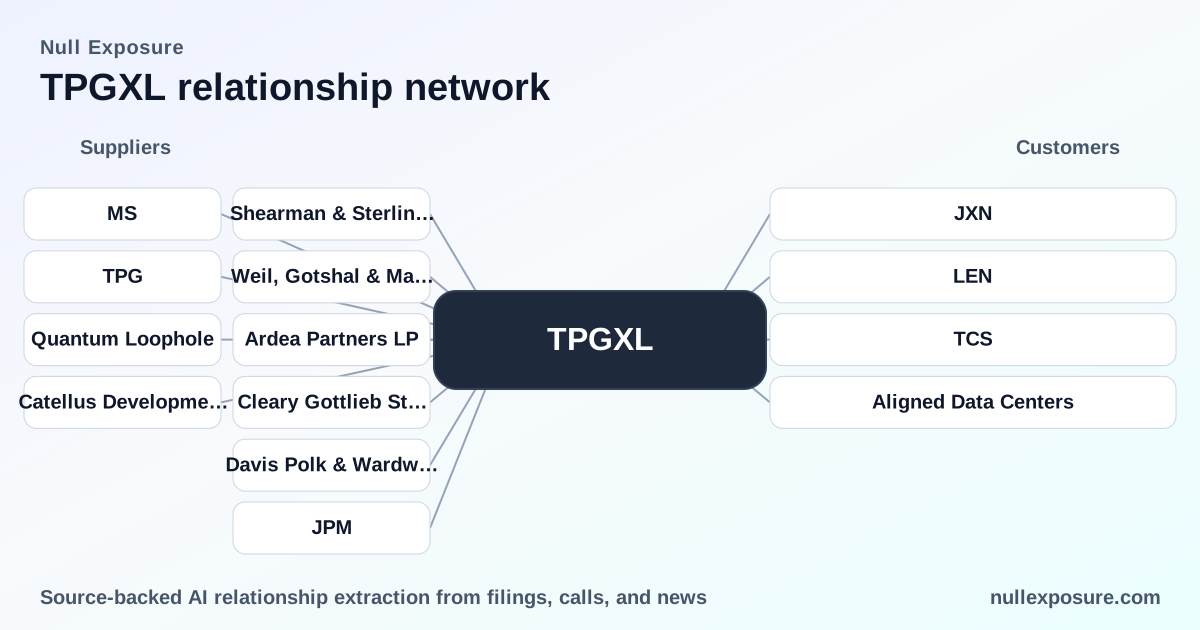
TPGXL Customer Relationships: Strategic Partners, Deal Flow, and Commercial Constraints
TPG Operating Group II, L.P. runs as a global alternative asset manager that monetizes primarily through management fees, incentive fees and capital-allocation income from its funds, while its TPGXL notes deliver a fixed 6.95% coupon to investors through 2064. For investors and operators evaluating counterparty exposure, the most important dynamics are how TPG’s strategic partnerships feed proprietary deal flow, how fund lifecycles drive recurring fee revenue, and how specific project-level arrangements create concentrated operational risk.
Learn more about our coverage at https://nullexposure.com/
What the partner map reveals about how TPG does business
TPG’s customer and counterparty footprint is characterized by long-term, fund-level commitments and recurring fee economics, not one-off product sales. The company reported $245.9 billion in AUM as of December 31, 2024, and explicitly structures many relationships with multi-year terms consistent with private fund economics. That operating posture produces three practical signals for credit and equity investors:
- Contracting posture: Long-term fund terms (typically six to ten years or longer) anchor fee visibility; management fees convert committed capital into recurring revenue while carried interest creates asymmetric upside tied to realizations.
- Concentration and counterparty mix: Revenues derive from a broad set of limited partners and portfolio companies, and TPG discloses no single investor above 10% of committed capital as of year-end 2024, implying limited single-investor concentration.
- Service-role and criticality: TPG acts as both investment manager and administrative service provider for affiliated vehicles; this dual role creates durable fee captures but also operational dependency on fund lifecycles and capital deployment pacing.
The firm-level signals above are also visible in specific partner relationships described below.
The relationships — who is connected and why it matters
Jackson Financial (JXN)
TPG disclosed a long-term strategic partnership with Jackson Financial in its 2025 Q4 earnings call, positioning Jackson as a key partner for TPG’s Insurance Solutions capabilities. According to the 2025 Q4 earnings call (reported March 2026), this agreement advances TPG’s distribution and product reach within insurance balance-sheet and asset-management channels. (Source: TPG 2025 Q4 earnings call, March 7, 2026)
Lennar / Quarterra (LEN)
TPG announced that TAC+ carved out Quarterra from Lennar as part of TPG’s essential housing strategy, signaling an acquisition/portfolio-carveout relationship with one of the nation’s largest homebuilders. The 2025 Q4 earnings call highlights Quarterra’s origin from Lennar and frames the transaction as strategic for TPG’s housing exposure. (Source: TPG 2025 Q4 earnings call, March 7, 2026)
Tata Consultancy Services (TCS)
TPG Rise Climate’s Global South initiative committed $1 billion into the AI data center business of Tata Consultancy Services, reflecting TPG’s approach of pairing capital with large technology operators to scale infrastructure in emerging regions. This investment was described during the 2025 Q4 earnings call as part of the Rise Climate Global South program. (Source: TPG 2025 Q4 earnings call, March 7, 2026)
ALTÉRRA Transformation LP
TPG’s public filings disclosed that ALTÉRRA Transformation LP made a $500 million commitment intended for catalytic capital deployment to Rise Climate Global South structures, with $444 million closed as of December 31, 2025, and that the commitment is excluded from certain fund commitments for reporting purposes. This detail is recorded in a Form 8‑K and referenced in market filings in early May 2026. (Source: Form 8‑K / market filing reported on ADVFN, May 2026)
Aligned Data Centers
Media coverage of the Frederick data‑center campus project—originally announced by TPG with Quantum Loophole—notes that Aligned Data Centers withdrew as the planned first tenant for a significant capacity block, citing state generator restrictions as the rationale for the pullout. That tenant loss illustrates project-level execution risk on large infrastructure initiatives in regulated jurisdictions. (Source: DataCenterDynamics coverage of the Frederick campus, reporting on earlier project developments)
How contract types and constraints shape revenue durability
TPG’s public disclosures and the relationship map reinforce how the business model turns capital commitments into recurring fees and episodic carried interest:
- Long-term fund tenors create durable revenue but concentrate income timing around realizations; management fees decline as invested capital shrinks and as funds move from committed to invested fee bases.
- Subscription-style economics are present in the Capital platform: management fee revenue tracks committed and invested capital levels and steps down when funds progress through deployment and realization cycles, which introduces cyclical fee compression risk when large funds wind down.
- Counterparty mix is large-enterprise and institutional-heavy, with sovereign wealth and government-linked pre-IPO investors participating historically; this supports stable capital but ties fundraising cycles to macro liquidity and institutional appetite.
- Geographic footprint is global—TPG leases offices across major financial centers—which provides diversification of deal flow but creates exposure to regulatory and local execution risks, demonstrated by the Frederick campus challenges.
- Materiality signal: No single investor accounted for more than 10% of committed capital at year‑end 2024, indicating limited single-LP concentration for fund-level revenue.
One explicitly named operational arrangement—the administrative services agreement with RemainCo—shows TPG acting as a seller of administrative services and charging an annual administration fee of 1% of RemainCo’s NAV, paid quarterly in advance, underlining the firm’s willingness to monetize operational functions beyond pure portfolio management.
Risk, downside scenarios, and what investors should monitor
TPG’s commercial map produces three clear monitoring priorities for note and equity investors:
- AUM and fee base trajectory: Watch fund realizations and fundraising; management fees are sensitive to invested vs. committed capital transitions.
- Partner-driven execution risk: Large infrastructure projects (for example, the Frederick campus) can lose tenants or face local regulatory limits that impair returns and capital deployment timing.
- Concentration of strategic partnerships: Major strategic deals—Jackson Financial for Insurance Solutions and the TCS data-center commitment—drive scale in targeted verticals; failures or delays in those initiatives would compress expected growth in fee-related revenue streams.
Investment implications and next steps
TPGXL holders and prospective investors should treat the notes as a yield play on a firm with diversified fee sources but execution-dependent growth vectors. The 6.95% fixed coupon provides an income cushion; however, underlying credit economics tie to fund performance, AUM trends and the success of strategic partnerships highlighted above. Monitor quarterly AUM disclosures, fundraising cadence for flagship funds, and public developments on major projects with partners such as Jackson, TCS, Lennar/Quarterra, and the Frederick campus.
For an ongoing feed of relationship-level intelligence and filings that matter to fixed-income and operational investors, visit https://nullexposure.com/
In sum: TPG’s revenue model is fee-forward and relationship-driven—long-term fund commitments provide visibility, but project and partner execution govern upside from carried interest and strategic initiatives. Use partner developments as a forward indicator of future fee acceleration or stress.