Tri Pointe Homes (TPH): Acquisition, Customer Footprint, and What the Sumitomo Deal Changes for Investors
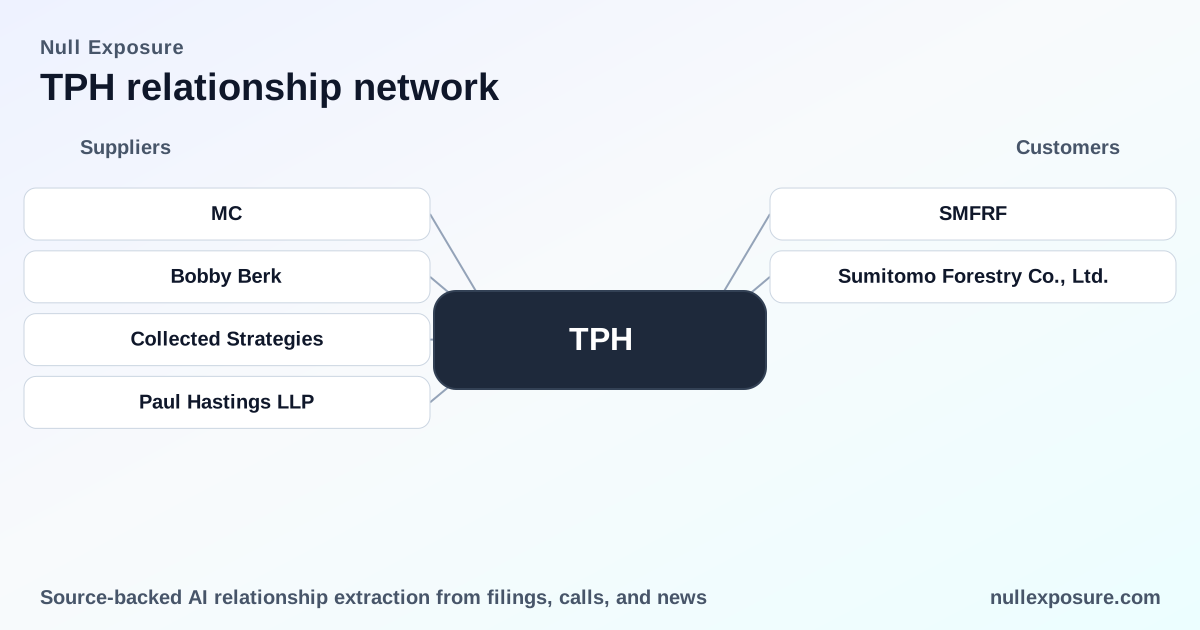
Tri Pointe Homes builds, finances and sells single‑family and attached homes across a broad set of U.S. markets and monetizes through home sales and adjacent financial services (mortgage, title/escrow, insurance). The company’s revenue mix is firmly real‑estate centric—core home sales generate the majority of revenues while Tri Pointe’s mortgage and title businesses provide fee income and transaction facilitation. The announced all‑cash sale to Japan’s Sumitomo Forestry at $47.00 per share is the defining corporate event that pivots the company’s valuation and governance horizon for investors. For a concise look at these customer‑relationship dynamics and legal headlines, see Null Exposure’s coverage: https://nullexposure.com/.
Market and deal context
- Tri Pointe is an established regional homebuilder operating in multiple U.S. states with an integrated financial services arm that supports closings and generates ancillary fees. The company’s latest public metrics show roughly $3.25 billion of trailing revenue and a market capitalization near $4.0 billion before the takeover consideration.
- The proposed acquisition by Sumitomo Forestry values Tri Pointe at roughly $4.5 billion, or $47.00 per share, representing a material premium to recent trading levels. That transaction reframes the company from a stand‑alone public homebuilder to a target undergoing a strategic ownership change.
Key relationship items in the media record Below are every relationship item captured in the results set, each summarized in plain English with its source.
MyCarrollCountyNews — investigation notice (May 4, 2026)
A press release reported that former Louisiana Attorney General Charles C. Foti, Jr. and the law firm Kahn Swick & Foti are investigating the proposed sale of Tri Pointe to Sumitomo Forestry, signaling shareholder litigation interest tied to deal terms and process (MyCarrollCountyNews, May 4, 2026 — https://www.mycarrollcountynews.com/online_features/press_releases/article_de80674a-1cc9-501a-a042-f12842bf39db.html).
SahmCapital — takeover price and fairness questions (first seen May 4, 2026; content dated March 24, 2026)
An article flagged the agreed deal price of $47.00 per share and raised questions about whether the transaction terms are fair to Tri Pointe shareholders, reflecting public scrutiny over deal valuation and advising investors to evaluate process outcomes (SahmCapital, content referencing March 24, 2026 — https://www.sahmcapital.com/news/content/are-tph-kore-nsa-obtaining-fair-deals-for-their-shareholders-2026-03-24).
The Globe and Mail — acquisition announcement and valuation context (March 10, 2026)
A press release published by The Globe and Mail summarized Tri Pointe’s agreement to be acquired by Sumitomo Forestry in an all‑cash merger valued at about $4.5 billion, noting the deal equated to roughly a 29% premium to the prior close and 42% above the 90‑day VWAP (The Globe and Mail press release, Mar 10, 2026 — https://www.theglobeandmail.com/investing/markets/stocks/TPH-N/pressreleases/224211/tri-pointe-to-be-acquired-by-sumitomo-forestry/).
The Globe and Mail — duplicate placement with acquirer ticker SMFRF (March 10, 2026)
The same Globe and Mail text is reproduced with the acquirer referenced under the ticker SMFRF, confirming the buyer identity as Sumitomo Forestry and reinforcing the $47.00 per share consideration and transaction rationale reported earlier (The Globe and Mail press release, Mar 10, 2026 — https://www.theglobeandmail.com/investing/markets/stocks/TPH-N/pressreleases/224211/tri-pointe-to-be-acquired-by-sumitomo-forestry/).
MyCarrollCountyNews — law firm investigation (March 10, 2026 entry)
A separate press notice reiterated that law firms in New York and elsewhere are investigating Tri Pointe in connection with the sale to Sumitomo Forestry, providing additional evidence of litigation interest accompanying the deal announcement (MyCarrollCountyNews press release, Mar 10, 2026 — https://www.mycarrollcountynews.com/online_features/press_releases/article_68566a35-9fb1-56eb-aab4-a2bf3ddb756f.html).
Operating model constraints and what they imply for customers and investors The extracted constraints in the record provide a concise view of how Tri Pointe runs its business and how that structure affects commercial exposures:
- Short‑term contracting posture: Tri Pointe’s performance obligations tied to home deliveries are typically satisfied within one year, and mortgage-originated loans are sold into the secondary market within 30 days. That dynamic creates rapid revenue recognition cycles and low structural lock‑in for customers once a home closes, which in turn makes near‑term cash flow and inventory turnover the key operating levers.
- Individual end‑customer orientation: The company’s counterparty base is predominantly individual homebuyers rather than large institutional customers, creating high volume/low concentration revenue streams where retention depends on local market reputation and product value.
- North American regional diversification: Tri Pointe operates across multiple U.S. states and reportable segments (West, Central, East), which provides geographic diversification while still exposing the company to cyclical regional housing markets and state‑level regulatory regimes.
- Dual role as seller and service provider: Home sales are the core revenue engine, but Tri Pointe also operates mortgage (Tri Pointe Connect), title/escrow (Tri Pointe Assurance), and insurance (Tri Pointe Advantage) businesses, which both facilitate closings and contribute fee revenue—an integrated model that reduces friction for buyers and captures incremental margin on transactions.
- Product and service maturity: The company’s focus on core homebuilding supplemented by financial services signals a mature, scaled operation with multiple revenue streams but limited long‑term contractual stickiness with customers.
Investment implications and risk signals
- Transaction premium crystallizes valuation: The $47 per share all‑cash offer standardizes the near‑term exit value for public shareholders and implies implied control value above pre‑deal trading levels.
- Process risk is visible via litigation activity: Multiple press notices and law‑firm advertisements documenting investigations into the sale process create potential for deal friction, supplemental disclosures, or renegotiation. Investors should treat legal and governance headlines as immediate execution risks to the closing timetable.
- Operational risk remains cyclical and regional: Despite acquisition interest, Tri Pointe’s underlying profitability remains closely tied to housing market cycles across its operating geographies—turnover speed, supply costs, and mortgage availability will continue to drive near‑term earnings.
- Strategic upside for acquirer: Sumitomo Forestry’s purchase provides a strategic rationale—access to U.S. homebuilding scale and distribution plus cross‑border capital—but investor returns for public shareholders are effectively capped by the agreed cash consideration.
If you want a deeper, customer‑level mapping of Tri Pointe’s revenue streams and counterparty dynamics tied to the acquisition, Null Exposure has detailed due‑diligence packages available at https://nullexposure.com/.
Bottom line: what investors should watch next
- Primary catalyst: deal close timing and regulatory clearance; the $47 cash consideration sets the short‑term valuation bar.
- Secondary risks: shareholder litigation and any supplemental disclosures tied to process or valuation; monitor filings and counsel notices closely.
- Operational relevance: Tri Pointe’s quick‑turn sales model and integrated financial services provide predictable transaction economics, but housing cycle sensitivity remains the dominant macro driver.
For investors evaluating TPH exposure, the transaction transforms a cyclical homebuilder into a near‑term takeover situation where legal process and closing conditions are the key variables—the $47 per share offer is the de facto valuation now, and any upside hinges on deal adjustments or competing bids.