Texas Pacific Land (TPL): Customer Relationships That Underpin a Toll‑Booth Business in the Permian
Thesis: Texas Pacific Land monetizes scarce Permian assets by collecting long‑dated surface lease payments, royalties, easement fees and water‑service revenues from large energy and infrastructure operators; its economics combine high margins and concentration into a predictable cashflow model that benefits from multi‑year contracts and critical service stickiness. For a quick look at the underlying customer map, visit https://nullexposure.com/.
Why customers matter more than acreage for TPL
TPL is not a traditional operator — it monetizes ownership and access, not drilling. Revenue is derived from oil and gas royalties, commercial leases, easements, water sales and produced‑water services. The result is a mix of fee and royalty income tied to third‑party activity on TPL land and to water services delivered through its TPWR subsidiary. That mix creates durable, high‑margin revenue with material customer concentration, which is both a strength (pricing power, predictability) and a governance focus for investors.
The customer map — who TPL deals with and why it matters
Below I cover every customer relationship surfaced in public reporting and press coverage.
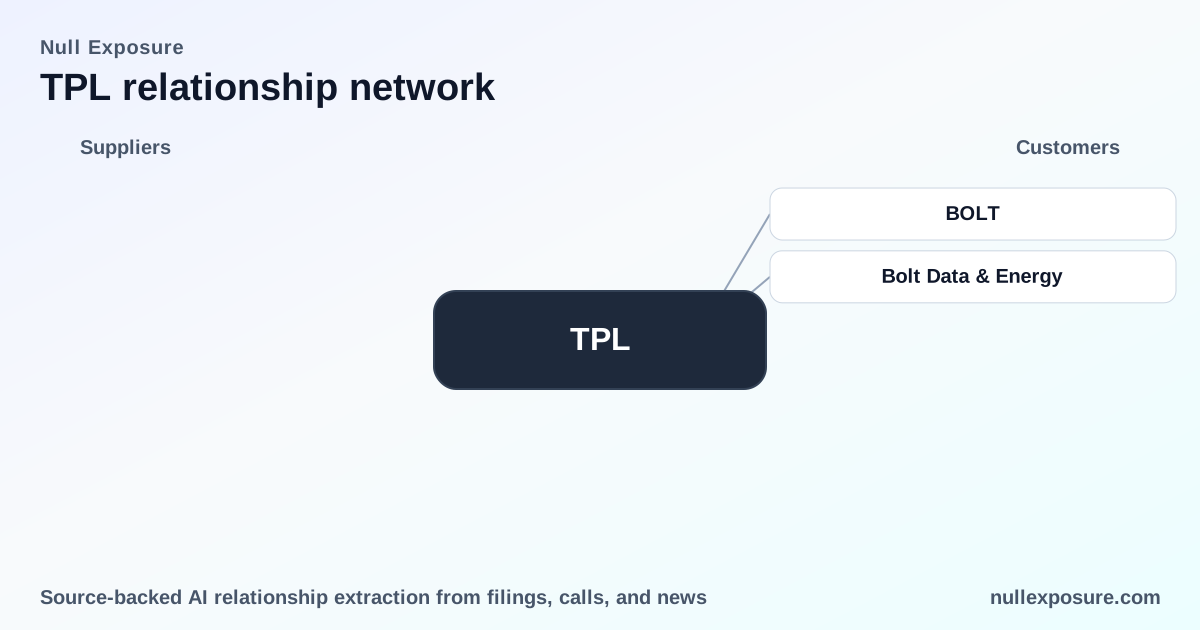
Bolt / Bolt Data & Energy — a strategic non‑operator partner for data centers and water
TPL has struck a deal with Bolt that gives TPL rights to acquire additional Bolt shares in exchange for providing land for future data centers, plus a right of first refusal to supply water and related power‑generation services for those facilities. This positions TPL as a land and water partner for an operator converting Permian land to large‑scale data and energy infrastructure. (Source: The Motley Fool, Mar 9, 2026; Insider Monkey mention via Finviz, Dec 18, 2025.)
ExxonMobil — a major producer paying royalties and fees on TPL acreage
TPL collects a percentage of production revenue from upstream operators such as ExxonMobil that drill on its land; these payments are royalty and lease related rather than operator profits. ExxonMobil is cited as a representative large counterparty that contributes to TPL’s significant operator revenue base. (Source: Finterra via FinancialContent, Apr 14, 2026.)
Chevron — another large upstream operator generating lease and royalty income
Chevron is explicitly named alongside ExxonMobil as an operator that pays TPL under lease and royalty arrangements, reinforcing the point that TPL’s customers include the largest integrated and independent oil companies operating in the Permian. Revenue from these customers is driven by commodity production on TPL acreage, not by TPL’s operational exposure. (Source: Finterra via FinancialContent, Apr 14, 2026.)
WBI / LandBridge reciprocal access — infrastructure access for water networks
WBI (and its partnership with LandBridge) documents a reciprocal crossing‑rights agreement with TPL covering roughly 64,000 acres to enable contiguous access for large‑scale water infrastructure development. WBI’s filings describe access agreements that are commercially significant for TPWR’s ability to build pipes, disposal and treatment infrastructure across checkerboarded land positions. This is a direct operational link tying TPL land rights to developed water services revenue streams. (Source: SEC filing referencing WBI and LandBridge, Aug 22, 2025; WBI Q3 2025 earnings call transcript, Mar 7, 2026.)
What the contract and relationship signals tell investors
The public excerpts collectively describe a company that contracts with large, long‑duration counterparties and markets high‑criticality services:
- Contracting posture: long‑term. Leases typically have a 10‑year nominal term and easements are framed as 30‑plus years with renewals, indicating multi‑decade optionality on land access and predictable fixed payments.
- Counterparty profile: large, enterprise operators. TPL reports that roughly 41% of 2024 revenue derived from three customers that are global energy leaders, signaling high counterparty quality but meaningful concentration.
- Geographic concentration: Permian Basin focus. TPL’s land and water operations are principally concentrated in the Permian—this local concentration amplifies both upside from basin activity and downside from basin‑specific shocks.
- Materiality: revenue concentration is meaningful. The three‑customer aggregate representing about 40.9% of revenue is a structural feature investors must price into valuation multiples and scenario analyses.
- Roles and revenue mechanics: seller, buyer and service provider. TPL acts as a land seller/lessor, a water and produced‑water service provider (via TPWR), and a counterparty for easements—creating multiple corridors of cashflow.
- Lifecycle and maturity: mix of active and prospect initiatives. Existing royalties, leases and water sales are active revenue streams, while desalination pilot programs and commercial discussions highlight an R&D → commercialization pipeline that is in early commercial stages.
These characteristics position TPL as a high‑quality asset owner with toll‑booth economics, but with concentration that requires active monitoring of a small set of counterparties.
For deeper mapping and sourcing of these customer relationships, see https://nullexposure.com/.
Investment implications and risk calibration
- Upside: High operating margins and predictable easement/lease revenues support elevated cash conversion and dividend capacity; large counterparty credit quality reduces counterparty risk relative to small producers.
- Concentration risk: With ~41% revenue tied to three customers, single‑counterparty shocks or changes in drilling intensity materially affect near‑term cash flow.
- Operational leverage to the Permian: TPL benefits from basin activity but is exposed to cyclicality in oil & gas volumes and basin water economics.
- Service expansion optionality: Water services and strategic non‑energy uses of land (e.g., data centers with Bolt) create diversification pathways that leverage existing land rights and long‑term easements.
Bottom line for investors and operators
Texas Pacific Land is a cashflow‑centric owner‑operator whose customer relationships are the core asset. Long leases and easements provide duration and predictability, while water and easement agreements with large oil companies and infrastructure partners create multiple monetization channels. The investment case rests on pricing this durable income against concentrated counterparty exposure and Permian concentration.
If you want a concise visual of these counterparties and the contract signals that drive TPL’s valuation, NullExposure has an integrated view at https://nullexposure.com/.