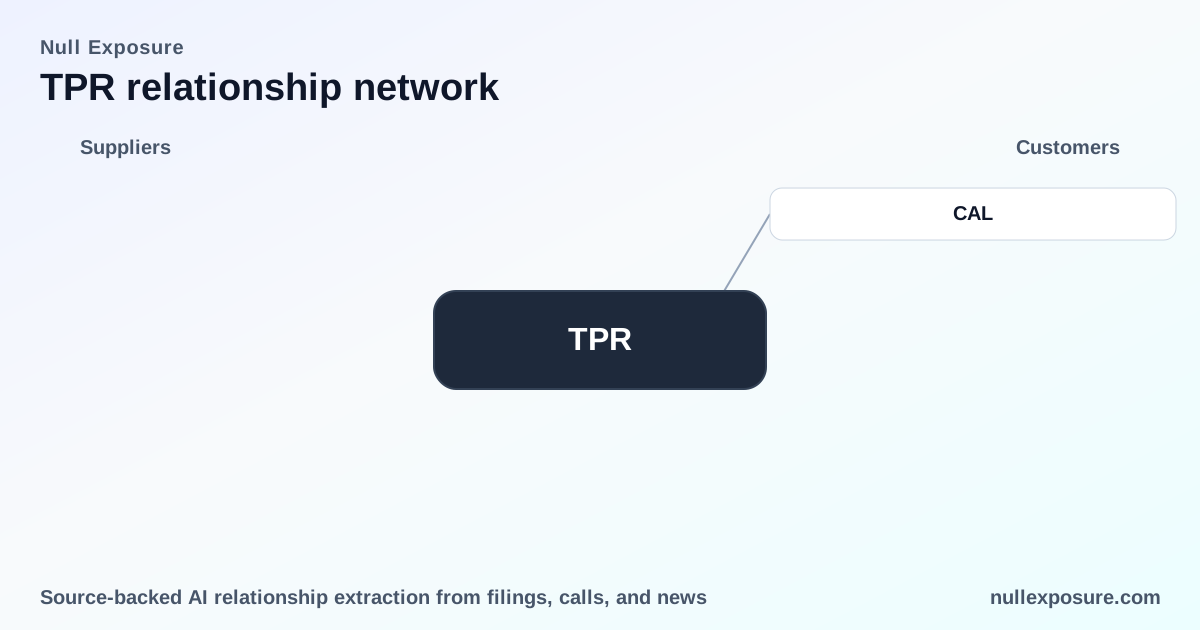
Tapestry’s customer map: revenue drivers, licensing posture, and four counterparties investors should track
Tapestry, Inc. runs a multi-brand luxury goods platform that monetizes through direct-to-consumer retail, wholesale relationships with large retailers, and trademark licensing. The company operates globally, recognizes licensing income over contract periods, and drives margin expansion from its core handbags and small leathergoods while layering in footwear, lifestyle and fragrance revenue streams. For investors evaluating customer and partner exposure, the relevant signals are a mix of long-term licensing arrangements, concentrated wholesale counterparty profiles, and strategic portfolio pruning that reshapes recurring revenue composition.
Explore this analysis and related relationship signals at NullExposure.
How Tapestry contracts and where the revenue really comes from
Tapestry’s operating model combines product sales and intellectual-property licensing, which produces two distinct cash-flow characteristics: point-in-time revenue from product transfers (DTC and wholesale) and over-time recognized licensing revenue tied to trademark access. The company explicitly recognizes licensing income over the life of agreements, which creates predictable but timing-dependent royalties that are less volatile than seasonal product sales. Tapestry’s wholesale book is populated by large enterprise retailers and national department stores, and roughly 40% of net sales are generated outside the U.S., giving the firm genuine global distribution scale and exposure to international retail trends.
These structural signals imply the following company-level characteristics:
- Contracting posture: A dual model — transactional sales contracts with wholesale partners and licensing contracts that produce recurring revenue over the contract term.
- Counterparty concentration: Wholesale counterparties are large enterprises (department stores, specialty chains, digital partners), increasing strategic dependence on a handful of distributors.
- Criticality: Licensing relationships for fragrances and accessories carry brand-extension economics that are high-margin and strategically important for brand presence.
- Maturity: Established long-term licensing relationships exist alongside active portfolio management (divestitures and brand sales) that reshape the mix of product, licensing, and retail revenue.
Counterparty map: four customers and partners to watch
Below are the customer/partner relationships surfaced in public reporting and market commentary. Each entry is a concise plain-English summary followed by a source reference.
Macy’s (M)
Macy’s expanded its assortment in 2025 to include fan‑favorite brands such as Coach, placing Tapestry products in a major department-store channel that drives wholesale volume and brand reach. According to The Sun (March 10, 2026), Macy’s added Coach alongside several other high-profile brands during 2025 merchandising changes.
Source: The Sun, news piece on Macy’s merchandising changes (March 10, 2026).
Caleres, Inc. (CAL)
Caleres completed the acquisition of the Stuart Weitzman brand from Tapestry in August 2025 for $108.7 million, and Caleres operates under a transition service agreement with Tapestry while integrating the business. Corporate press and industry reporting document both the sale and the short-term TSA that governs the handover and operational continuity.
Source: WWD reporting on the Caleres acquisition and transaction terms (March 2026); InsiderMonkey transcript noting the transition service agreement (Q3 2025 earnings call excerpt).
Inter Parfums (IPAR)
Inter Parfums extended its licensing relationship with the Coach fragrance business with a multi‑year renewal that runs through 2031, preserving high-margin fragrance royalties and long-term trademark monetization for the Coach brand. Inter Parfums’ earnings remarks confirm a five‑year extension signed in 2026.
Source: Inter Parfums Q4/FY2025 earnings commentary and public remarks (March–May 2026).
Movado Group (MOV)
Movado operates a watches-and-accessories business that includes licensed Coach timepieces, illustrating Tapestry’s strategy to capture accessory adjacencies through licensing rather than direct manufacture. Multiple filings and market commentaries list Coach among Movado’s licensed names contributing to product momentum in FY2025–FY2026.
Source: Movado FY2025/2026 public filings and industry commentary (TradingView/ad‑hoc news and index analysis, March–May 2026).
What these relationships mean for revenue, margins and risk
These counterparties are complementary: department-store placements (Macy’s) and licensed product partnerships (Movado, Inter Parfums) amplify brand reach without equivalent fixed-cost exposure, while the Stuart Weitzman divestiture to Caleres reduces direct product complexity and shifts a revenue stream out of Tapestry’s P&L. The net effect is a leaner brand portfolio with a stronger tilt toward licensing and core higher-margin leather goods.
Key investment implications:
- Revenue mix shift: Expect licensing to be a steadier, contractually governed revenue component; product sales will remain seasonal and tied to wholesale/DTC execution.
- Margin profile: Licensing and brand-extension royalties are higher margin and support operating leverage as the company scales its core handbags and accessories.
- Counterparty exposure: High reliance on a small set of large retailers and licensees concentrates commercial risk; distribution decisions by partners like Macy’s can materially affect wholesale volumes.
- Portfolio simplification: The Stuart Weitzman sale reduces Tapestry’s brand count but improves focus on core product segments, changing future revenue volatility and capital allocation priorities.
Investors tracking Tapestry should monitor licensing renewals, wholesale placement decisions at major retailers, and the cadence of DTC comp growth to anticipate top-line shifts and margin expansion.
For full access to relationship signals and curated coverage, visit NullExposure.
Practical signals to watch in near-term filings and market commentary
- Licensing cadence and renewal timelines (Inter Parfums’ extension through 2031 is a model case).
- Wholesale placement announcements and merchandising changes at large department stores such as Macy’s.
- Earnings call detail on transition service arrangements and post-divestiture integration with acquirers (Caleres for Stuart Weitzman).
- New licensees or product adjacencies that convert owned-brand equity into recurring royalty streams (examples include watch and fragrance license partners).
Bottom line for investors
Tapestry’s commercial model is strategically shifting toward licensing and a concentrated set of large wholesale partners, delivering a cleaner margin profile and more predictable licensing revenue streams while concentrating counterparty risk into a smaller group of enterprise buyers. Monitoring the four relationships covered—Macy’s, Caleres, Inter Parfums, and Movado—provides immediate insight into distribution health, licensing durability, and the success of the company’s portfolio simplification.