Tootsie Roll’s customer map: concentration, channels and what investors should price in
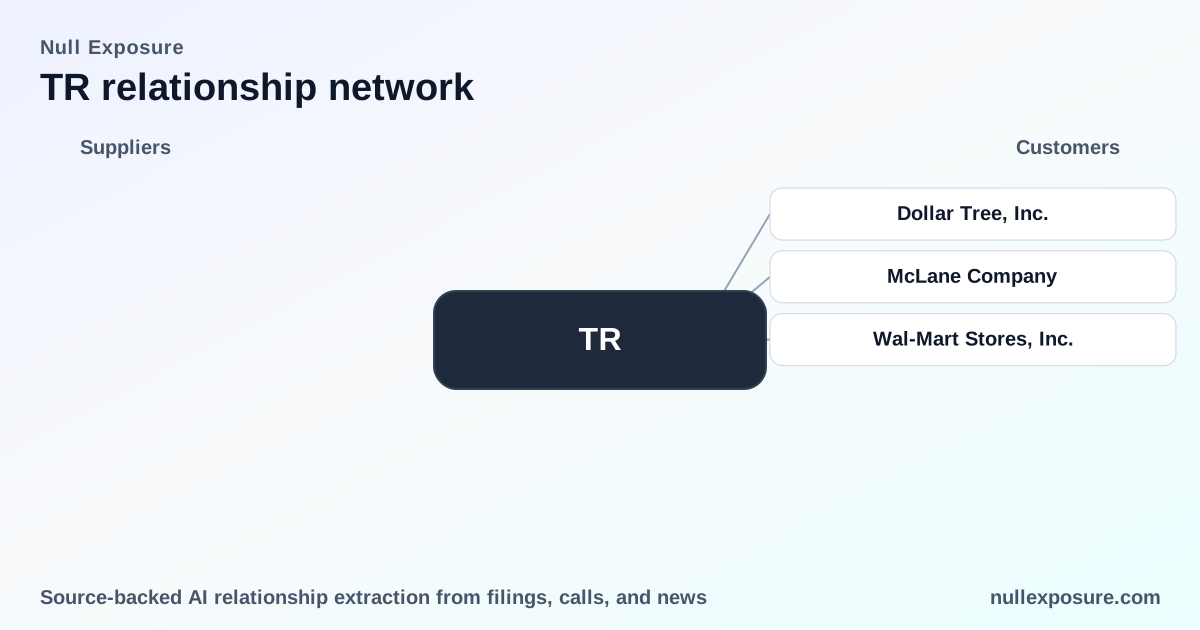
Tootsie Roll Industries manufactures and sells confectionery products and monetizes primarily through direct product sales to large retail chains, wholesalers and brokers across the United States, Canada and Mexico, with a trivial secondary royalty stream from licensing. The business model is a single‑segment manufacturing and distribution operation that drives cash flow from enduring shelf brands sold into a concentrated set of national retailers; Wal‑Mart and Dollar Tree together represent a material share of product revenue, and distribution partners such as McLane act as operational intermediaries. For a deeper read on customer exposure and commercial posture, visit https://nullexposure.com/.
Why customers matter to valuation right now
Tootsie Roll is not a diversified commercial services provider; it is a manufacturer whose revenue is realized at retail through a small number of large buyers. Concentration is a primary valuation lever: FY2024 net product sales attributed to Wal‑Mart were approximately 23.2% and to Dollar Tree roughly 12.6%, leaving the top three customers responsible for a material chunk of receivables and sales. That structure compresses downside in the event of retail channel disruption and amplifies the operational importance of distribution partners and retail merchandising decisions.
According to the company’s FY2024 Form 10‑K, the three largest customers accounted for about 41.9% of total accounts receivable at year‑end 2024, signalling meaningful counterparty credit and negotiation risk if any relationship deteriorates.
How each major buyer actually fits in (what the filings say)
Wal‑Mart Stores, Inc.
Wal‑Mart accounted for approximately 23.2% of net product sales in FY2024 (22.2% in 2023, 23.0% in 2022), making it the largest single retail customer and a dominant demand anchor for core confectionery SKUs, per the company’s FY2024 Form 10‑K.
Source: Tootsie Roll Industries, Form 10‑K for the year ended December 31, 2024.
Dollar Tree, Inc. (including Family Dollar)
Sales to Dollar Tree (including Family Dollar) aggregated to roughly 12.6% of net product sales in FY2024, representing the company’s footprint in the value/dollar channel where price elasticity and private label competition influence margin pressure, as disclosed in the FY2024 10‑K.
Source: Tootsie Roll Industries, Form 10‑K for the year ended December 31, 2024.
McLane Company
McLane is identified as a national grocery wholesaler that purchases Tootsie Roll product and services/delivers inventory to Wal‑Mart, Dollar Tree and other retailers, functioning as a logistics and order‑fulfillment intermediary rather than a final retail point of sale, according to the FY2024 filing.
Source: Tootsie Roll Industries, Form 10‑K for the year ended December 31, 2024.
Contracting posture and channels — the practical mechanics investors should price
Tootsie Roll’s commercial posture is seller‑first with a wholesale distribution overlay. The company sells either directly to retailers or through food and grocery brokers and relies on wholesalers like McLane to reach large chains. Licensing exists but is insignificant—royalty income is recognized from sales‑based licensing and is stated to be less than 0.1% of consolidated net sales, so third‑party licensing is not a material driver of cash flow.
Company-level signals to note:
- Single industry, single segment: manufacturing and sale of confectionery is the only line of business; this increases operational transparency but reduces optionality.
- Geographic concentration in North America: principal markets and manufacturing are in the U.S., Canada and Mexico, concentrating macro and retail cycle exposure in those regions.
- Counterparty breadth includes government and non‑profit channels: customers listed include the U.S. military and fund‑raising charitable organizations, which diversifies outlet types but does not materially change concentration risk with major retail chains.
Source for contracting and channel details: Tootsie Roll Industries, Form 10‑K (FY2024).
(If you want a concise, exportable summary of these customer exposures, see https://nullexposure.com/.)
Portfolio implications: where upside and risks live
- Revenue stability with concentrated counterparty risk. Brand durability and low product substitution support steady sales, but reliance on a handful of large buyers increases bargaining leverage for those customers and leaves Tootsie Roll exposed to merchandising and assortment decisions.
- Operational coupling to wholesalers. McLane’s role as a distributor is an efficiency enabler; disruptions or contract reassignments at the wholesale level can alter route‑to‑market economics and working capital timing.
- Licensing is negligible. The company acts as a licensor only to a tiny degree, so licensing upside is not a valuation lever.
- Receivables and credit concentration are material. The FY2024 filing states the three largest customers accounted for ~41.9% of accounts receivable at year‑end 2024, underlining counterparty credit and collections risk.
Strategic and financial maturity signals investors should weigh
Tootsie Roll is a mature, single‑segment manufacturer with over a century of operations, which confers brand equity and operating discipline. Maturity reduces execution risk but also means secular growth must come from share gains, product innovation or pricing power rather than new business lines. Pricing strategy and trade promotion with Wal‑Mart and Dollar Tree are core profit drivers; investor returns will track the company’s ability to defend shelf space and manage trade spend while maintaining margins.
Bottom line: pricing concentration into your model
For investors and operators evaluating TR customer relationships, the principal headline is concentration—Wal‑Mart and Dollar Tree together are material to sales, McLane serves as a distribution fulcrum, and licensing is immaterial. Model scenarios should treat a mid‑single‑digit change in buying behavior from Wal‑Mart or Dollar Tree as a high‑impact event, and stress testing of working capital and margin under adverse merchandising outcomes is essential.
Bold takeaways:
- Wal‑Mart is the single largest demand anchor (≈23.2% of product sales, FY2024).
- Dollar Tree contributes ~12.6% of product sales (FY2024).
- McLane functions as a national wholesaler and delivery intermediary to those retailers.
- Licensing revenue is negligible (<0.1% of sales).
- Top three customers comprised ~41.9% of accounts receivable at 12/31/2024.
For a focused, investor‑grade breakdown of how these customer concentrations translate into earnings risk and working capital exposure, visit https://nullexposure.com/ for the company dossier and scenario templates.