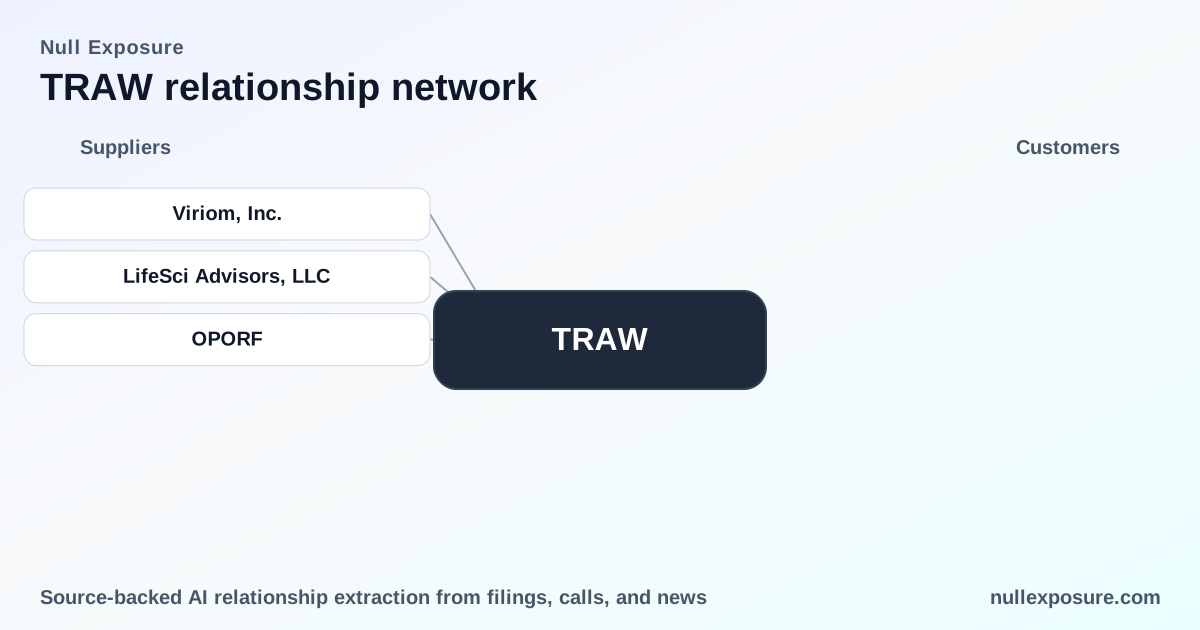
Traws Pharma (TRAW): how customer and financing relationships shape an early-stage biotech investment
Traws Pharma is a clinical-stage biopharmaceutical company that discovers and develops oncology and antiviral candidates and monetizes primarily through licensing agreements, supply obligations and occasional milestone/deferred revenue recognition, while funding operations with periodic private financings. The company’s operating footprint is small—TTM revenue is about $2.79 million against negative EBITDA—but its strategic value to investors is concentrated in partnered commercialization arrangements and near-term program financing that determine cash runway and revenue volatility. For an active investor, the immediate questions are capital sufficiency, counterpart concentration, and the enforceability of commercial supply and licensing terms that can generate or swing revenue recognition. If you want a concise record of the upstream relationship signals, see more at https://nullexposure.com/.
Quick guide to the disclosed relationships that matter now
Below I cover every relationship surfaced in public reporting and filings that materially affects Traws’ near-term prospects. Each entry includes a plain-English summary and the original source context.
Sirenia Capital Management LP — financing lead for a private placement
Traws announced a private placement financing led by Sirenia Capital Management LP to advance its influenza program, notably supporting a planned human challenge trial for tivoxavir marboxil in the United Kingdom; the financing was described as “up to $60 million” in the company release. This is a direct funding relationship that reduces immediate dilution risk from other sources and ties capital availability to the progress of the influenza program. According to the company’s GlobeNewswire press release dated April 15, 2026, the private placement was structured to advance that program directly.
Source: GlobeNewswire press release, April 15, 2026 — “Traws Pharma announces up to $60 million private placement financing.”
Symbio — termination triggered deferred revenue recognition that boosted 2025 revenue
Traws disclosed that termination of a license agreement with Symbio led to the recognition of previously deferred revenue, producing a year-over-year increase in reported 2025 revenue. That recognition is a one-off accounting event tied to contractual termination rather than organic product sales, which highlights the lumpy and partner-dependent nature of Traws’ revenue. The detail comes from the company’s full-year 2025 results press release.
Source: GlobeNewswire press release, April 15, 2026 — “Traws Pharma Reports Full Year 2025 Results and Provides Business Highlights.”
Contractual backbone: the Knight License Agreement and what it signals about Traws’ operating posture
Traws historically entered an exclusive Distribution, License and Supply Agreement with Knight Therapeutics Inc. (the “Knight License Agreement”). Under that agreement, Traws granted Knight an exclusive, royalty-bearing license to commercialize specified products in Canada (with a conditional option for Israel), and Traws agreed to supply all of Knight’s requirements for the licensed products. That structure establishes Traws as both licensor and committed supplier — a contracting posture that produces recurring obligations and geographic concentration risk tied to the Knight Territory.
Source: Company disclosures describing the Knight License Agreement (agreement executed November 2019 and referenced in Traws’ public filings).
What these relationships collectively say about Traws’ operating model
- Contracting posture: license-first, supply-bound. Traws operates primarily through licensing agreements that transfer commercialization rights while retaining manufacturing/supply obligations. Exclusive, royalty-bearing licenses with sublicense rights (as in the Knight agreement) create long-term revenue upside but also lock Traws into supply commitments that can pressure working capital and production planning.
- Concentration and criticality: a small number of counterparties drive disproportionate revenue and cash outcomes. The Symbio termination accounting event demonstrates revenue lumpiness tied to contract status, while Knight-style exclusive licenses concentrate geographic exposure. The Sirenia financing shows reliance on targeted capital raises to de-risk clinical workstreams.
- Maturity profile: clinical-stage with limited commercial revenue and negative operating cash flow. Traws’ TTM revenue of roughly $2.79 million and negative EBITDA (about -$17.8 million) confirm the company is pre-commercial in scale and dependent on partner events and financings to fund operations.
- Funding dependence: private placements and institutional partners determine program execution. The Sirenia-led placement is an example of how external capital sponsors can directly enable trial execution and de-risk specific programs without immediate dilution through other means.
Investment implications — upside drivers and principal risks
Traws’ value is binary and partnership-driven: either partnered programs (like tivoxavir marboxil) succeed in near-term clinical readouts and create licensing/milestone upside, or the company will continue to rely on financings that dilute shareholders or increase leverage.
Key takeaways for investors:
- Upside: successful human challenge trial or attractive re-licensing/sale of programs could generate material milestones or reclassify deferred revenue into recurring streams. The Sirenia financing directly funds a program that can validate a clinical hypothesis and unlock value.
- Risk: revenue is lumpy and contract-dependent (e.g., Symbio termination caused a one-time revenue bump). Supply obligations under exclusive licenses (e.g., Knight) create operational exposure and potential working capital strain. Continued negative EBITDA requires either successful fundraising or partner payments.
- Counterparty concentration: a small number of commercial partners and financings disproportionately affect cash runway and reported revenue volatility.
If you track Traws as an investor, monitor three items closely: progress and outcomes of the tivoxavir marboxil human challenge trial, cash runway and structure of any subsequent financings, and the status of existing license/supply agreements (especially those that govern revenue recognition events).
For a deeper signal feed and relationship-level tracking, visit https://nullexposure.com/.
Bottom line
Traws is a small, clinical-stage company whose financial trajectory is governed by partner contracts and episodic financings. The Sirenia-led private placement funds a strategically important trial and demonstrates how external capital intermediaries can directly accelerate development; the Symbio termination underscores the volatile nature of revenue recognition for a company that monetizes largely through licensing events. Historically negotiated distribution and supply agreements—most notably with Knight—illustrate the company’s commitment to out-license commercialization while retaining supply obligations, a structure that amplifies both upside and operational risk. Investors must treat Traws as a partnership-driven, capital-sensitive play: clinical milestones and partner contract mechanics will determine value more than near-term organic sales.