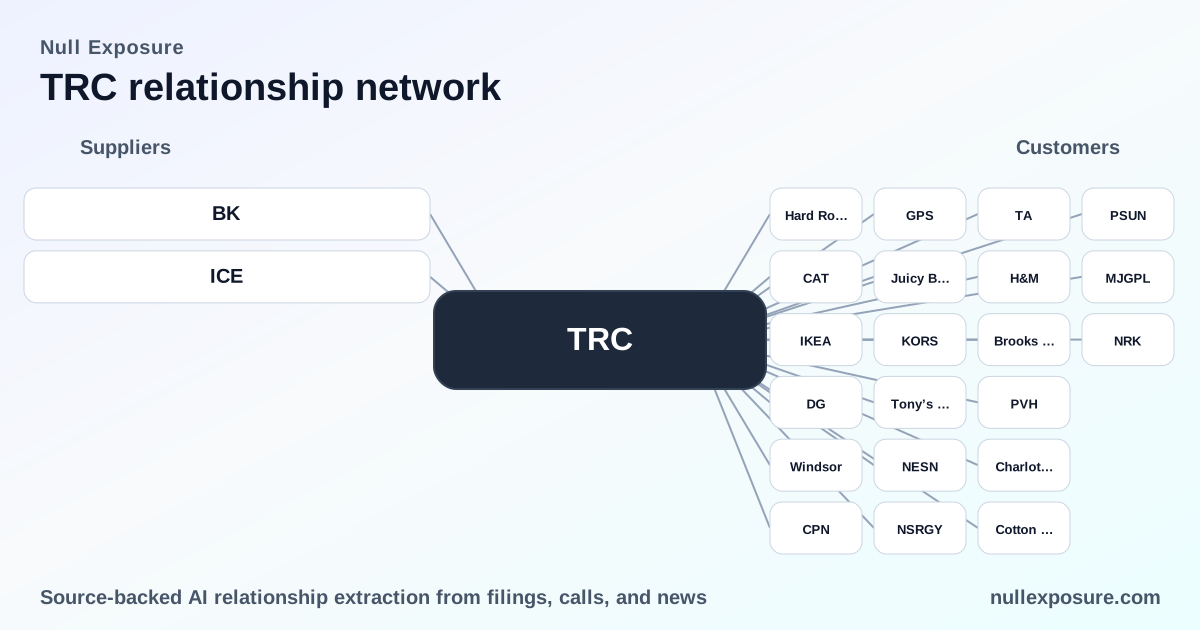
Tejon Ranch (TRC): Customer Map and Commercial Implications for Investors
Tejon Ranch is a dual-purpose operator — a large-scale agribusiness and a land-focused real estate developer that monetizes through land sales, long-term leases, joint-venture development and operating profit centers (notably retail outlets and travel plaza JVs). Revenue drivers are a mix of one-time land monetizations and recurring cash flow from leased industrial, retail and hospitality assets, amplified by strategic joint ventures that shift development risk while preserving upside. For a focused view on TRC’s customer relationships and commercial exposures, see https://nullexposure.com/.
Why customer relationships matter for TRC investors
TRC’s valuation and cash-flow profile are directly tied to who occupies its land and how those tenants scale operations on TRC-controlled property. Large distribution tenants and JV partners transform the long-duration land asset into predictable rent and sale events; conversely, concentration in logistics and outlet retail creates sector-specific exposure. Below I catalog every customer relationship found in TRC’s public commentary and press coverage, with plain-English takeaways and source notes for investor diligence.
Customer relationships: line-by-line evidence and takeaways
-
Hard Rock Tejon Casino — Management flagged the opening of a new $600 million Hard Rock Tejon Casino as a near-term transformational event for TRCC, highlighting development-scale monetization at the property. (2025 Q3 earnings call transcript, reported Mar 7, 2026.)
-
Caterpillar (CAT) — Zacks coverage noted Caterpillar operates a distribution facility at TRCC, confirming TRC’s role as a logistics landlord for major industrial customers. (Zacks analysis, FY2021.)
-
IKEA — Zacks reported IKEA among the distribution tenants leasing space in TRCC’s industrial portfolio, underscoring TRC’s appeal to large west‑coast distributors. (Zacks, FY2021.)
-
Dollar General — Zacks also listed Dollar General as a distribution tenant at TRCC, reflecting demand from national retail chains for regional fulfillment space. (Zacks, FY2021.)
-
Caterpillar Inc. (duplicate entry) — The company is repeatedly identified in TRC coverage as a long‑term distribution tenant, reinforcing Caterpillar’s status as a meaningful logistics occupant. (Zacks, FY2021.)
-
IKEA (KVPR 2013) — Local reporting in 2013 described TRCC as home to “giant warehouse distribution centers” for IKEA, reinforcing that these industrial relationships are longstanding. (KVPR community report, Nov 2013.)
-
Windsor — Apparel News reported Windsor opened an outlet store at Tejon’s new outlet center, illustrating TRC’s retail tenant mix at the Outlets at Tejon. (Apparel News, July 2014.)
-
Nestlé — In TRC’s 2025/2026 results, management disclosed two TRCC land transactions in 2025, including back‑end revenue tied to the Nestlé land sale — indicating a completed sale structure with deferred payments. (GlobeNewswire press release, Q4 2025 results, Mar 19, 2026.)
-
Nestlé USA — GlobeNewswire and TRC’s mid‑2025 releases document construction and completion of a >700,000‑sq‑ft Nestlé USA distribution facility at TRCC, signaling delivery of a major industrial asset. (GlobeNewswire, Q2 & Q3 2025 results.)
-
Nestl (InsiderMonkey coverage) — Commentary on the Q4 2025 call referenced a back‑end payment from the Nestlé transaction, confirming revenue recognition mechanics tied to that sale. (InsiderMonkey summarizing Q4 2025 earnings call commentary.)
-
Caterpillar (KVPR 2013) — Local coverage from 2013 again identifies Caterpillar among TRCC’s distribution tenants, adding historical depth to that relationship. (KVPR, Nov 2013.)
-
Caterpillar (duplicate KVPR entry) — Reinforces prior local reporting that TRCC has long hosted Caterpillar distribution operations. (KVPR, Nov 2013.)
-
Calpine — SCV News reported in 2013 that TRC received increased rent from energy company Calpine, demonstrating TRC’s exposure to energy sector lease income and commodity‑linked rent adjustments. (SCV News, 2013.)
-
Juicy Burger — Apparel News noted Juicy Burger as a restaurant tenant at the Outlets at Tejon, illustrating the F&B tenant mix supporting outlet center traffic. (Apparel News, July 2014.)
-
Michael Kors — Apparel News listed Michael Kors among the ~70 retailers opening at the Outlets at Tejon, confirming presence of national retail brands in TRC’s retail inventory. (Apparel News, July 2014.)
-
Tony’s Pizza — Apparel News cited Tony’s Pizza as a tenant, again underscoring food service leasing within TRC’s retail footprint. (Apparel News, July 2014.)
-
NESN (Nestlé symbol entry, Q2 2025) — TRC’s Q2 2025 release explicitly called out Nestlé USA nearing completion on the >700,000‑sq‑ft distribution facility, reiterating the size and strategic nature of that tenant. (GlobeNewswire, Aug 7, 2025.)
-
Nestlé USA (duplicate Q2 2025 entry) — Repeats the Q2 2025 status that Nestlé’s project was nearing completion, confirming development cadence. (GlobeNewswire, Aug 2025.)
-
Nestlé USA (Q3 2025 completion) — In Q3 2025 reporting TRC confirmed Nestlé completed construction in July 2025, converting development activity into in‑service inventory. (GlobeNewswire, Q3 2025 results.)
-
NSRGY (symbol duplicate for Nestlé, Q3 2025) — Financial reporting used the Nestlé ADR symbol to reference the completed distribution facility, reinforcing the same transactional fact. (GlobeNewswire, Q3 2025.)
-
TA/Petro — Management described the TA/Petro joint venture as TRC’s highest‑performing profit center, signaling that travel plaza operations are a material recurring earnings driver. (2025 Q3 earnings call transcript, Mar 7, 2026.)
-
TA (duplicate TA/Petro entry) — The TA partner is called out directly in the earnings call as the co‑operator in the high‑performing travel plaza JV. (2025 Q3 earnings call, Mar 7, 2026.)
-
CPN (Calpine symbol entry) — Historical reporting records rent increases from Calpine, showing TRC’s exposure to energy tenants and the sensitivity of rent to power price movements. (SCV News, 2013.)
-
Gap — Apparel News confirmed Gap as one of the national retailers at the Outlets at Tejon, supporting the center’s tenant quality for mall‑style outlet demand. (Apparel News, July 2014.)
-
GPS (duplicate Gap symbol) — The coverage used Gap’s ticker to denote its presence in the outlet mix, reinforcing brand-level exposure. (Apparel News, July 2014.)
-
Brooks Brothers — Brooks Brothers was listed among outlet tenants, representing higher‑end apparel presence in TRC’s retail portfolio. (Apparel News, July 2014.)
-
Calvin Klein (PVH) — The report named Calvin Klein (PVH) among the outlet center’s anchors, indicating national branded retail leases. (Apparel News, July 2014.)
-
Charlotte Russe — Apparel News listed Charlotte Russe among the opening retailers, highlighting fast‑fashion representation in the outlet tenant roster. (Apparel News, July 2014.)
-
Cotton On — Cotton On was another named tenant, adding international fast‑fashion exposure to the outlet center. (Apparel News, July 2014.)
-
H&M — H&M’s presence was recorded among the stores at the Outlets at Tejon, pointing to continued demand from large retail chains for outlet locations. (Apparel News, July 2014.)
-
Pacific Sunwear (PSUN) — Pacific Sunwear was cited as an outlet tenant, complementing the apparel category concentration in TRC’s retail assets. (Apparel News, July 2014.)
-
MJGPL (Majestic Realty JV) — TRC management emphasized five industrial joint ventures with Majestic Realty that contribute stable cash flow, making Majestic a cornerstone industrial JV partner. (2025 Q3 earnings call, Mar 7, 2026.)
-
Majestic Realty (duplicate MJGPL entry) — The company named Majestic Realty explicitly as a repeat JV partner across multiple industrial projects, highlighting strategic partner concentration. (2025 Q3 earnings call, Mar 7, 2026.)
-
NRK (Rockefeller JV) — Management confirmed the Outlets at Tejon operate as a 50/50 JV with Rockefeller, exemplifying TRC’s use of equal‑share retail partnerships to de‑risk development. (2025 Q3 earnings call, Mar 7, 2026.)
-
Rockefeller (duplicate NRK entry) — Rockefeller was named directly, corroborating the 50/50 JV structure for the outlet center and illustrating TRC’s preferred partnership execution in retail. (2025 Q3 earnings call, Mar 7, 2026.)
For a comprehensive interface to these customer touchpoints and additional context, visit https://nullexposure.com/.
How TRC’s operating model and constraints shape investor risk/reward
Two company‑level signals from TRC’s public remarks frame how investors should think about customer risk:
-
Active leasing and occupancy posture. TRC reports its industrial portfolio was 100% leased and commercial was 96% leased as of Dec 31, 2024, indicating an active, income‑producing portfolio rather than speculative land inventory — a positive for near‑term cash flow stability (company reporting).
-
Distribution‑centric segment positioning. TRC situates TRCC on both sides of Interstate 5, giving tenants immediate access to the West Coast north‑south goods corridor, which explains the concentration of large distribution tenants and makes TRC a strategic logistics landlord (company description).
From a governance and commercial lens this implies:
- Contracting posture: TRC favors long‑term leases and JV structures that convert land development into recurring cash flow while sharing construction risk with large institutional partners.
- Concentration: High exposure to distribution and outlet retail creates sector concentration risk, offset by strong occupancy metrics and marquee tenants (Nestlé, IKEA, Caterpillar).
- Criticality: Facilities serving national supply chains are economically critical to tenants, supporting lease durability and value capture on land sales.
- Maturity: The portfolio combines mature retail (Outlets at Tejon) and newly completed large-scale industrial projects, creating a blend of stabilized income and episodic sale events.
Investment implications — concise takeaways
- Positive: TRC has converted land into high-quality, leased industrial inventory (Nestlé, IKEA, Caterpillar) and lucrative JVs (TA/Petro, Majestic, Rockefeller) that stabilize cash flow.
- Risk: Sector concentration in logistics and outlet retail creates exposure to retail cycles and distribution demand shifts, though occupancy statistics indicate current resilience.
- Actionable: Monitor JV profit contribution and back‑end sale payments (Nestlé back‑end recognition) as drivers of episodic earnings and cash flow.
For institutional access to structured customer intelligence and to track updates to these relationships, you can explore additional analysis at https://nullexposure.com/.