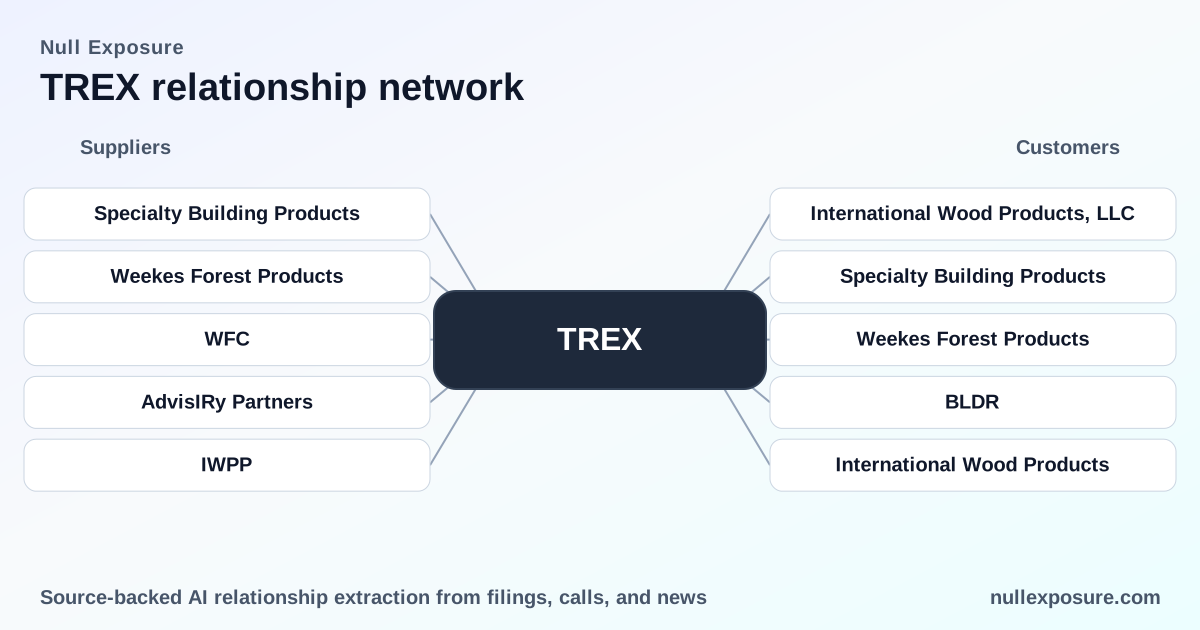
Trex (TREX) — customer map, distribution strategy, and the concentration risk investors must price
Trex manufactures and distributes wood‑plastic composite decking, railing and outdoor living products and monetizes primarily through wholesale distribution and national retail channels. The company sells finished product to wholesale distributors and two national retailers under short‑term purchase orders, then collects margin on manufacturing and branded product sales; geographic expansion is driven by adding regional distributor partners and retailer stocking programs. For a concise business‑risk scan of Trex customer relationships, see https://nullexposure.com/.
Key takeaways up front
- Revenue is channel‑driven: Trex sells to distributors and national retailers rather than through long‑term supply contracts.
- Customer concentration is critical: three customers accounted for ~81% of sales in 2024, making counterparty exposure a dominant risk.
- Growth lever is distribution expansion: recent FY2026 actions expanded coverage in the West, upper Midwest and Michigan via named distributors and SBP’s Amerhart centers.
How the customer map explains Trex’s operating posture
Trex runs a distributor‑centric go‑to‑market model: the firm manufactures a branded, durable core product and relies on regional distributors plus two large national retailers to reach end consumers. The company’s contract posture is short‑term — primarily individual purchase orders of less than one year — which delivers pricing and fulfillment flexibility but concentrates revenue on a small number of large counterparties. That structure explains both Trex’s ability to reallocate inventory quickly across channels and its sensitivity to disruptions at a handful of distributors or the two big retailers.
For ongoing monitoring of Trex’s customer exposures and distribution expansions, visit https://nullexposure.com/.
Customer relationships and recent developments (each source summarized)
International Wood Products, LLC — tradingview (SEC 10‑K summary, FY2026)
Trex expanded its distribution footprint in the Western U.S. through additional work with International Wood Products, strengthening coverage in the Pacific Northwest and California. According to a TradingView summary of Trex’s SEC filing (FY2026), this was part of a targeted geographic expansion strategy.
Weekes Forest Products — tradingview (SEC 10‑K summary, FY2026)
Trex increased its Midwest distribution through Weekes Forest Products to strengthen presence in the Intermountain West and surrounding markets. The TradingView report cites the FY2026 filing noting this expansion as a channel footprint increase.
Specialty Building Products — tradingview (SEC 10‑K summary, FY2026)
TradingView’s write‑up of Trex’s FY2026 updates records an expanded distribution footprint with Specialty Building Products, reflecting broader state‑level penetration efforts. The item highlights enhanced reach into Michigan and other regional markets.
Specialty Building Products — Investing.com (analyst note, FY2026)
An analyst note on Investing.com described Trex’s decision to expand distribution via Specialty Building Products’ Amerhart centers in Michigan as a strategic move to deepen statewide coverage, reinforcing a long‑standing partnership. The Investing.com piece frames the expansion as execution on channel strategy (published May 2026).
BLDR — Trex 10‑K (FY2024)
Trex’s FY2024 10‑K records a recognition from Builders FirstSource: Trex awarded Morris Tolly National Supplier of the Year and Supplier of the Year for the Northeast Region, signaling strong commercial ties and programmatic recognition from a major building‑products buyer. The 10‑K (filed for year ended Dec 31, 2024) lists this supplier award explicitly.
Builders FirstSource — Trex 10‑K (FY2024)
The company disclosure reiterates Builders FirstSource’s role as a strategic customer and partner for distribution and project channels, as reflected by supplier awards in the FY2024 10‑K. That filing frames Builders FirstSource as a meaningful commercial counterparty in the distribution ecosystem.
Specialty Building Products — InsiderMonkey (earnings commentary, FY2026)
Trex’s management highlighted in its Q4 2025 earnings call transcript (reported by InsiderMonkey) that the company expanded its relationship with Specialty Building Products in November, building on a long‑standing collaboration. The management comment underscores SBP as an executed growth channel in FY2026.
Weekes Forest Products — InsiderMonkey (earnings commentary, FY2026)
Management also noted expanding Weekes Forest Products coverage in the upper Midwest—Minnesota, Wisconsin, Iowa and North Dakota—during the FY2026 commentary, which confirms the TradingView summary and demonstrates coordinated regional execution. InsiderMonkey captured these remarks from the earnings transcript.
International Wood Products — InsiderMonkey (earnings commentary, FY2026)
Trex cited a midyear expansion with International Wood Products that builds on prior success in the Pacific Northwest and California, per the Q4 2025 call transcript reported by InsiderMonkey. That comment aligns with the FY2026 expansion narrative.
SBP’s Amerhart centers — Investing.com (analyst note, FY2025)
Earlier coverage (Investing.com, FY2025) emphasized that SBP’s Amerhart centers represent an avenue to enhance Trex distribution across Michigan, strengthening a long‑standing relationship and improving retail/regional availability. The analyst note frames Amerhart program expansion as tactical distribution strengthening.
LOW (Lowe’s) — Lowe’s earnings call transcript (2025 Q2)
Trex products (including the Trex brand alongside TimberTech and Deckorators) are carried by Lowe’s, one of the two national retailers that purchase directly from Trex for store stocking, according to a Lowe’s earnings call transcript excerpt. That channel role positions Lowe’s as a direct purchasing customer in Trex’s reported go‑to‑market model (2025 Q2 earnings transcript).
Company‑level constraints and what they mean for investors
- Short‑term contract posture. Trex executes primarily via individual customer purchase orders of less than one year, which gives the company pricing flexibility but reduces visibility into forward demand. This is a company‑level signal derived from the firm’s revenue recognition disclosures.
- Large‑enterprise counterparties. The firm sells through distributors and two national retailers; this implies a customer mix skewed toward large enterprises with the bargaining power and inventory economics that accompany national retail programs.
- Critical concentration. The company disclosed that three customers represented roughly 81% of total net sales in 2024, making customer concentration the single largest operational risk; disruptions at any of these major buyers would have outsized impact on revenue and working capital.
- Roles across the channel. Trex serves as both seller/manufacturer and supplier to distributors and resellers; it also supplies national buyers (Home Depot and Lowe’s) that stock product directly, which concentrates commercial negotiations and promotional commitments with those retailers.
- Distribution is the business. The principal segment logic is distribution of a core product (composite decking and railing) through wholesale and retail channels, so expanding distribution points is the primary growth lever.
Investment implications and risk checklist
- Positive: scalable branded manufacturing + distributor coverage. Trex’s model benefits from branded product strength and the ability to add regional distributor partners to drive incremental revenue.
- Negative: extreme customer concentration. With three customers ~81% of sales (2024), investors must price the risk of lost shelf space, promotional margin pressure or retailer inventory destocking.
- Operational sensitivity: short‑term purchase orders. Near‑term revenue is volatile to housing/remodel cycles and distributor inventory strategies.
- Execution catalyst: regional distributor roll‑outs. The FY2026 moves with International Wood Products, Weekes, and SBP (Amerhart) are direct levers to restore or expand market share in targeted geographies.
For a practical customer‑risk dashboard and to track new distributor and retailer developments, visit https://nullexposure.com/.
Bottom line: Trex’s economics rest on a repeatable manufacturing margin for a differentiated product, but investors must underwrite concentrated customer exposure and short‑term purchase order dynamics when modeling revenue and downside scenarios. The company’s recent regional distributor additions are constructive execution, but they do not eliminate the underlying counterparty concentration that defines Trex’s risk/return profile.