Thomson Reuters (TRI): Customer relationships driving AI adoption and recurring revenue
Thomson Reuters monetizes a global mix of subscription software, licensed content and managed services across legal, tax, compliance and financial markets. The company converts proprietary content into high-margin, recurring revenue through enterprise contracts, strategic alliances and embedded platform partnerships, and is accelerating monetization via AI-enabled products that extend both reach and pricing power.
Learn more about our coverage at https://nullexposure.com/
What investors need to know about TRI's customer posture
Thomson Reuters operates as a mission-critical vendor for regulated and knowledge-intensive workflows. Contracting posture is enterprise-grade: customers include global institutions, law firms and professional services firms that sign multi-year agreements and integrate Thomson Reuters products into core operating processes. That structure produces high revenue visibility and pricing leverage, as evidenced by explicit contractual price changes tied to large partners. The customer base is diverse in scale but concentrated in strategic relationships — a mixture of very large platforms and many smaller law- and accounting-firm customers — which reduces churn risk while preserving outsized exposure to a handful of enterprise counterparties.
No formal third-party constraints were disclosed in the available relationship data, which itself is a company-level signal of operational maturity and limited external encumbrances in the sampled period.
How partnerships and client wins are translating into product-led growth
AI and data licensing are the operational accelerants investors should track. Thomson Reuters is translating content strength into AI validation and cross-sell opportunities, notably via CoCounsel Legal and ONESOURCE integrations that embed into customer workflows and channel partners.
Customer relationships observed (FY2026 evidence)
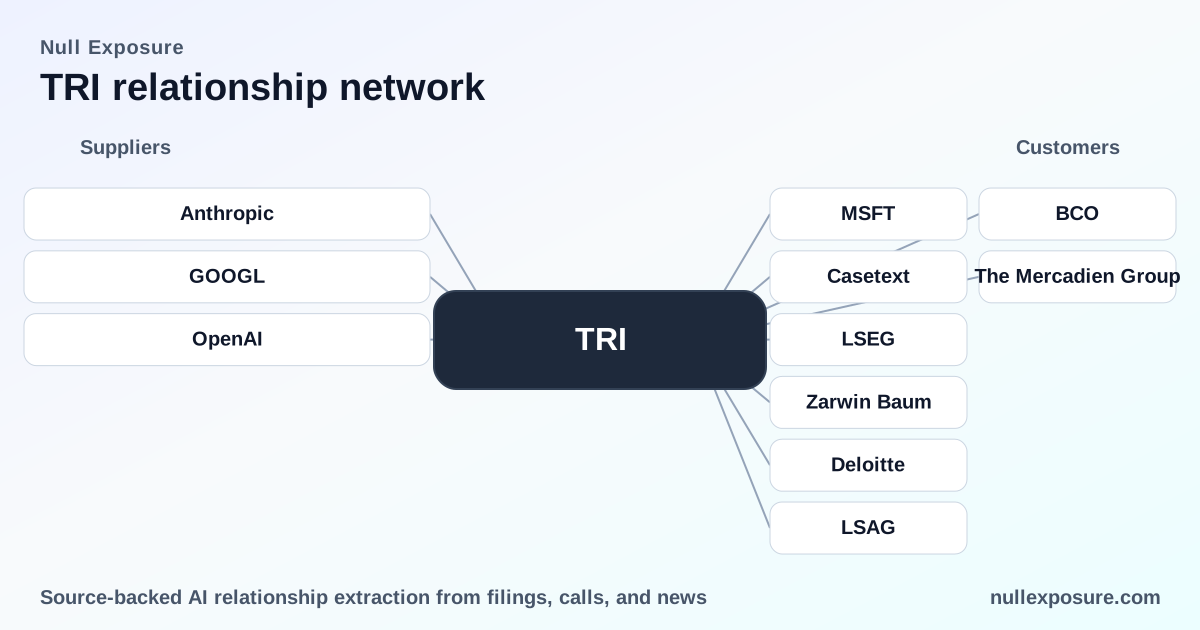
Below are the relationships surfaced in the FY2026 coverage window, with a concise plain-English take and the original source.
Microsoft (MSFT)
Thomson Reuters cited Microsoft as a council win that validates demand for domain-specific, AI-enabled offerings — a marquee endorsement that supports enterprise uptake of TR’s AI products. (Q4 2025 earnings call transcript, reported Mar 10, 2026: https://www.insidermonkey.com/blog/thomson-reuters-corporation-nasdaqtri-q4-2025-earnings-call-transcript-1690317/)
Zarwin Baum
The Pennsylvania law firm Zarwin Baum adopted CoCounsel Legal and realized concrete efficiency gains, illustrating how Thomson Reuters’ generative-AI tools convert into tangible law-firm productivity improvements. (Thomson Reuters press release, Jan 2026: https://www.thomsonreuters.com/en/press-releases/2026/january/thomson-reuters-launches-ai-tax-compliance-solution-that-saves-time-and-reduces-risk)
Smokeball
Thomson Reuters and Smokeball announced an integration that syncs practice-management documents into CoCounsel Legal, indicating a channel-led strategy to embed TR’s AI capabilities deeper into small and midsize law firm workflows. (Coverage noted by Wells Fargo commentary, reported May 4, 2026: https://www.insidermonkey.com/blog/wells-fargo-maintains-equal-weight-on-thomson-reuters-tri-1741885/)
Casetext
TR’s acquisition of Casetext is positioned as a strategic move to accelerate AI capabilities and distribute TR content into a complementary legal-AI platform, extending content monetization and product-market fit. (Morningstar coverage discussing the acquisition, Mar 10, 2026: https://www.morningstar.com/stocks/thomson-reuters-casetext-acquisition-bet-ai)
London Stock Exchange Group (LSEG)
A contractual price increase in the news agreement with LSEG’s Data & Analytics division was explicitly cited as a driver of Reuters organic revenue growth, demonstrating pricing power in headline news/data licensing. (Sahm Capital report quoting CEO remarks, Feb 2026: https://www.sahmcapital.com/news/content/thomson-reuters-ceo-says-ai-is-delivering-tangible-gains-2026-02-05)
LSAG
Management attributed 5% Reuters organic growth to the news agreement with LSAG’s data and analytic business, plus a small but notable $5 million of generative-AI transactional licensing revenue — a signal that TR’s content licensing is already producing AI-related transactional income. (Q4 2025 earnings call transcript, Mar 10, 2026: https://www.insidermonkey.com/blog/thomson-reuters-corporation-nasdaqtri-q4-2025-earnings-call-transcript-1690317/)
Deloitte
Deloitte expanded a strategic alliance with Thomson Reuters to provide managed e-invoicing and e-reporting for clients using ONESOURCE Pagero, under a global managed-service arrangement that channels TR technology through Big Four distribution. (Thomson Reuters press release, Jan 22, 2026: https://www.thomsonreuters.com/en/press-releases/2026/january/deloitte-and-thomson-reuters-launch-a-strategic-alliance-to-support-end-to-end-global-e-invoicing-and-e-reporting-for-organizations)
Brinks (BCO)
Brinks leveraged CoCounsel to rework legal workflows and gain competitive advantage, a deployment that reflects enterprise adoption of TR’s AI legal tools in complex corporate legal operations. (Thomson Reuters press release, Jan 2026: https://www.thomsonreuters.com/en/press-releases/2026/january/thomson-reuters-launches-ai-tax-compliance-solution-that-saves-time-and-reduces-risk)
The Mercadien Group
The Mercadien Group moved to TR’s Cloud Audit Suite to streamline auditing workflows, signaling traction for cloud-native audit and accounting products among mid-market professional services firms. (Thomson Reuters press release, Jan 2026: https://www.thomsonreuters.com/en/press-releases/2026/january/thomson-reuters-launches-ai-tax-compliance-solution-that-saves-time-and-reduces-risk)
Blackstone (BX)
Press coverage referenced Blackstone’s role in the 2018 sale of Refinitiv, a legacy strategic transaction that underpins TR’s financial markets footprint and capital strategy. This historical relationship continues to matter as a structural element of TR’s competitive position in data and analytics. (Yahoo Finance report on shareholder approval, May 4, 2026: https://finance.yahoo.com/markets/stocks/articles/thomson-reuters-shareholders-approve-cad-104601799.html)
What these relationships imply for investors
- Product stickiness is high. Law firms, professional services firms and exchanges are integrating TR tools into core processes, which supports recurring revenue and low churn. The Microsoft council win and Deloitte alliance provide strategic validation and scale distribution for AI offerings.
- Pricing leverage exists with large partners. The LSEG/LSAG news agreement and referenced contractual price increase demonstrate the ability to extract higher pricing in data licensing contracts.
- Channel expansion matters. Partnerships with Smokeball and Deloitte show TR is pursuing both direct enterprise agreements and embedded distribution through third parties to reach smaller firms.
- AI is converting content into incremental, measurable revenue. Management disclosed $5 million of generative-AI transactional licensing in Reuters’ agency business, indicating early but visible monetization of AI-enabled content.
Key investment risks and operational constraints
- Integration of acquired AI players and third-party partners requires execution and could create short-term cost pressure even as long-term revenue expands.
- Concentration risk persists at the enterprise level: a handful of large agreements materially impact Reuters revenue trends and pricing.
- Regulatory and data-licensing friction is a structural exposure given the sensitive nature of licensed news and financial data.
- No explicit constraints were present in the sampled relationship records, which is a company-level signal that material external restrictions were not reported for these customer interactions in the FY2026 window.
Bottom line
Thomson Reuters is executing a disciplined transition from content licensor to AI-enabled workflow platform with a balanced combination of direct enterprise contracts and channel integrations. For investors, the critical metrics to watch are AI-related transactional revenue growth, renewal pricing in large data agreements, and the successful scaling of recent acquisitions and partnerships.
Explore further analysis and relationship tracking at https://nullexposure.com/