Trillium Therapeutics (TRIL): One Strategic Customer — and an Exit That Defined the Business Model
Trillium Therapeutics operated as a clinical-stage oncology developer focused on immune-oncology checkpoint molecules and monetized primarily through strategic partnerships and a full corporate exit; the company’s principal customer/partner outcome was a 2021 acquisition by Pfizer for roughly US$2.26 billion, crystallizing enterprise value for equity holders and converting R&D upside into cash. For investors evaluating TRIL relationships, the Pfizer transaction is the single, material commercial event that drives counterparty exposure, concentration and exit economics. Learn more about how NullExposure sources and presents relationship signals at https://nullexposure.com/.
The deal in a sentence: Pfizer bought Trillium for scale and assets
In August 2021 Pfizer agreed to acquire Trillium Therapeutics for US$2.26 billion, paying US$18.50 per share in cash to purchase all outstanding Trillium shares it did not already own. A CityNews report and contemporaneous business coverage summarized the transaction as a cash takeover that sent TRIL shares sharply higher on the announcement; Financier Worldwide and BioSpace documented the per-share price and the acquisition mechanics. (CityNews Aug 2021; Financier Worldwide Aug 2021; BioSpace Aug 2021.)
What the public sources say, concisely
- CityNews reported the US$2.26 billion valuation when the deal was announced in August 2021.
- Financier Worldwide and BioSpace recorded that Pfizer offered US$18.50 per share for remaining Trillium stock.
- Fox Business and retail market coverage noted the immediate market reaction—the stock jumped sharply on the buyout news.
- MedicalXpress highlighted that the per-share offer represented more than double the 60‑day weighted average trading price at the time.
- Retail investor outlets (StocksToTrade) reiterated the $18.50 per-share cash figure and the price move in market trading.
A complete, plain-English inventory of observed relationships
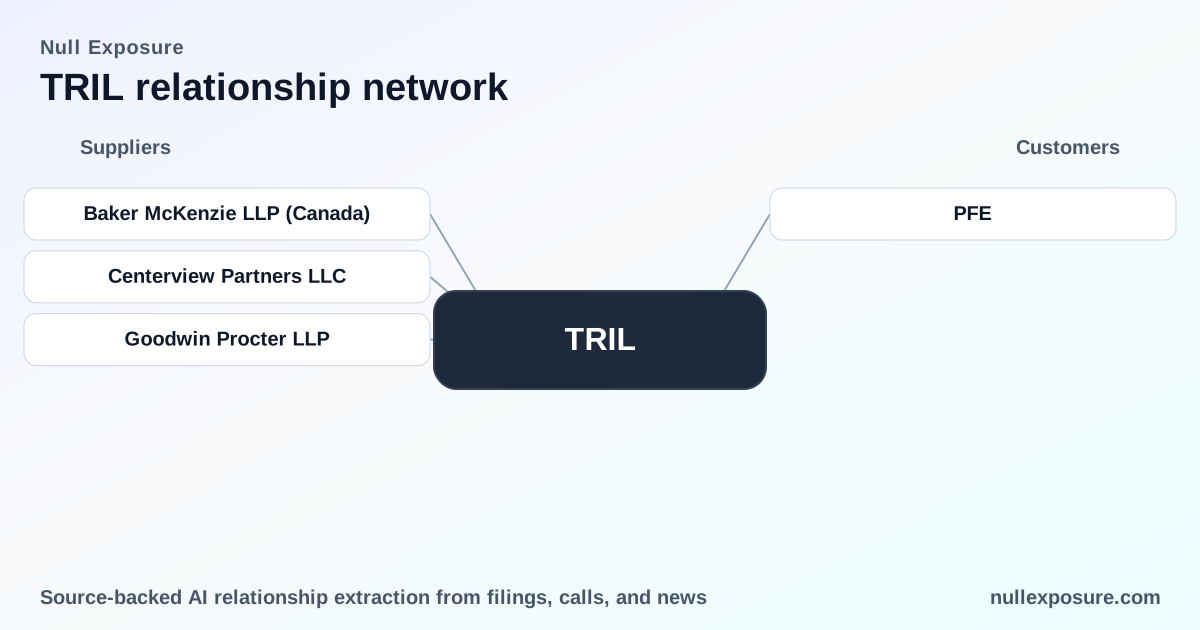
- Pfizer Inc. / PFE — Pfizer executed a cash acquisition of Trillium in August 2021, paying US$18.50 per share and valuing the deal at approximately US$2.26 billion; the acquisition closed the primary counterparty relationship by folding Trillium’s programs into Pfizer’s oncology portfolio (reported across CityNews, Financier Worldwide, BioSpace, Fox Business, MedicalXpress, StocksToTrade in Aug 2021).
Source citations: CityNews (Aug 2021); Financier Worldwide (Aug 2021); BioSpace (Aug 2021); Fox Business (Aug 2021); MedicalXpress (Aug 2021); StocksToTrade (Aug 2021).
What this single, definitive relationship implies about TRIL’s operating model
- Contracting posture: acquisition-focused rather than long-term commercial contracting. Trillium’s dominant monetization route concluded via an M&A exit, not by building a diversified revenue stream from product sales or multiple large commercial customers. The Pfizer purchase is the primary commercial settlement of the company’s asset portfolio.
- Concentration: extreme single-counterparty outcome. The observable relationship set is concentrated — Pfizer is the acquirer and therefore the ultimate counterparty controlling commercialization of Trillium’s assets after the deal; there is no evidence of a broad base of paying commercial customers pre-exit.
- Criticality: high for acquirer strategy, limited for a diversified supplier base. Trillium’s assets were sufficiently critical to Pfizer’s oncology strategy to justify a multi‑billion-dollar purchase, signaling high strategic value to that specific counterparty while offering limited systemic exposure to multiple buyers.
- Maturity: exit completed; R&D converted to cash. The acquisition closes the chapter on Trillium as an independent R&D-stage commercial entity and marks a maturity event—value realization through sale rather than through staged commercial launches.
These operating-model characteristics are company-level signals derived from the acquisition event documented in public reporting; they are not assignments from third‑party contract excerpts.
Investor implications: what to watch in comparable analyses
- Valuation benchmark: The US$18.50 per-share cash price and ~US$2.26 billion headline provide a firm market valuation for Trillium’s programs at the time of acquisition; use that as the starting point when valuing comparable small-cap immuno-oncology developers. (Financier Worldwide; BioSpace.)
- Exit precedent: The transaction reinforces a pathway where biotech companies with differentiated checkpoint inhibitor assets can monetize value via strategic sale rather than slow-to-scale commercialization. (CityNews; Fox Business.)
- Concentration risk in peer selection: For investors and counterparties assessing pipeline companies, prioritize how reliant a target is on a single strategic partnership or the prospect of being acquired; Trillium’s path shows how concentrated counterparty outcomes alter risk-return profiles. (MedicalXpress; StocksToTrade.)
Risk and opportunity checklist — headline takeaways
- Opportunity: High strategic value to large pharma acquirers can drive outsized returns for early equity; the Pfizer deal is a clear liquidity event.
- Risk: Lack of diversified commercial customers prior to exit means revenue continuity was not established; the business model depended on asset sale rather than product cash flows.
- Operational implication: Counterparties evaluating similar companies should query whether the target’s commercialization plan is to pursue partnerships/licensing or to remain acquisition-focused, and price in the likelihood and timing of an exit event.
How operators and investors should use this signal
- For buy‑side research, treat the Pfizer acquisition as a definitive comparator when modeling exit scenarios or negotiating valuation premia for pipeline-stage oncology assets.
- For corporate development teams, use the public terms—US$18.50 per share, ~US$2.26 billion headline—to calibrate what major pharmaceutical acquirers have paid for late-stage checkpoint assets and to shape negotiation anchors.
Explore more relationship intelligence and comparable deal signals at NullExposure: https://nullexposure.com/. If you are analyzing counterparty concentrations or preparing M&A comparables in life sciences, our coverage and sourced relationship logs provide focused, deal-level context to complement clinical and financial diligence.