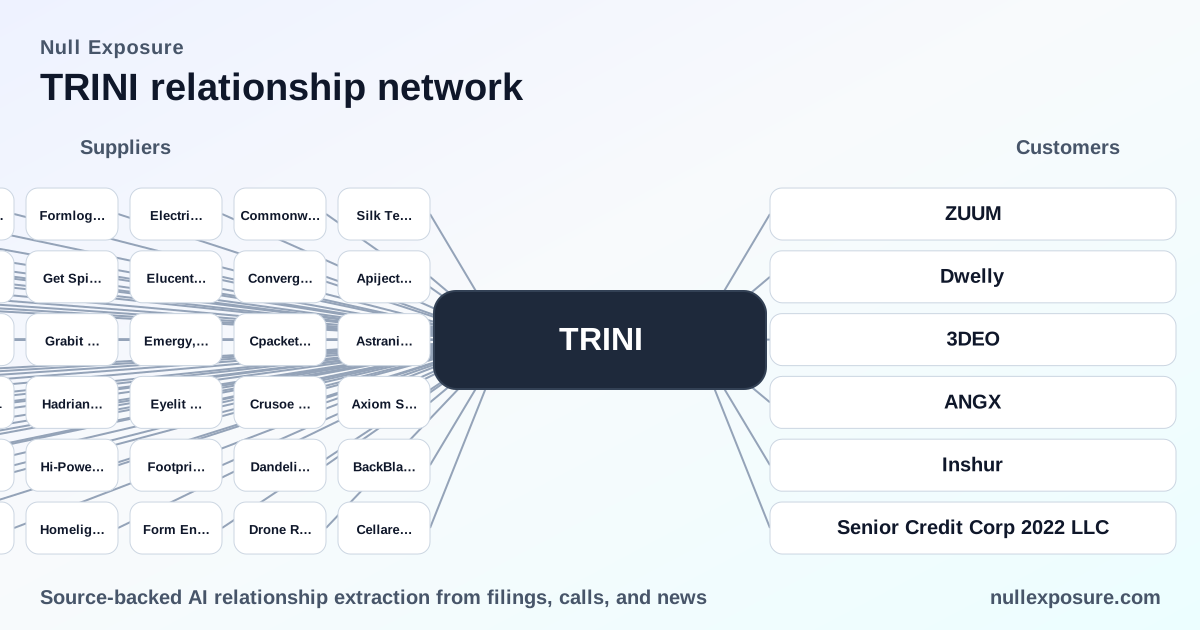
Trinity Capital (TRINI) — customer relationships that shape yield and credit risk
Thesis: Trinity Capital operates as a specialty lender and venture-debt investor that monetizes through secured loans, equipment financings and advisory fees, targeting growth-stage technology, medtech and energy companies; its business model delivers high yield through concentrated, large-ticket growth commitments while exposing investors to borrower credit cycles and legacy non‑accruals.
For a concise portfolio view and relationship monitoring, visit https://nullexposure.com/ for ongoing updates and source consolidation.
How Trinity makes money and what that implies for investors
Trinity generates revenue primarily by originating and holding secured loans and equipment financings to institutional-backed, growth-stage companies and by collecting advisory fees through its Adviser Sub. The firm’s model prioritizes higher coupons and collateralized instruments to offset credit risk; recent public announcements show a strategic tilt toward larger growth commitments ($30–$100 million) in technology, medtech and energy sectors that produce recurring interest income and equity upside through structured growth financings.
Company-level operating signals that matter to underwriting
- Contracting posture: The firm’s public filings and press releases consistently describe transactions as secured loans and equipment financings, indicating a bias toward collateralized structures that improve recoverability on default.
- Contract maturity and tenor: Filings reference multi-year maturities (evidence of long-term instruments), signaling that many loans are long-dated and cash‑flow dependent, which increases sensitivity to borrower commercial execution.
- Geographic concentration: The portfolio is heavily U.S.-centric, with stated concentration in Western and Northeastern U.S. headquarters and limited but present exposure to Western Europe and Canada — a signal that credit cycles in U.S. tech and health markets drive performance.
- Relationship roles and revenue mix: Trinity functions primarily as a seller/lender and increasingly as a service provider through its registered Adviser Sub, creating diversification between interest income and advisory fee revenue.
- Segment focus and ticket size: The company emphasizes services and software (SaaS) and is making sizeable commitments consistent with the 100M+ spend band seen in recent deals, reflecting strategic concentration on larger, later-stage growth financings rather than micro loans.
These characteristics imply a higher-yield, concentrated portfolio that benefits from collateral and structuring but requires active credit surveillance for legacy exposures and sector cycles. For a live view of portfolio shifts, see https://nullexposure.com/.
Relationship roll call — what every named customer connection means for credit and upside
Below are plain-English takeaways for each company Trinity has publicly announced relationships with, with source context.
-
Dwelly — Trinity committed $50 million in growth capital to Dwelly, an AI-first UK lettings and property-management platform, signaling an expansion into proptech and international exposure. According to a PR Newswire release and subsequent coverage in March 2026, Trinity framed the deal as strategic growth financing (PR Newswire/Sahm Capital, March 2026).
-
Torus — Trinity provided $35 million in equipment financing to Torus to support American-made energy systems, reflecting targeted industrial/equipment financing outside pure software credit exposure. MarketScreener reported the announcement as part of Trinity’s April–May 2026 financing activity (MarketScreener, May 2026).
-
Cala Health — Trinity committed $50 million in growth capital to Cala Health to support commercial expansion of its wearable tremor therapy, increasing Trinity’s medtech exposure and commercial-stage device financing. The transaction was disclosed in April 2026 company announcements (MarketScreener, April 2026).
-
Emboline, Inc. — Trinity closed $20 million in growth capital to Emboline to advance embolic protection technology for structural heart procedures, marking a deliberate expansion into cardiovascular medtech. PR Newswire and Simply Wall St covered the deal as part of Trinity’s medtech commitments in spring 2026 (PR Newswire/Simply Wall St, May 2026).
-
Iantrek — Trinity provided $30 million in growth capital to Iantrek to accelerate commercialization and product development, reinforcing the firm’s playbook of mid‑size, equity‑linked growth financings for clinical-stage medtech companies (PR Newswire, May 2026).
-
Sage Health — Trinity committed $50 million to expand senior-focused primary care and wellness centers through Sage Health, demonstrating portfolio diversification into healthcare services and on‑the‑ground care delivery finance (MarketScreener, March 2026).
-
3DEO — 3DEO is identified as a legacy borrower moved to non‑accrual during Q4 after ceasing payments, reflecting residual credit work-out risk from earlier vintages. The Q4 earnings call transcript and investor press coverage list 3DEO among small legacy non‑accruals (Earnings call transcript/InsiderMonkey, March 2026).
-
ZUUM — ZUUM is another legacy borrower placed on non‑accrual in Q4, illustrating that a small number of older credits continue to affect reported credit metrics even as new growth commitments accelerate (Globe and Mail/earnings call press release, March 2026).
-
Angel Studios (ANGX) — Trinity committed $100 million in growth capital and later amended Angel Studios’ 2025 loan facility, establishing both significant exposure and active covenant management (Yahoo Finance/TradingView, March 2026).
-
Monteris Medical — Trinity committed $35 million to Monteris Medical to support neurosurgical device advancement, consistent with the firm’s material push into medtech growth financings in early 2026 (PR Newswire/Sahm Capital, May 2026).
-
Neuros Medical — Included in a medtech trio, Trinity disclosed growth capital commitments to Neuros Medical as part of a broader medtech strategy totaling large aggregate exposure in 2026 (Simply Wall St/Sahm Capital, March–May 2026).
-
Senior Credit Corp 2022 LLC — Listed in Trinity’s investment schedules as a small line item within total debt investments, this entity represents portfolio-level allocation visibility rather than an operating customer relationship; it is noted in Trinity’s Q3 2025 financial disclosures (PR Newswire, Q3 2025 filing).
-
Inshur — Inshur received $35 million from Trinity to develop AI for embedded auto insurance offerings in autonomous vehicles, pointing to strategic interest in insurtech and AI-enabled underwriting tools (Insurance Journal, July 2025).
Investment implications: concentrated yield versus legacy credit work
Trinity’s large, named growth commitments ($30M–$100M) increase yield potential but concentrate credit risk in discrete borrowers and sectors (medtech, proptech, insurtech, energy). The presence of legacy non‑accruals (ZUUM, 3DEO) underscores active workout exposure. Company-level signals — secured lending posture, long-tenor contracts, U.S. geographic concentration, and a mix of lending and advisory revenue — shape a portfolio that delivers a superior coupon at the cost of active credit management and borrower selection.
Key takeaway: Trinity’s strategy is scaled, structured lending with selective service revenue, creating differentiated yield but requiring continuous surveillance of borrower performance and sector cycles.
For ongoing tracking of Trinity’s counterparty announcements and portfolio shifts, visit https://nullexposure.com/ for consolidated source coverage and relationship intelligence.