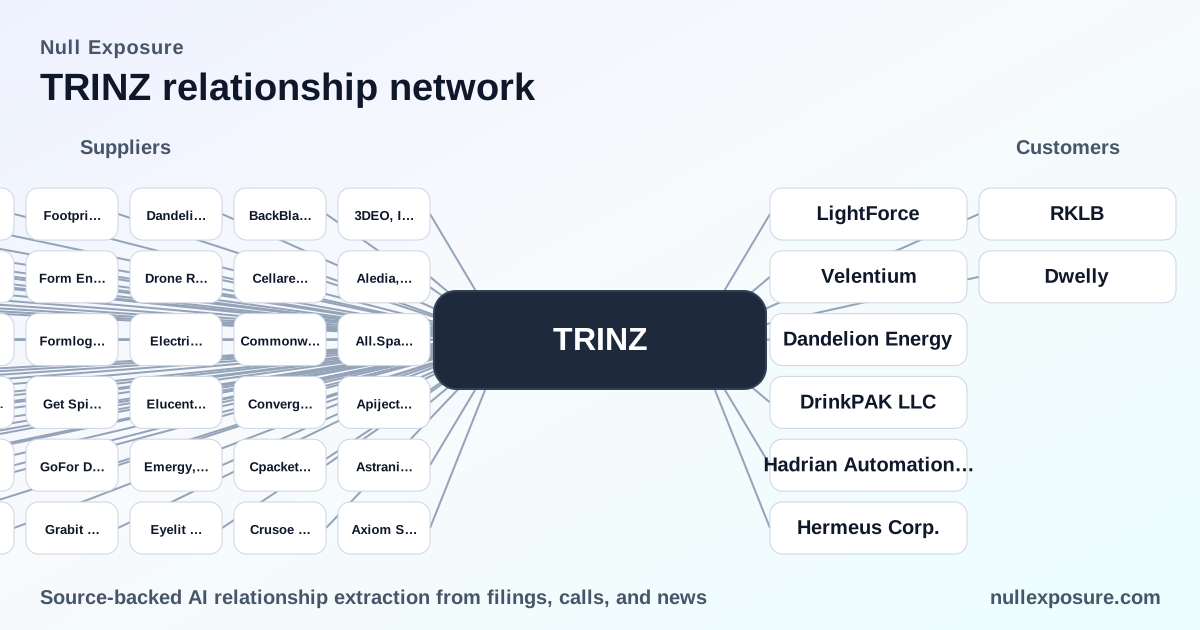
Trinity Capital (TRINZ) — Customer Relationships and What Investors Should Price In
Trinity Capital operates as a specialty growth-capital and equipment-finance lender to emerging, institutional-backed companies, monetizing through interest income on secured loans and equipment financings, fee income from advisory services via its Adviser Sub, and capital management activities that support its liquid debt instrument holders (including the 7.875% notes due 2029). Recent announcements show a clear emphasis on $15–$50 million growth capital and equipment-finance commitments across healthtech, medtech, energy, proptech and aerospace—a pattern that drives predictable yield generation while concentrating exposure to mid-market growth borrowers.
For a concise company snapshot and the underlying source material, visit https://nullexposure.com/.
How recent commitments change the investment picture
Trinity’s public deal flow in FY2025–FY2026 demonstrates a repeatable operating model: originating secured loans and equipment financings to scale-stage companies and taking minority equity or structured growth- capital positions where appropriate. That mix creates a dual revenue stream—direct lending yield plus advisory and fee income from its Adviser Sub and resource-sharing arrangements. Trinity’s disclosed commitments (multiple $30–$50 million transactions) point to a contracting posture that is lender-first, asset-backed, and tailored to support commercial expansion rather than early seed risk.
Key behavioral signals:
- Ticket sizes cluster in the $10M–$100M band, consistent with mid-market positioning and the company’s stated unfunded commitments profile.
- Geographic concentration is heavily U.S.-centric, with small exposure to Western Europe and Canada, reinforcing domestic credit-cycle sensitivity.
- Sector mix is diversified but tilted to services and medical/device hardware, with equipment finance supporting capital-intensive manufacturers and aerospace.
A deeper ledger of counterparties follows; see mid-article analysis and an additional resource at https://nullexposure.com/.
Relationship ledger — every disclosed counterparty and the deal context
Torus
Trinity committed up to $35 million in equipment financing to Torus to support U.S.-based energy technology infrastructure development. This was announced via PR Newswire on May 4, 2026 (PR Newswire, May 2026: https://www.prnewswire.com/news-releases/trinity-capital-inc-provides-35-million-in-equipment-financing-to-torus-helping-power-american-made-energy-systems-302757993.html).
Dwelly
Trinity committed $50 million in growth capital to UK-based proptech Dwelly as part of a broader financing round, disclosed alongside strong Q4/2025 results (SimplyWallSt coverage, FY2026: https://simplywall.st/stocks/us/diversified-financials/nasdaq-trin/trinity-capital/news/trinity-capital-trin-is-up-54-after-earnings-beat-and-new-dw).
Sage Health
Trinity committed $50 million in growth capital to Sage Health to expand senior-focused primary care and wellness centers, a transaction disclosed in a March 2026 PR Newswire release (PR Newswire, Mar 2026: https://www.prnewswire.com/news-releases/trinity-capital-provides-50-million-in-growth-capital-to-sage-health-to-expand-senior-focused-primary-care-wellness-centers-302726721.html).
LightForce
Trinity provided $50 million in growth capital to LightForce, a dental/medical technology company, as announced in PR Newswire (FY2024 disclosure reported in 2026 filings and press materials: https://www.prnewswire.com/news-releases/trinity-capital-inc-provides-50-million-in-growth-capital-to-lightforce-302237379.html).
Cala Health
Trinity committed $50 million to Cala Health to support commercial expansion of its wearable neuromodulation therapy for tremor disorders, per PR Newswire and follow-up market coverage in FY2026 (PR Newswire, Apr 2026: https://www.prnewswire.com/news-releases/trinity-capital-inc-provides-50-million-in-growth-capital-to-cala-health-to-support-commercial-expansion-of-wearable-tremor-therapy-302745099.html).
Emboline, Inc.
Trinity provided $20 million in funding to Emboline in March 2026 to support company growth initiatives, as reported by MarketScreener (MarketScreener, Mar 11, 2026: https://www.marketscreener.com/news/trinity-capital-inc-provides-30-million-in-growth-capital-to-iantrek-to-accelerate-commercial-expa-ce7f59d2d88cf122).
Iantrek
Trinity committed $30 million in growth capital to Iantrek, a bio‑interventional ophthalmic surgery company, to accelerate commercial expansion and the product pipeline, disclosed in a PR Newswire release (PR Newswire, May 2026: https://www.prnewswire.com/news-releases/trinity-capital-inc-provides-30-million-in-growth-capital-to-iantrek-to-accelerate-commercial-expansion-and-advance-product-pipeline-302755098.html).
Velentium
Trinity provided $15 million in debt financing to Velentium, a medical device CDMO, as reported in a PR Newswire release and corroborated by Axios reporting on CDMO financing (PR Newswire, FY2024: https://www.prnewswire.com/news-releases/trinity-capital-inc-provides-15-million-in-growth-capital-to-velentium-302196133.html; Axios coverage: https://www.axios.com/pro/health-tech-deals/2024/07/15/velentium-debt-medical-device-manufacturing-cdmo).
Hadrian Automation, Hermeus Corp., Rocket Lab USA (RKLB), Dandelion Energy, DrinkPAK LLC
Trinity’s equipment-finance vertical reported over $1 billion in fundings, with named customers including Hadrian Automation, Hermeus, Rocket Lab USA (RKLB), Dandelion Energy, and DrinkPAK; these relationships reflect Trinity’s role as an equipment lender to capital‑intensive manufacturing and aerospace firms (PR Newswire, equipment finance milestone announcement, FY2025: https://www.prnewswire.com/news-releases/trinity-capital-incs-equipment-finance-vertical-celebrates-milestone-over-1-billion-in-fundings-to-high-growth-companies-302356349.html).
What the company-level constraints imply for investors
The sourced constraints provide structured signals about how Trinity underwrites and scales:
- Counterparty mix: Trinity targets mid-market, institutional-backed growth companies with expected annual revenues up to $100 million, indicating a borrower profile that is growth-oriented but revenue-proven (company filing language).
- Geography: U.S.-centric portfolio composition (West, Northeast, Mountain et al.) increases sensitivity to U.S. macro and regional industrial cycles while keeping underwriting jurisdiction consistent.
- Role and contract posture: Trinity functions primarily as a service provider/lender and occasional buyer of investments, and it uses a resource-sharing model with its Adviser Sub to capture advisory fees—a structural diversification away from pure net interest income.
- Segment exposure: The portfolio spans services, software (SaaS), medical devices (hardware), and equipment financing, implying asset-backed protections for capital-intensive borrowers and revenue exposure in tech-enabled services.
- Spend concentration: Ticket sizes in the $10M–$100M range align with disclosed unfunded commitments and indicate potential concentration risk at the borrower or sector level if multiple large commitments cluster.
These are company-level signals drawn from Trinity’s filings and press releases; they describe organizational posture rather than any single counterparty unless explicitly identified in the source text.
Investment takeaways and risk framing
- Earnings durability: Trinity’s mix of secured lending and equipment finance provides steady interest income supported by collateral and contractual repayment streams, complemented by fee-bearing advisory activities through the Adviser Sub.
- Concentration risk: Ticket sizes and U.S. geographic concentration create meaningful exposure to regional downturns and sector-specific shocks (healthcare reimbursement, energy capex cycles, aerospace demand).
- Collateral quality matters: The prominence of equipment financing and secured loans makes asset valuation and residual value assumptions critical to credit performance.
- Liquidity profile: The 7.875% notes due 2029 and public disclosures indicate active liability management; investors should weigh funding cost trajectories against portfolio yield.
For a focused, investor-grade briefing on Trinity’s deal flow and counterparties, consult our broader coverage at https://nullexposure.com/ — it provides integrated research and transaction-level links.
Bold conclusion: Trinity’s disclosed customer relationships reinforce a repeatable mid-market lending playbook that produces yield through secured lending and advisory fees, but the strategy concentrates exposure by ticket size and geography—factors investors must underwrite when valuing TRINZ debt and equity-linked instruments.