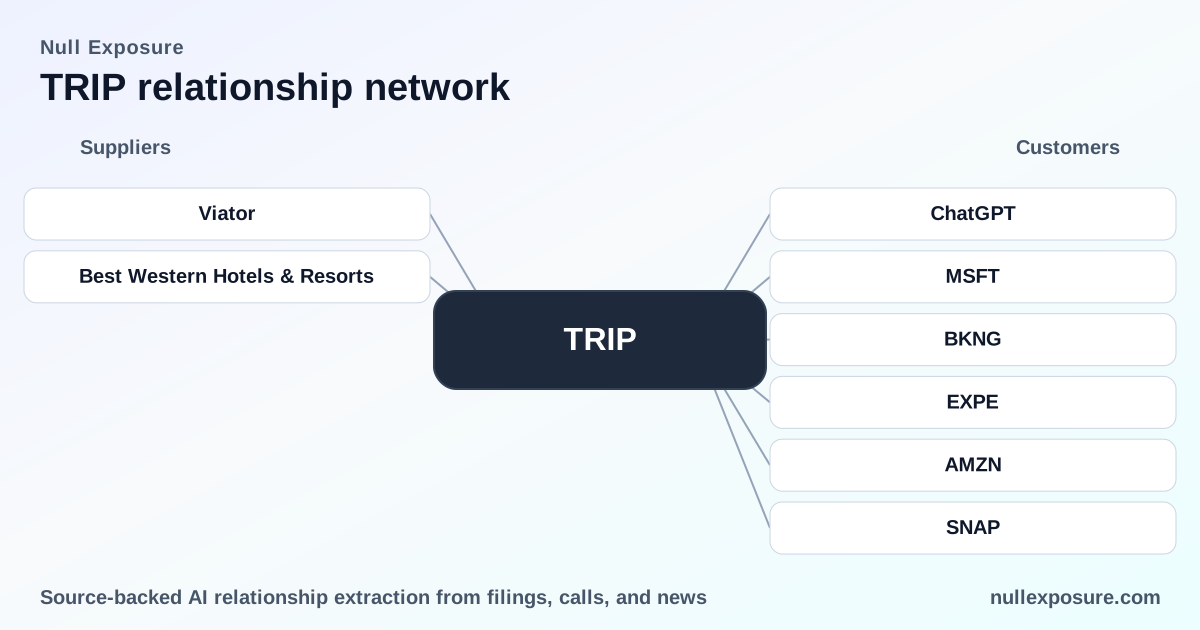
TripAdvisor (TRIP): Customer Map and What It Means for Revenue Durability
TripAdvisor operates as a digital travel marketplace that monetizes two principal ways: click‑based commerce (CPC/meta hotel referrals) and subscription‑style B2B products for lodging and restaurants. Its platform funnels consumer demand to travel providers and is increasingly embedded into third‑party AI assistants and apps, creating both traditional referral revenue and new distribution channels for experiences and bookings. Learn more at https://nullexposure.com/.
Business model in one sentence — and the operating constraints investors must track
TripAdvisor’s revenue mix is built on a hybrid contracting posture: a large share of revenue is usage‑based (CPC) that pays at the point of click, complemented by subscription‑based advertising and B2B services sold on relatively short contracted terms; the company also recognizes a meaningful portion of revenue at a point in time for transactions. The result is high top‑line sensitivity to traffic and partner mix, while subscription contracts provide a modest base and predictable straight‑line recognition.
- Contracting posture: Predominantly CPC (usage) with sizeable subscription products sold for limited terms (often ≤ 1 year) and terminable on short notice.
- Concentration: Revenue is geographically and partner‑concentrated—U.S. revenues dominate, and two travel partners (Booking and Expedia) together represent roughly 21–22% of consolidated revenue.
- Criticality & maturity: Core hotel meta/CPC is mature and commoditized, while new growth vectors are integration into AI assistants and experience marketplaces (Viator), which are early but strategically important.
How TripAdvisor’s customer relationships are evolving with AI and distribution
TripAdvisor is actively embedding its content and commerce into a range of third‑party platforms and assistant ecosystems. These partnerships shift some distribution from TripAdvisor’s owned properties to partner surfaces, creating both scale opportunities and margin pressure depending on commercial terms.
Take a look at the full set of customer relationships seen in public reporting and coverage — each relationship below is summarized with its source.
Relationship roster — plain English briefs and sources
-
Amazon / AMZN
TripAdvisor has an existing commercial integration with Amazon that is expanding into next‑generation voice and assistant experiences (referred to as Alexa+), broadening distribution for hotel and experience inventory. Source: HospitalityNet coverage of TripAdvisor’s AI partnerships (May 4, 2026) and TripAdvisor commentary in earnings call coverage (InsiderMonkey, Mar 10, 2026). -
Anthropic
TripAdvisor and its Viator experiences are accessible inside Anthropic’s Claude assistant, enabling itinerary and experience discovery through a third‑party AI interface. Source: HospitalityNet article describing availability inside Anthropic’s AI assistant (May 4, 2026). -
ChatGPT (OpenAI apps platform)
TripAdvisor’s Viator app is live within ChatGPT as a proof‑of‑concept, signaling distribution experiments on conversational platforms for tours and activities. Source: Earnings call transcript coverage reporting the Viator app in ChatGPT (InsiderMonkey, Mar 10, 2026). -
Microsoft / MSFT
TripAdvisor has explored marketplace data collaborations with Microsoft and is testing new AI form factors and device integrations (example cited: glasses or other devices) to surface travel content beyond the web. Source: Earnings call discussion summarized in Insidermonkey’s Q4 2025 transcript coverage (Mar 10, 2026). -
Expedia / EXPE
Expedia and its subsidiaries are one of TripAdvisor’s two most significant travel partners; Expedia contributed a material share of consolidated revenue alongside Booking. TripAdvisor’s FY2025 disclosures list Expedia as a top partner. Source: TripAdvisor Form 10‑K (FY2025) noting Expedia’s contribution to consolidated revenue. -
Booking / BKNG
Booking and its subsidiaries accounted for 10% or more of TripAdvisor’s consolidated revenue; together with Expedia, Booking represents a concentrated revenue nexus responsible for approximately 21–22% of total revenue. Source: TripAdvisor Form 10‑K (FY2025) disclosure on partner revenue concentration. -
Snap / SNAP
TripAdvisor referenced exploratory work with Snap as part of a multimodal AI strategy, indicating experiments to present travel content in image‑first and mixed‑media social surfaces. Source: Earnings call coverage (InsiderMonkey transcript, Mar 10, 2026).
Each of these relationships is either a distribution channel for TripAdvisor’s consumer products (meta/referral traffic) or a host environment for Viator/TheFork apps and services; together they represent both sources of traffic and strategic routes to capture user intent in non‑web environments.
What the constraints tell investors about revenue durability and risk
The contractual evidence in TripAdvisor’s filings and commentary paints a clear picture:
- Revenue mix and cash convertibility: Click‑based CPC remains the primary engine for hotel‑related revenue; this produces variable cash flow tied to traffic quality and partner economics, while subscription products provide recurring but limited‑term revenue recognized on a straight‑line basis.
- Contract tenor and lift‑risk: Many agreements are short‑term or terminable on short notice, so churn or repricing by large partners can quickly affect top line.
- Geographic concentration: With the U.S. contributing the largest share of revenue, macro travel cycles in North America will disproportionately affect overall growth and margins.
- Partner concentration is material: Booking and Expedia together represent a material concentration risk, and their bargaining power over placement and CPC economics is a structural constraint on TripAdvisor’s pricing leverage.
- Role diversity: TripAdvisor functions both as a buyer of certain services (for example, restaurant reservation tech) and a service provider/marketplace; this dual role supports product breadth but increases dependency on ecosystem partners.
Investment implications — what to watch and why it matters
- Upside: Embedding TripAdvisor and Viator into AI assistants and device ecosystems (Amazon Alexa+, ChatGPT, Anthropic, Microsoft surfaces) is a high‑leverage path to scale lower‑cost distribution and incremental CPC volume and experiences revenue. Successful conversion on these surfaces drives margin expansion more than raw traffic growth.
- Risk: Revenue concentration with Booking and Expedia and the short‑term nature of many commercial arrangements create earnings volatility if partner economics shift or traffic declines. Monitor partner revenue disclosures and changes in CPC rates.
- Signal to track: Activation metrics and monetization outcomes from AI integrations (e.g., confirmed commerce conversion rates within assistant environments) will be the next proxy for sustainable growth.
For a deeper read on TripAdvisor’s partner footprint and how distribution partnerships shape revenue exposure, visit https://nullexposure.com/.
Bottom line
TripAdvisor’s core business is scaled referral commerce coupled with subscription B2B offerings, operating with a contracting mix that produces both predictable subscription revenue and highly variable CPC income. Material partner concentration (Booking + Expedia) and increasingly important AI distribution tie the stock’s upside to successful monetization of new assistant platforms while leaving earnings exposed to partner repricing and traffic cycles. Investors should watch partner revenue disclosure, AI integration performance, and CPC trends as leading indicators of the company’s near‑term trajectory.