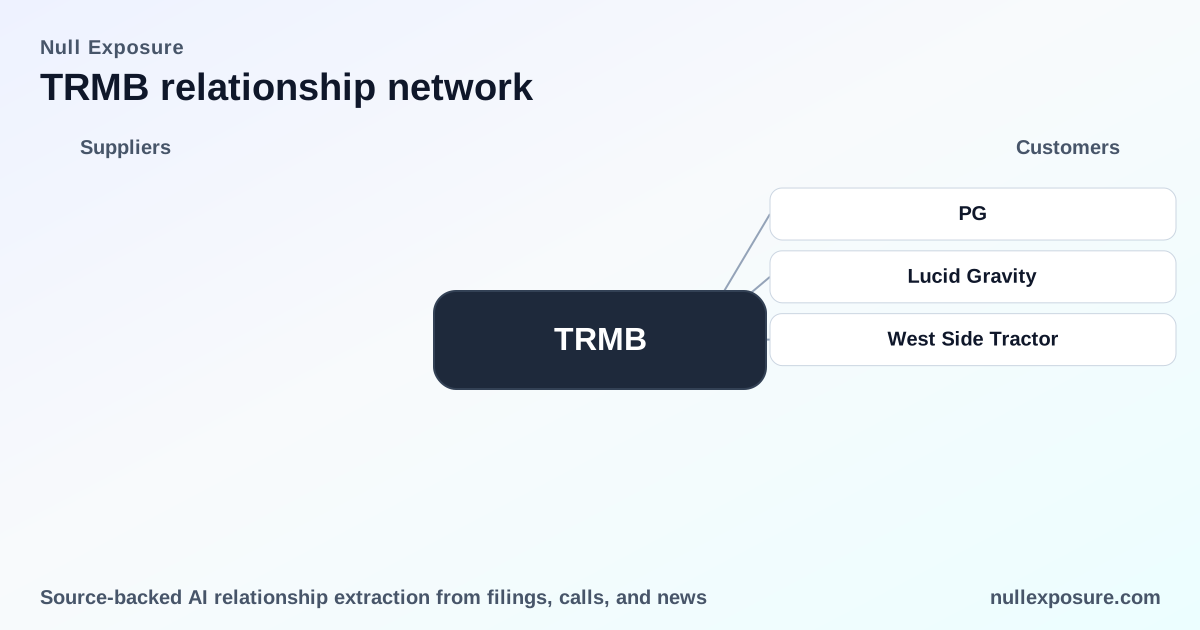
Trimble’s customer footprint: anchor tenants, dealers, and technology partners that drive recurring revenue
Trimble monetizes a combined hardware, software and services portfolio by selling precision hardware and licensed software, then migrating customers onto subscription and consumption billing for cloud services and support; direct sales, dealer distribution and digital channels together accelerate adoption in construction, agriculture, transportation and robotics. Investors should view Trimble as a hybrid vendor with growing recurring revenue, enterprise anchor customers, and a distribution-led field presence that limits single-customer concentration. For a deeper look at the customer map and what it implies for revenue durability, see https://nullexposure.com/.
How Trimble contracts and how that shapes revenue
Trimble’s commercial footprint is defined by a deliberate mix of licenses, subscriptions and usage-based billing. The company sells perpetual and term licenses, operates SaaS offerings, and provides consumption-priced services when appropriate — subscription terms typically run month-to-month to one-to-three years and revenue is recognized over the subscription term. This contracting posture drives more predictable revenue while still preserving transactional hardware sales that accelerate adoption of the software stack.
Geography and counterparty composition are material company-level characteristics. Trimble reports a large share of revenue from the United States while noting no single customer or country accounted for 10%+ of revenue in recent years, which implies a broad base of mid-to-large enterprise buyers rather than dependence on a single anchor. Counterparty mix spans governments, enterprise asset owners, dealers and individual operators, and Trimble sells both directly and through dealer/distributor channels — a setup that combines mission-critical enterprise relationships with a mature indirect distribution model.
Key company-level signals:
- Contracting posture: Transitioning toward recurring subscription and consumption models while continuing to sell hardware and perpetual licenses.
- Concentration: High U.S. revenue but diversified customer base without single-customer concentration above 10%.
- Criticality: Customers include enterprises and public-sector agencies for whom positioning and accuracy are mission-critical.
- Maturity: Well-established dealer/distributor channels alongside direct sales and cloud services, indicating a mature go-to-market.
Customer relationships that matter now
Below I cover every customer relationship noted in public reporting and media coverage, with one-line business summaries and the primary source for each mention.
Procter & Gamble (PG)
Trimble announced Procter & Gamble as an anchor tenant on its freight marketplace, cited as a major shipper win that supports marketplace expansion and recurring mobility revenue. This placement signals enterprise-level validation for Trimble’s logistics marketplace proposition. (Reported in The Globe and Mail and FreightWaves, March 10, 2026.)
Lucid Gravity
Trimble’s RTX and ProPoint Go positioning is credited as the accuracy engine behind Lucid Gravity’s hands-free driver-assistance systems, demonstrating Trimble positioning into autonomous and robotics navigation stacks. This is evidence of Trimble technology being embedded as a core navigation layer for third-party autonomy platforms. (Mentioned in a robotics industry analysis published March 2026.)
West Side Tractor / West Side Tractor Sales Co.
Trimble expanded its machine-control distribution network by naming West Side Tractor Sales Co. as a Trimble Technology Outlet, widening access to Trimble construction technology on John Deere equipment across parts of the U.S. Midwest; coverage also noted broader dealership expansion in January 2026. This is a classic reseller expansion that increases hardware attach rates and subscription conversions. (Announced via company channel and covered by Simply Wall and robotics sector press, May 2026 / March 2026.)
AGCO
Trimble products are sold through dealer partners that also distribute AGCO precision-planting and PTX Trimble products, enabling broader precision-agriculture coverage and deeper customer engagement through co-sold dealer networks. This partnership underlines Trimble’s strategy of channel-led scale in agriculture. (Referenced in an AGCO earnings transcript, Q4 2025 / reported March 2026.)
KVH Industries (KVHI)
KVH’s GEO-FOG 3D inertial navigation system incorporates an embedded Trimble GNSS receiver, showing Trimble’s hardware being integrated into third-party inertial navigation systems for unmanned platforms — a complementary OEM relationship that extends Trimble reach into specialized unmanned systems. (Documented in Unmanned Systems Technology coverage, October 2020; referenced in later summaries.)
What these relationships collectively indicate
- Enterprise anchor adoption (logistics and manufacturing): Wins like Procter & Gamble validate Trimble’s marketplace and logistics offerings and create high-value, recurring revenue paths tied to large shippers.
- Channel-driven expansion (construction and agriculture): Agreements with dealers such as West Side Tractor and shared dealer arrangements with AGCO show Trimble leaning on established resale networks to convert hardware buyers into software subscribers. This reduces direct sales cost and accelerates geographic penetration.
- Technology embed and OEM play: Partnerships with robotics and unmanned navigation players (Lucid Gravity, KVH) demonstrate Trimble’s navigation stack is treated as a platform component, enabling defensive moats in precision and positioning beyond pure software.
Investment implications and risk profile
- Upside: recurring revenue leverage. The combination of subscription/consumption billing and enduring hardware installs gives Trimble multiple levers to grow predictable revenue and expand lifetime value per customer.
- Operational resilience through channels. Dealer and OEM relationships diversify go-to-market risk; indirect channels reduce the need for proportional expansion in Trimble’s direct salesforce.
- Geographic concentration nuance. Heavy U.S. revenue exposure concentrates macro and regulatory risk in North America, but the absence of any single customer >10% limits counterparty concentration risk.
- Dependency on enterprise anchors for marketplace credibility. Anchor tenants like P&G accelerate marketplace liquidity and customer trust, but marketplace economics require sustained platform scale to fully monetize.
- Maturity of execution. Trimble is a mature operator with proven hardware and software integration capabilities; the critical task is sustaining migration to higher-margin recurring offerings while managing hardware cycles.
Conclusion: what to watch next
Monitor three signals: (1) the mix shift to subscription and usage-based revenue in Trimble’s quarterly disclosures, (2) the pace of new anchor customer additions to marketplaces or logistics programs, and (3) dealer network expansions or OEM embed announcements that convert point hardware sales into ongoing software relationships. For a consolidated view of Trimble’s customer map and how these relationships alter revenue durability, visit https://nullexposure.com/.
Key takeaway: Trimble’s customer set combines enterprise anchor wins, extensive dealer distribution, and strategic embeds into robotics and unmanned systems — a structure that supports faster recurring revenue growth while preserving broad market exposure across construction, agriculture and transportation.