Transcat (TRNS): Calibration services meet durable enterprise demand
Transcat monetizes a two-pronged business: recurring, mission‑critical services (calibration, repair, inspection) sold to large industrial and defense customers, and distribution/rental of laboratory instruments. Revenue derives from ongoing service contracts, transaction volume through a proprietary asset-management platform (CalTrak® and the C3® portal), and equipment sales/rental — a mix that produces steady cash flow but compresses operating margin. For diligence and monitoring, see more at https://nullexposure.com/.
How Transcat’s commercial model actually works
Transcat runs a service-first operating model complemented by distribution. The Service segment handles calibration, repair, inspection, preventive maintenance and consulting, most of which is processed through the company’s proprietary CalTrak® system and online portal C3®. The Distribution segment sells and rents branded and proprietary instruments nationally and internationally. Service contracts drive repeatable revenue and create high switching costs, while distribution provides transactional revenue and product margin.
According to the company’s FY2025 disclosures, Transcat serves roughly 30,000 customers across both segments with about 20–25% transacting across both businesses, supporting a blended revenue stream and cross-sell opportunities. The firm discloses that no single customer or controlled group accounted for 5% or more of total revenue in FY2025 or FY2024, which signals a low customer concentration at the top end.
Geography and customer profile: concentrated scale with broader reach
Transcat’s revenue base shows a clear North American dominance — domestic customers comprised the bulk of Distribution sales (93.3% in fiscal 2025), while Canadian and other international markets are far smaller. The company also reports the ability to sell and rent instruments globally through Distribution, giving it an addressable international market for product sales. At the customer level, Transcat lists leading manufacturers across life sciences/pharma, energy, defense, aerospace and industrial process control as core buyers, indicating a client roster dominated by large enterprises.
- Customer scale and type: company filings describe a Fortune 500 client base and industry‑mandated service models, which support stickiness and predictable renewal patterns.
- Geography: predominantly North America for revenue, but Distribution is global in capability.
- Materiality: no single customer exceeds 5% of revenue in the latest filings, indicating large but dispersed customer relationships.
For more context on Transcat’s business structure and customers, consult the company filing snapshots available via https://nullexposure.com/.
How Transcat is typically contracted and why that matters
Transcat operates as both a seller (equipment/distribution) and a service provider (calibration and maintenance). The contracting posture is oriented toward recurring, service-based engagements with enterprise clients and overflow arrangements for customers that maintain in-house capabilities. This combination yields high operational criticality — calibration and maintenance are mandatory for regulated environments — while preserving a lower concentration risk because clients often keep primary in-house teams and outsource overflow or specialized work.
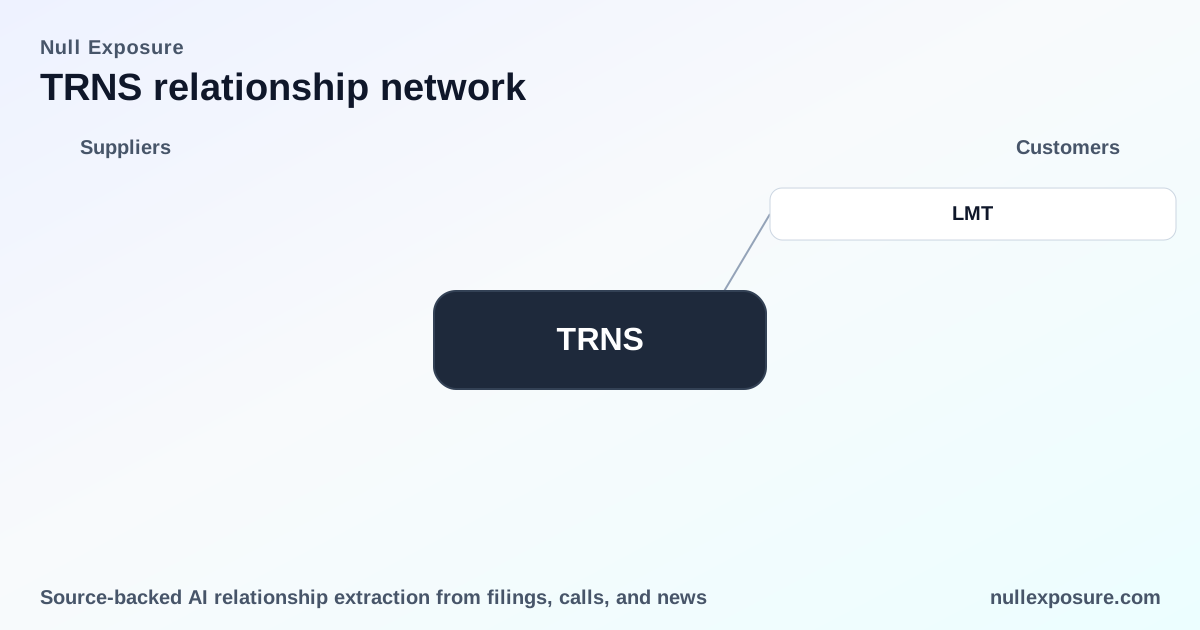
Relationship map: what public sources show about specific customers
Below are every relationship captured in the results set, each with a concise plain‑English summary and a source.
LMT — Lockheed Martin (entry indexed as LMT)
Transcat indicated on an FY2026 earnings call that defense contractors such as Lockheed run their own in‑house calibration labs and use Transcat for overflow work, positioning Transcat as a complementary supplier rather than a primary captive provider. Source: InsiderMonkey, Q3 FY2026 earnings call transcript (March 2026): https://www.insidermonkey.com/blog/transcat-inc-nasdaqtrns-q3-2026-earnings-call-transcript-1689398/
Lockheed (duplicate entry)
The transcript repeats that work from large defense contractors, including Lockheed, is largely overflow — Transcat fills capacity gaps when customer labs are at limit, rather than serving as a full-service provider on core calibration for such customers. Source: InsiderMonkey, Q3 FY2026 earnings call transcript (March 2026): https://www.insidermonkey.com/blog/transcat-inc-nasdaqtrns-q3-2026-earnings-call-transcript-1689398/
(Note: the results include two indexed relationships that reference the same disclosure; both entries are reported above.)
Operational constraints and what they signal for investors
The collected constraints from Transcat’s filings produce several company-level operational signals:
- Large-enterprise clientele: filings and disclosures consistently reference a Fortune 500 client base and leading manufacturers in regulated industries — this supports contract longevity and pricing power in certain niches (constraint: counterparty_type = large_enterprise).
- North American revenue concentration with global distribution capability: distribution is available globally, but reported revenue is heavily weighted to the United States (constraint: geography_region = na; also evidence of global distribution capability).
- Low top-customer concentration: no customer >5% of revenue in FY2025/FY2024, which reduces single-client dependency (constraint: materiality = immaterial).
- Dual role in the go-to-market: Transcat acts as both seller (instrument sales/rental) and service provider (calibration/maintenance), creating diversified revenue streams (constraints: relationship_role = seller and service_provider).
- Active relationship footprint: serving roughly 30,000 customers with an active installed base supports recurring revenue potential and predictable maintenance cycles (constraint: relationship_stage = active).
- Segment maturity: the company explicitly operates through mature Service and Distribution segments, which implies established processes but modest margin expansion potential absent structural change.
These signals combine to portray Transcat as a stable, low‑concentration service operator with a defensible niche in regulated industries, but operating in a margin‑sensitive environment where growth must be balanced against pricing and capacity constraints.
Risks, valuation signals and what to watch next
- Margin sensitivity: Transcat reports modest operating margin metrics; services are mission‑critical but competitively pressured, so margin expansion is a key monitor.
- Capacity and contract mix: overflow relationships with large defense firms create revenue but limit pricing leverage; watch for changes in contract scope (more core work vs. overflow) with customers like Lockheed.
- Geographic concentration: heavy North American revenue exposure leaves the company sensitive to domestic industrial cycles; international Distribution growth is an upside pathway.
- Valuation: market multiples (e.g., EV/EBITDA ~20x) imply investors are pricing growth or quality — execution on recurring revenue and higher-margin service expansion is required to justify that premium.
Final read for investors
Transcat is a durable service operator embedded in regulated industrial clients, monetizing through recurring calibration contracts and instrument sales. The relationships reported in public transcripts show the firm’s role as a complementary, overflow capacity provider to large defense contractors — a profile consistent with its declared client mix and service orientation. For active monitoring and deeper client-level insights, visit https://nullexposure.com/ for additional reporting and relationship signals.