TROOPS Inc: Customer relationships that define a workflow-integration growth story
TROOPS Inc builds and sells workforce-management and operational-intelligence software—positioning itself as an integration layer between CRM systems (notably Salesforce) and collaboration platforms such as Slack and Microsoft Teams. The company monetizes primarily through enterprise software contracts and integrations, supplemented by strategic equity and financing transactions, which together drive revenue while shaping capital flexibility for product and go-to-market expansion. For investors and operators, the combination of large-name customer references and active balance-sheet transactions creates a profile of high strategic relevance paired with early-stage financial fragility.
Visit https://nullexposure.com/ for additional coverage and analytic services.
How TROOPS actually makes money and where value concentration lives
TROOPS sells software that connects sales, marketing and support systems into collaboration tools so teams act on signals faster; customers pay for licensed access and implementation/integration services. Revenue is concentrated at an early growth stage (TTM revenue roughly $17.1 million) while profitability is negative and insider ownership is high, which creates a capital-dependence dynamic: growth relies on continued contract wins and occasional financing or equity transactions to support product development and sales scale. Integration relationships with enterprise platforms are functionally critical because they determine adoption velocity inside larger customers; those platform ties are therefore central to TROOPS’s commercial strategy.
Customer relationship run‑down: the counterparties reported in public sources
DIGITAL INSURA, INC.
Troops’s wholly owned subsidiary, Giant Connection Limited, reversed a prior equity acquisition by selling back its 49% stake in Blue Pool Ventures Limited to DIGITAL INSURA, INC. for HK$11,833,500, with payment via a promissory note; the agreement was made on December 24, 2025 and closed December 31, 2025. This is a balance-sheet-level transaction that reduces a minority investment position and expedites regulatory review. (TipRanks company announcement reporting the December 2025 transaction.)
Slack
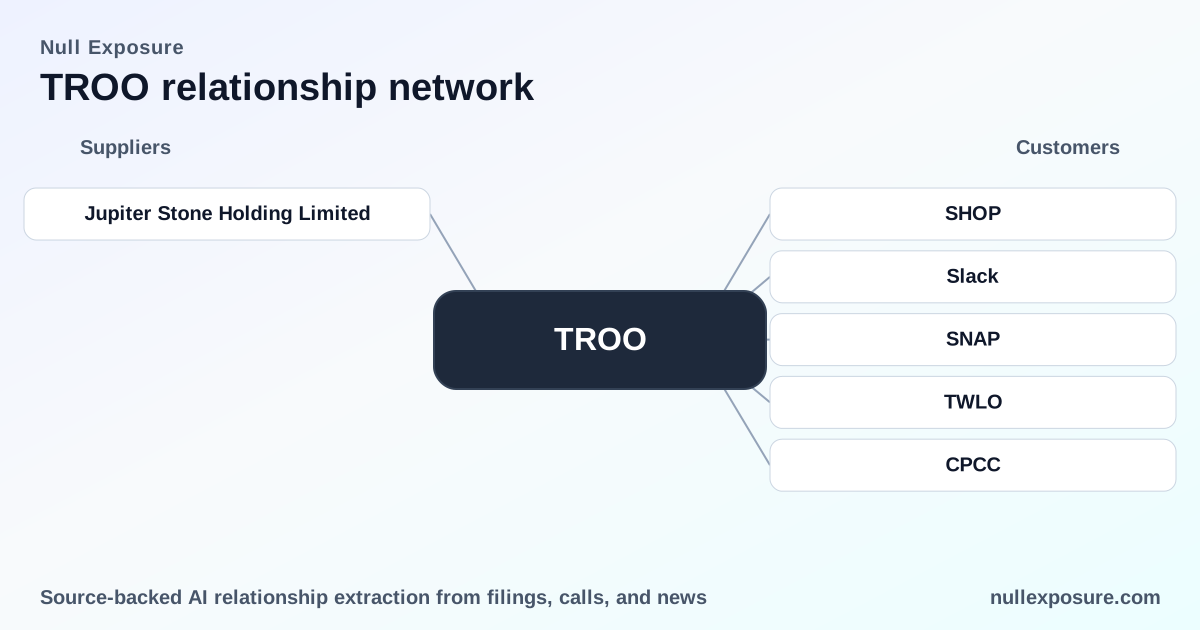
Industry reporting cites Troops as an integration layer used within Slack to surface Salesforce-driven alerts and workflows to teams; Slack is listed among the high-profile customers that adopted the product. This positions Troops as a workflow fabric embedded into team collaboration channels. (CRN coverage quoting AppExchange, March 10, 2026, referencing FY2022 usage.)
Snapchat
AppExchange and subsequent media coverage identify Snapchat as one of the enterprise users of Troops’ integration product, indicating engagement with advertising- and growth-oriented customers that value real-time sales and support signals. (CRN coverage quoting AppExchange, March 10, 2026, referencing FY2022 usage.)
Shopify
Troops is named alongside Shopify as a user of its Salesforce-to-collaboration integrations, signaling traction in e‑commerce stacks where operational speed and customer lifecycle signals are commercially valuable. (CRN coverage quoting AppExchange, March 10, 2026, referencing FY2022 usage.)
Twilio
Twilio is listed by AppExchange as a Troops customer, which underlines use cases tied to communications and customer-engagement platforms where Twilio’s services overlap with Troops’ alerting and workflow features. (CRN coverage quoting AppExchange, March 10, 2026, referencing FY2022 usage.)
TWLO (duplicate listing)
The dataset contains a second listing of TWLO (Twilio’s ticker) that duplicates the Twilio reference from the same CRN/AppExchange source; this entry reinforces the same customer relationship but does not add distinct contractual detail. (CRN coverage quoting AppExchange, March 10, 2026.)
Stripe
Stripe is also named among the companies using Troops’ integration layer, which demonstrates penetration into payments and fintech-adjacent operations where event-driven workflows improve response time and conversion. (CRN coverage quoting AppExchange, March 10, 2026, referencing FY2022 usage.)
HK Golden, Inc.
MarketScreener reported that HK Golden, Inc. received funding from TROOPS, Inc., indicating Troops’ willingness to execute financing or strategic capital deployments to support ecosystem partners or affiliates. This transaction represents an outbound financing relationship rather than a classic software customer contract. (MarketScreener earnings/announcement summary for FY2025.)
Wang & Lee Holdings, Inc.
Troops sold 14,050,000 ordinary shares to Wang & Lee Holdings, Inc. at $0.90 per share on May 28, 2025 and then repurchased 4,400,000 of those shares for $3.96 million on July 24, 2025 under a repurchase agreement; Troops later amended lock-up restrictions related to these transactions. These transactions are governance- and liquidity-oriented and reflect active capital management with a counterparty investor. (TipRanks reporting on the May–July 2025 transactions.)
What these relationships collectively tell investors about operating constraints
- Contracting posture: Troops operates as a software licensor and systems integrator with strategic platform integrations that make it both a vendor and an operational dependency inside customer stacks. The company also executes occasional equity and financing transactions—an operational flexibility that supplements cash flow but introduces investor/partner dependence on capital events.
- Customer concentration and criticality: Public-facing references to major technology names (Slack, Twilio, Shopify, Stripe, Snapchat) are important commercial signals that validate product-market fit in enterprise collaboration and growth-platform contexts, but there is no single disclosed customer that dominates revenue in public records; this pattern suggests diversified reference customers without confirmed concentration risk in public filings.
- Financial maturity: Revenue is small relative to valuation and profitability is negative, so the business trades with early-stage financial characteristics: rapid product-led adoption potential offset by reliance on capital and insider liquidity actions. Insider ownership north of 50% and institutional ownership under 1% indicate concentrated control and limited institutional governance pressure.
- Transactional history signal: At the company level, Troops has historically acted as a seller in capital markets—evidence shows it sold units in a 2008 offering—indicating a precedent for equity transactions and secondary-market activity as part of its corporate finance toolkit. This is a company-level signal about the firm’s willingness to transact securities and restructure ownership, not a relationship-specific attribute.
Investment implications and next steps for analysts
- Upside thesis: Troops carries strategic value as an integration layer for enterprise CRM-to-communication workflows; major-name references validate technical relevance and support a go-to-market trajectory into high-value enterprise segments.
- Risk profile: High insider ownership, limited institutional participation, negative margins, and a high price-to-sales multiple imply a classic growth-versus-capital-risk tradeoff—investors must reconcile product traction with balance-sheet durability and governance dynamics.
- Due diligence checklist: Focus on contract-level revenue concentration, renewal rates with the named customers, the monetization mix between subscription and services, and the details of recent financing and repurchase agreements that affect shareholder dilution and insider liquidity.
For more granular relationship maps and transaction timelines, review our company dossiers at https://nullexposure.com/ — our research team tracks counterparties and balance-sheet events for active coverage universes.
Bold takeaway: Troops is strategically embedded in high-value enterprise workflows but remains financially immature; customer references de‑risk the product story while capital transactions and concentrated insider control shape the investment risk.