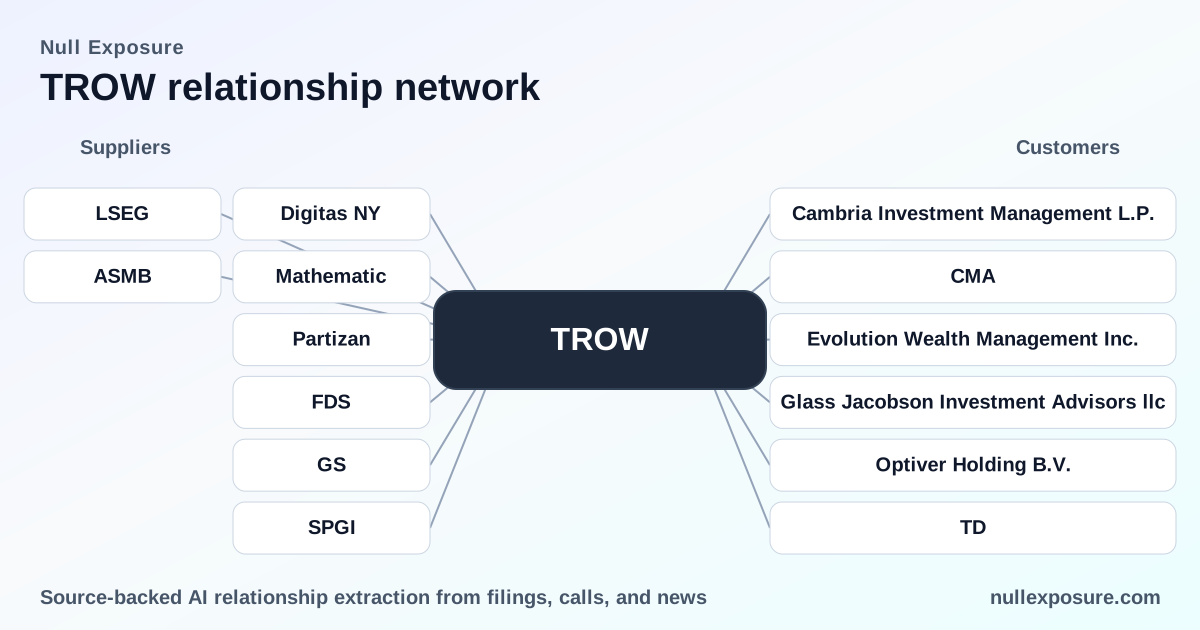
T. Rowe Price (TROW): Customer Relationships that Drive Product Distribution and Fee Revenue
T. Rowe Price is a global asset manager that monetizes through investment advisory fees, fund management, and related administrative services, selling strategies to individuals, financial advisors, institutions and retirement-plan sponsors worldwide. Its commercial motion combines direct retail fund sponsorship with distribution partnerships and third‑party platform placements, creating recurring fee streams tied to assets under management and product adoption across channels. For investors, the health of these external relationships is a leading indicator of AUM stability and fee growth potential. Learn more at https://nullexposure.com/.
Market read: T. Rowe Price’s recent relationship activity emphasizes distribution expansion (banks and wealth platforms), tax-smart portfolio delivery, and targeted product partnerships, signaling a push to scale model portfolios and institutional channels while parking capital in strategic asset-management alliances.
How T. Rowe Price’s operating model shapes commercial risk and opportunity
- T. Rowe Price’s investment agreements are relatively short-term and governable, with many fund mandates terminable on roughly 60 days’ notice—this creates low contractual lock-in but high governance oversight, so retention depends on performance and client relationships rather than long-term contractual entrenchment.
- The firm’s revenue base is dual: retail/individual clients plus large institutional counterparties, so commercial concentration is balanced across client types but U.S.-domiciled investors dominate AUM, with international clients representing a smaller but strategic share.
- Product delivery is service-led: T. Rowe Price is both seller and service provider, administering mutual fund and recordkeeping services in addition to advisory mandates—this increases stickiness where administrative integration is deep but also exposes operations to service execution risk.
- Overall, the company operates as a global asset manager with regional channel focus (Americas core, EMEA and APAC present); material counterparty losses (for example, termination of significant U.S. mutual fund agreements) would be material to results, so relationship management is a core risk-control function.
Key relationship signals (full coverage) Below I summarize every reported customer relationship in the source set; each item is limited to one or two plain-English sentences and cites the underlying report.
Amazon — transactional real estate sale
T. Rowe Price sold a parcel of its Owings Mills campus to Amazon for $15.2 million, reflecting non-core asset monetization rather than a strategic distribution tie. This was reported by the Baltimore Business Journal in late April 2026 (BizJ, Apr 30, 2026: https://www.bizjournals.com/baltimore/news/2026/04/30/t-rowe-price-owings-mills-campus-amazon-sale.html).
55ip — tax-smart model portfolio collaboration
T. Rowe Price partnered with 55ip (a J.P. Morgan-owned tax‑technology platform) to offer advisors custom model portfolios combining T. Rowe strategies with ActiveTax Technology for transitions, tax-loss harvesting and efficient withdrawals, expanding T. Rowe’s advisor-facing tax-capable product set. The collaboration announcement was covered by SahmCapital on April 22, 2026 (SahmCapital, Apr 2026: https://www.sahmcapital.com/news/content/is-t-rowe-price-trow-quietly-reframing-its-edge-around-taxsmart-advisor-solutions-2026-04-25).
Aspida — asset-management partnership for insurance platform
T. Rowe Price invested in a strategic partnership with Aspida and now, together with OHA, manages certain public and private assets on behalf of Aspida’s $30 billion life insurance and annuity platform, representing a distribution and delegated‑asset mandate into insurance balance sheets. This was noted in the Q1 2026 earnings call transcript (Investing.com transcript, Q1 2026: https://www.investing.com/news/transcripts/earnings-call-transcript-t-rowe-prices-q1-2026-eps-beats-forecasts-stock-dips-93CH-4649462).
Cambria Investment Management L.P. — investor in T. Rowe ETF
Cambria purchased a new stake in the T. Rowe Price Blue Chip Growth ETF (TCHP) during the third quarter, signaling third-party investment interest in T. Rowe’s ETF product lineup. The filing-based report was covered in March 2026 (DefenseWorld report, Mar 6, 2026: https://www.defenseworld.net/2026/03/06/cambria-investment-management-l-p-buys-new-stake-in-t-rowe-price-blue-chip-growth-etf-tchp.html).
CMA (ticker CMA) — small new stake in T. Rowe ETF
A Comerica Bank filing listed a new, modest position in the T. Rowe Price Blue Chip Growth ETF, reported at about $38,000—an example of regional bank/wealth manager participation in T. Rowe ETFs. The position was detailed in the same March 2026 coverage (DefenseWorld, Mar 6, 2026: https://www.defenseworld.net/2026/03/06/cambria-investment-management-l-p-buys-new-stake-in-t-rowe-price-blue-chip-growth-etf-tchp.html).
Comerica Bank — confirmation of new, modest ETF position
Comerica Bank is separately reported as having acquired a new stake in the Blue Chip Growth ETF valued at roughly $38,000, reinforcing that regional banks are accumulating exposure to T. Rowe ETFs at a granular level. Source: DefenseWorld coverage based on SEC filings (Mar 2026: https://www.defenseworld.net/2026/03/06/cambria-investment-management-l-p-buys-new-stake-in-t-rowe-price-blue-chip-growth-etf-tchp.html).
Glass Jacobson Investment Advisors LLC — significant position increase
Glass Jacobson increased its holding in the T. Rowe Price Blue Chip Growth ETF by 92.4% during the reported quarter, indicating substantial reallocation toward this T. Rowe product by a boutique advisor. Reported in the March 2026 aggregation of Form 13 filings (DefenseWorld, Mar 6, 2026: https://www.defenseworld.net/2026/03/06/cambria-investment-management-l-p-buys-new-stake-in-t-rowe-price-blue-chip-growth-etf-tchp.html).
Evolution Wealth Management Inc. — new position in ETF
Evolution Wealth Management initiated a new position in the Blue Chip Growth ETF valued at approximately $172,000, demonstrating advisory-platform adoption of T. Rowe ETF offerings. Source: March 2026 filings coverage (DefenseWorld, Mar 6, 2026: https://www.defenseworld.net/2026/03/06/cambria-investment-management-l-p-buys-new-stake-in-t-rowe-price-blue-chip-growth-etf-tchp.html).
Optiver Holding B.V. — new market participant in ETF
Optiver purchased a new position in the Blue Chip Growth ETF valued at $175,000, signaling proprietary or liquidity-provision interest from a market‑making/trading firm. Reported in the March 2026 filings roundup (DefenseWorld, Mar 6, 2026: https://www.defenseworld.net/2026/03/06/cambria-investment-management-l-p-buys-new-stake-in-t-rowe-price-blue-chip-growth-etf-tchp.html).
TD (ticker TD) — Canadian intermediary ramping ETF exposure
TD Waterhouse Canada increased its holdings in the Blue Chip Growth ETF by 192.2% during the second quarter, representing material channel adoption within a major Canadian brokerage. Source: filings coverage, March 2026 (DefenseWorld, Mar 6, 2026: https://www.defenseworld.net/2026/03/06/cambria-investment-management-l-p-buys-new-stake-in-t-rowe-price-blue-chip-growth-etf-tchp.html).
TD Waterhouse Canada Inc. — same Canadian firm, same growth signal
The specific entity TD Waterhouse Canada Inc. is identified as growing its ETF holdings by 192.2%, underscoring strong distributor activity from a national brokerage arm (DefenseWorld, Mar 6, 2026: https://www.defenseworld.net/2026/03/06/cambria-investment-management-l-p-buys-new-stake-in-t-rowe-price-blue-chip-growth-etf-tchp.html).
Goldman Sachs — product and model‑portfolio collaboration
T. Rowe Price reported that collaboration with Goldman Sachs is progressing on model portfolios and product development, including plans for an interval fund and a target‑date sister series later in the year—this expands T. Rowe’s institutional distribution and product shelf. The update came during the Q1 2026 earnings call transcript (Investing.com transcript, Q1 2026: https://www.investing.com/news/transcripts/earnings-call-transcript-t-rowe-prices-q1-2026-eps-beats-forecasts-stock-dips-93CH-4649462).
First Abu Dhabi Bank — moving from planning to execution
T. Rowe Price advanced its partnership with First Abu Dhabi Bank into execution, with marketing, training and client support preparations for a targeted mid‑2026 launch, indicating concrete APAC/EMEA channel expansion. This was stated on the Q1 2026 call (Investing.com transcript, Q1 2026: https://www.investing.com/news/transcripts/earnings-call-transcript-t-rowe-prices-q1-2026-eps-beats-forecasts-stock-dips-93CH-4649462).
JP Morgan — strategic distribution partnership win
T. Rowe Price secured a partnership with JP Morgan to distribute model portfolios, a notable win given JP Morgan’s scale and the competitive marketplace for model‑portfolio supply. RIA Biz reported on this development in late April 2026 (RIA Biz, Apr 28, 2026: https://riabiz.com/a/2026/4/28/t-rowe-nabs-coveted-jp-morgan-partnership-not-long-after-signing-one-with-goldman-sachs-both-trace-to-its-2024-hire-of-model-portfolios-executive-josh-horesh-from-blackrock).
Goldman Sachs — additional reporting on the JP Morgan/Goldman context
A second RIA Biz note referenced the Goldman Sachs partnership alongside the JP Morgan deal, reinforcing that T. Rowe is executing a deliberate model‑portfolio distribution strategy with multiple large intermediaries (RIA Biz, Apr 28, 2026: https://riabiz.com/a/2026/4/28/t-rowe-nabs-coveted-jp-morgan-partnership-not-long-after-signing-one-with-goldman-sachs-both-trace-to-its-2024-hire-of-model-portfolios-executive-josh-horesh-from-blackrock).
Interpreting the relationship map for investors
- Distribution is the priority: partnerships with Goldman Sachs, JP Morgan and First Abu Dhabi Bank, together with advisor tools like 55ip, demonstrate a deliberate move to scale product placement through major intermediaries and tax‑efficient advisor workflows.
- Product diversification is tactical: ETF placements and the planned interval and target‑date products broaden recurring-fee engines while giving distribution partners more reasons to allocate client assets to T. Rowe vehicles.
- Commercial exposure is manageable but performance‑sensitive: short‑notice termination clauses across fund agreements mean client retention relies on performance, product fit and distribution execution, not contractual lock‑in.
If you’re evaluating T. Rowe Price for exposure to distribution-led growth or assessing counterparty concentration, these relationship developments are material signals of execution. For a consolidated view of customer relationships and ongoing monitoring, visit https://nullexposure.com/ for more curated coverage and tools.