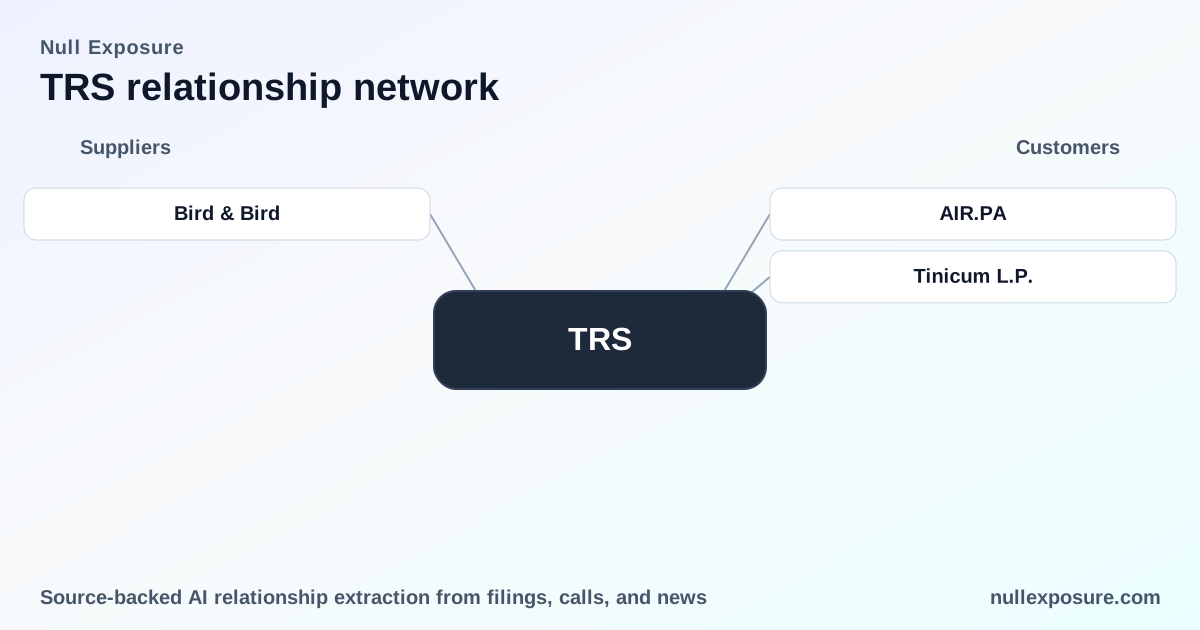
TriMas (TRS) — Customer Relationships That Reshaped an Aerospace Franchise
TriMas operates and monetizes as a diversified industrial manufacturer: it designs, engineers and manufactures branded components and packaging products for consumer, aerospace & defense, and industrial customers, selling through a mix of direct OEM contracts and distribution partners. Revenue is generated from recurring product sales, long-term supplier agreements in aerospace and industrial markets, and targeted acquisitions/divestitures that reshape cash flow and capital allocation.
For a granular customer-risk read on TriMas’s recent moves and counterparties, see the company-level mapping at https://nullexposure.com/ — the platform aggregates these relationship signals for investment and operational due diligence.
Business model signals investors should carry forward
TriMas’s commercial model blends stable OEM relationships with distribution channels and selective M&A to scale specialized brands. Key monetization vectors are recurring supply contracts with aerospace OEMs and Tier One suppliers, industrial sales through distributors, and packaging revenue from a global sales footprint. The company translates branded engineering into margin via scale and certification-driven supply positions in regulated markets.
- Direct OEM exposure produces higher revenue visibility but concentrates counterparty risk.
- Distributor channels smooth market access but create inventory and order-timing variability.
- M&A and divestitures are an explicit capital allocation tool, transforming balance-sheet value into cash and altering revenue composition.
For expanded coverage and an annotated relationship map, visit https://nullexposure.com/.
What TriMas’s operating constraints reveal about customer risk
TriMas’s public disclosures and recent filings reveal several company-level operating constraints that shape customer dynamics:
- Contracting posture: long-term supplier relationships with conservative accounting — TriMas records engineering and R&D for products sold on long-term supply arrangements as expense unless a customer contractual guarantee exists, signaling that TriMas absorbs upfront development cost risk unless contracts explicitly shift it to customers.
- Counterparty mix includes government and large enterprises — TriMas Aerospace lists OEMs, Tier One suppliers, distributors and the United States government among primary customers, indicating defense and large-enterprise pockets that carry procurement cycles, certification barriers and sometimes favorable durability.
- Geographic concentration with global reach — Approximately 77% of 2024 net sales came from North America, although packaging operations are managed on a global footprint; this creates North American revenue concentration risk alongside diversified international operations.
- Channel structure: distributor and direct-seller hybrid — The company relies on both direct OEM contracts and leading distributors, which reduces go-to-market friction but introduces inventory-cycle exposure.
- Mature supplier status in aerospace — TriMas brands are long-term, certified aerospace suppliers, which underpins stable contract renewal prospects but also means high switching costs and certification-related operational obligations.
Together these constraints describe a company that operates with durable aerospace supplier credentials, material North American revenue concentration, and a contracting model that leaves TriMas economically exposed to pre-production costs absent customer guarantees.
Relationship roll-call — every customer/transaction signal in the dataset
Below are the identified counterparties and transaction signals drawn from recent reporting and filings. Each item is summarized in plain English with source attribution.
-
PennAero
TriMas completed the sale of its aerospace unit to PennAero for approximately $1.45 billion in cash, a transaction that materially alters TriMas’s aerospace cash flow and reduces direct OEM supplier exposure within the consolidated company. (Investing.com report, May 2026 — https://www.investing.com/news/company-news/trimas-declares-004-quarterly-dividend-payable-in-may-93CH-4632729) -
Airbus (multi-year contract announcement via Torque Expo)
TriMas Aerospace’s Monogram, Allfast and Mac Fasteners brands were awarded a multi-year global contract with Airbus, reflecting continued OEM-level wins and the company’s ability to secure large enterprise aerospace business. (Torque-Expo article, March 2026 — https://www.torque-expo.com/article/trimas-secures-multi-year-contract-airbus) -
AIR.PA (duplicate reporting for Airbus contract)
The same Airbus award was reflected again in market reporting under the AIR.PA ticker, reinforcing that Airbus represents a material OEM counterparty for TriMas’s fastening brands in FY2025 coverage. (Torque-Expo article republished / mirrored entry, March 2026 — https://www.torque-expo.com/article/trimas-secures-multi-year-contract-airbus) -
Tinicum L.P.
Legal advisory filings show that Jones Day advised TriMas on the $1.45 billion sale of its Aerospace segment to an affiliate of Tinicum L.P., indicating that private-equity-related ownership plays a role on the buyer side of the divestiture. (Jones Day advisory notice, reported 2025/2026 — https://www.jonesday.com/en/practices/experience/2025/11/trimas-sells-aerospace-segment) -
Airbus (earnings call disclosure referencing GMT Aerospace purchase agreement)
In TriMas’s earnings-call transcript, management disclosed a purchase agreement for GMT Aerospace — a target with approximately €20 million in revenue, roughly half tied to Airbus — and noted the deal was expected to close subject to customary conditions, highlighting transactional activity that preserves Airbus-related revenue exposure even as the broader aerospace unit was being sold. (Earnings call transcript reported by The Motley Fool, April 2026 — https://www.fool.com/earnings/call-transcripts/2026/04/22/trimas-trs-q3-2024-earnings-call-transcript/)
Implications for investors and operators
- De-risking via divestiture but sustaining OEM links. The aerospace sale to PennAero / affiliate of Tinicum L.P. unlocks substantial cash but TriMas retains exposure to Airbus through contracted product lines and smaller OEM acquisitions like GMT Aerospace; this is a deliberate pivot from owning a large aerospace segment to preserving targeted routes to market.
- Customer concentration and geography remain material. With a majority of revenue in North America and significant OEM customers, TriMas’s topline is concentrated by region and counterparty type; investors must weigh the stability of certification-driven contracts against cyclical aerospace demand.
- Contract terms drive economic exposure. The company’s accounting posture on R&D and pre-production costs signals that TriMas bears early-stage development expense risk absent explicit customer reimbursement clauses, which affects margin volatility on new product programs.
Bold takeaway: TriMas has converted a heavyweight aerospace operating franchise into a capital-rich, more focused manufacturer while keeping commercial exposure to strategic OEM customers like Airbus; that repositioning changes credit and revenue risk profiles but does not eliminate OEM concentration.
For a complete mapping of TriMas customer signals and to integrate these relationship data into credit or supplier diligence workflows, consult the annotated relationship overview at https://nullexposure.com/.
Final note for portfolio managers
TriMas now trades and operates from a different base: a smaller aerospace footprint sold for meaningful cash proceeds, ongoing OEM contracts that sustain product-level revenue, and a distribution/packaging business with global reach but North American concentration. Investors evaluating TRS should focus diligence on the contractual allocation of development costs, the pace of integration or divestiture-related transitions, and the concentration of revenue by large enterprise OEMs.