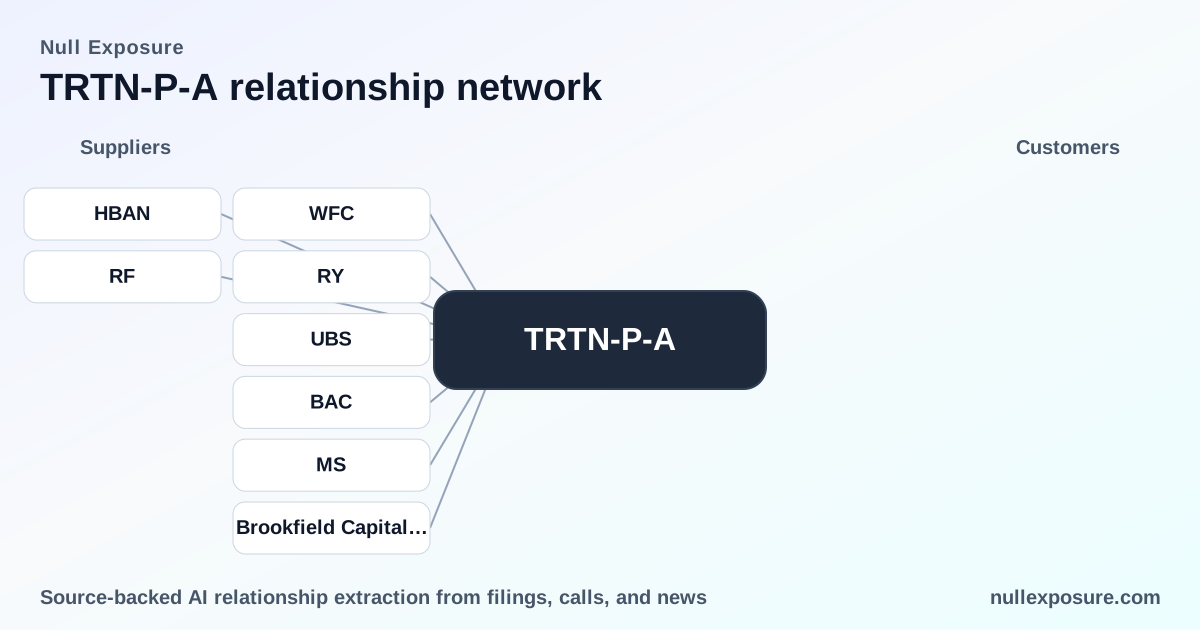
Triton International (TRTN-P-A): Customer Concentration and Counterparty Profile
Triton International operates and monetizes a global container-leasing business: the company leases intermodal freight containers and related equipment to ocean carriers and logistics operators, generating recurring lease billings and finance-lease receipts that underpin cash available to preferred shareholders. For investors evaluating TRTN-P-A, the core underwriting question is counterparty concentration and the stability of lease cash flows tied to a small number of very large shipping lines. For a fast pass to structured counterparty intelligence, visit the NullExposure homepage.
Big carriers account for the bulk of lease billings — concentration is real and material
Triton discloses that its top three customers accounted for nearly half of lease billings in 2022: CMA CGM S.A. (20%), Mediterranean Shipping Company S.A. (17%) and Ocean Network Express (11%) — a combined 48% of lease billings in 2022. This level of concentration identifies a clear counterparty risk vector for preferred-equity investors: cash flow stability depends on continued business with a very small set of large liner companies, whose demand and credit profiles fluctuate with global trade cycles. The source for these figures is Triton’s 2022 annual report filed with the SEC (https://www.sec.gov/Archives/edgar/data/1660734/000166073423000033/trtn-20221231.htm).
Bold takeaway: Top-three customer concentration (48% of lease billings in 2022) is a primary underwriter risk for TRTN-P-A.
Relationship-by-relationship breakdown
-
CMA CGM S.A. — Triton reported CMA CGM represented approximately 20% of lease billings in 2022, making it the company’s single largest customer; this level of exposure concentrates revenue on one major liner operator (see Triton’s 2022 SEC filing at https://www.sec.gov/Archives/edgar/data/1660734/000166073423000033/trtn-20221231.htm).
-
Mediterranean Shipping Company S.A. — MSC accounted for approximately 17% of lease billings in 2022, the company’s second-largest customer and another cornerstone counterparty whose commercial and credit behavior directly affects Triton’s lease revenue (Triton 2022 SEC filing).
-
Ocean Network Express — ONE represented approximately 11% of lease billings in 2022, ranking third by billing volume and forming the remainder of the top-tier counterparty exposure that drives much of Triton’s lessor economics (Triton 2022 SEC filing).
-
TriStar Container Services (Asia) Private Limited — Triton received $2.0 million of payments on finance leases with TriStar for each of the years ended December 31, 2022 and 2021, a discrete cash-flow datapoint that illustrates the presence of smaller, finance-lease counterparties alongside the major liners (Triton 2022 SEC filing).
-
APO (Apollo Global Management) — A report in FY2026 noted that an Apollo-managed fund completed the acquisition of a majority stake in Kelvion Holding GmbH from Triton’s Fund IV, reflecting Triton’s private-equity fund activity rather than a customer-supplier relationship for the container-leasing business; this is sourced from a Simply Wall St summary dated FY2026 (https://simplywall.st/stocks/us/diversified-financials/nyse-apo/apollo-global-management).
Each of these entries pulls directly from Triton’s public filing or the third-party report above; the SEC annual report is the anchor for customer concentration data and TriStar’s finance-lease payments (https://www.sec.gov/Archives/edgar/data/1660734/000166073423000033/trtn-20221231.htm).
How the operating model shapes risk and return for preferred holders
Triton’s business model is built on leasing high-turnover, commoditized assets into global trade flows. From an investor perspective, this creates four compact, actionable characteristics:
-
Contracting posture: recurring lease billings. The business recognizes revenue through lease billings and finance-lease receipts, which produces predictable cash flows when counterparties perform. Those cash flows are nevertheless exposed to renewal timing and utilization cycles in ocean freight.
-
Concentration: high counterparty concentration at the top. The top three accounts produced 48% of lease billings in 2022, concentrating both revenue and counterparty credit exposure in a handful of global liners. This structural feature elevates the impact of any credit stress or renegotiation by those carriers.
-
Criticality: containers are essential to global liner operations. Containers are fundamental inputs to shipping networks; that criticality supports demand elasticity but does not eliminate counterparty credit risk or residual-value pressures in downturns.
-
Maturity: industry is mature with cyclical demand. Container leasing is a mature service with established commercial norms; revenue volatility tracks global trade volumes and fleet utilization rather than startup-style growth drivers.
These characteristics combine to make TRTN-P-A an income instrument whose stability is driven by counterparty credit and shipping-cycle dynamics rather than rapid organic revenue expansion.
Practical implications for valuation and risk management
Preferred shareholders should underwrite TRTN-P-A against three vectors:
-
Counterparty credit risk from the largest liners. Given the 48% concentration, underwrite scenarios where one or more of CMA CGM, MSC, or ONE reduces lease utilization or experiences credit stress.
-
Residual value and asset utilization risk. Container values and secondary-market transport economics can compress lessor returns in downturns; preferred dividends are sensitive to both lease payments and asset impairment cycles.
-
Diversification and tail exposure. Smaller finance-lease customers (for example, TriStar’s $2.0M receipts) partially diversify cash flows but do not materially offset the concentration at the top.
Investors should stress-test preferred cash flows against shipping-cycle shocks and counterparty rating deterioration, and factor in the potential for covenant and structural protections embedded in the preferred issue documentation.
What the public record shows — and what it doesn’t
Primary public evidence for customer concentration comes from Triton’s FY2022 disclosures on the SEC (https://www.sec.gov/Archives/edgar/data/1660734/000166073423000033/trtn-20221231.htm). A FY2026 market summary from Simply Wall St documents fund-level transactions involving Apollo and Triton’s private-equity activity (https://simplywall.st/stocks/us/diversified-financials/nyse-apo/apollo-global-management). The company profile provided for TRTN-P-A lacks granular current operating metrics (several financial fields are blank or zero), so credit and coverage analysis must lean on company filings and market data rather than the supplied profile.
For investors who require structured counterparty mapping, concentration dashboards, and source-linked evidence to support capital allocation decisions, the NullExposure homepage provides tools and visualizations built for this style of due diligence.
Conclusion — the investor view
Triton’s preferred shares are anchored in a business with material revenue concentration among the world’s largest container lines and cash flow mechanics tied to recurring lease billings. That concentration is the defining risk for TRTN-P-A: it offers income potential tied to an essential global infrastructure asset, but the upside is paired with exposure to a small set of counterparties whose fortunes swing with global trade. Investors should prioritize counterparty credit monitoring, residual-value scenarios, and explicit stress testing of the top-three customer relationships when underwriting TRTN-P-A.