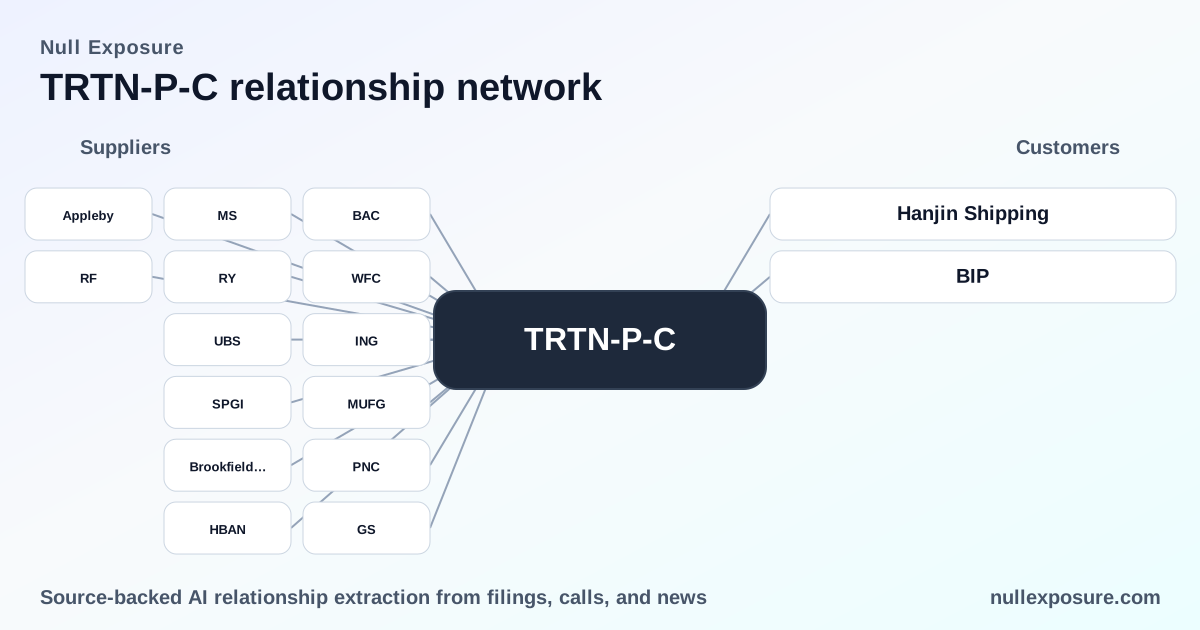
TRTN-P-C Customer Relationships: Counterparty Risk and the Private-Equity Transition
Triton International is a capital-intensive lessor of intermodal shipping containers that generates revenue through lease rentals and secondary sales of fleet assets; its economics are driven by fleet utilization, lease tenor, and residual values. For investors in TRTN-P-C, the critical lens is counterparty quality and structural ownership: lease cashflow is predictable when counterparties are creditworthy, but concentrated exposures and ownership changes materially reframe counterparty contracting posture and liquidity optionality. For a concise toolkit to analyze counterparties across preferred and common capital structures, review Null Exposure’s platform at https://nullexposure.com/.
How one customer shock defines credit economics
Triton’s historical interaction with Hanjin Shipping is the canonical example of counterparty concentration risk translating directly into earnings volatility and insurance recoveries. In 2016 Hanjin defaulted on leases, and Triton later reported insurance receipts tied to lost leasing revenue as well as tax revaluation benefits stemming from corporate tax changes. This underscores that counterparty defaults are not hypothetical — they generate measurable cashflow impacts, insurance claims, and one-off tax effects that distort operating results.
The ownership change: from public lessor to Brookfield-controlled asset
A wave of reporting in 2026 confirmed that Brookfield’s infrastructure arm closed on the acquisition of Triton, removing the company from active public listing and retiring the TRTN ticker. Private ownership under an infrastructure investor shifts contracting posture away from public-market reporting cadence and toward multi-year asset management and capital structuring objectives. Multiple outlets noted the deal value and subsequent suspension of trading.
Relationship-by-relationship read (clean, investor-focused)
Hanjin Shipping
Triton had roughly 3% of its container fleet leased to Hanjin when that carrier filed for bankruptcy, an event that produced lost lease revenues and subsequent insurance recoveries; Triton disclosed $6.8 million in insurance receipts tied to that default and recognized related tax impacts in later reporting. Source: The Royal Gazette reporting on Triton’s exposure to Hanjin (FY2017–FY2018) — see https://www.royalgazette.com/international-business/business/article/20170316/triton-shares-surge-on-upbeat-outlook/ and https://www.royalgazette.com/other/business/article/20180227/tax-benefit-boosts-triton-profits/.
BIP (inferred symbol BIP)
News wires reiterated that the acquisition by Brookfield Infrastructure Partners closed and that Triton’s listing has been suspended, effectively retiring the TRTN ticker and moving customer relationships under Brookfield’s stewardship. Source: ad-hoc news summary referencing Reuters and Bloomberg on the closure (FY2026) — https://www.ad-hoc-news.de/boerse/ueberblick/triton-international-from-container-giant-to-private-equity-play-what/68450702.
Brookfield Infrastructure Partners
Brookfield Infrastructure Partners is reported as the acquirer that closed the transaction, taking direct control of Triton’s fleet and customer contracts and shifting the company from a public lessor to a private infrastructure asset. Source: ad-hoc news summary citing major financial wires on the deal closure (FY2026) — https://www.ad-hoc-news.de/boerse/ueberblick/triton-international-from-container-giant-to-private-equity-play-what/68450702.
Brookfield / BAM (inferred symbol BAM)
Brookfield’s broader corporate family was cited in coverage of the purchase, with market reporting indicating a roughly $13 billion enterprise valuation including debt, which places Triton squarely in the strategic infrastructure portfolio of Brookfield and affords larger-scale balance-sheet flexibility for customer contract management. Source: PE-Insights and other financial coverage on the acquisition (FY2024 reporting cited in 2026 articles) — https://pe-insights.com/brookfield-trumps-buyout-titans-with-50bn-deal-spree/.
What these relationships tell investors about operating posture and risk
- Contracting posture: Under public ownership, Triton operated as an asset-light lessor reliant on transparent quarterly disclosures; now, under Brookfield control, contracting posture shifts toward longer-term asset management, less public disclosure cadence, and more centralized counterparty risk management. This is a company-level signal, not linked to a single customer.
- Concentration and counterparty risk: The Hanjin episode demonstrates that even single-name exposures in the low single-digit fleet share can produce outsized impacts through lost rent and recovery processes. Portfolio diversification across lessees is essential to stabilize cashflows.
- Criticality of relationships: Shipping lines are operationally critical customers — containers are essential inputs for trade — but supplier substitutability and the secondary container market moderate monopoly power. Customer importance is high, but counterparty leverage exists on both sides.
- Maturity and capital intensity: The container lessor business sits in a mature, cyclical industry where fleet investment and disposal timing drive returns; private ownership under Brookfield signals a shift toward multi-year optimization of fleet cycles and balance-sheet financing, reducing short-term volatility but concentrating decision-making.
- Disclosure and liquidity constraints: With the TRTN listing suspended, information flows and market liquidity for claims tied to preferred instruments change materially; preferred holders should reassess liquidity access and covenant protections as company reporting transitions to private formats.
For deeper, structured analysis of how customer exposures map to capital structure outcomes, see Null Exposure’s research hub at https://nullexposure.com/.
Investment implications: priorities for preferred holders
- Counterparty credit monitoring is the primary risk vector. The Hanjin default shows that even modest fleet exposure to a single lessee leads to real cashflow disruption and reliance on insurance outcomes.
- Ownership transition reduces public transparency but increases balance-sheet flexibility. Brookfield ownership likely reduces short-term refinancing and liquidity stress but concentrates strategic control—preferred holders should evaluate contractual protections under the private ownership regime.
- Focus diligence on lease tenor, concentration metrics, and insurance coverage. The combination of lease lengths, customer concentration, and the adequacy of contingent recoveries drives residual value and coupon coverage for preferred instruments.
- Re-evaluate market liquidity and exit routes. The effective retirement of the public ticker removes a straightforward market price discovery mechanism; holders must plan for lower liquidity and different exit alternatives.
Bottom line
Triton’s customer relationships demonstrate two consistent themes: counterparty credit drives earnings volatility, and ownership structure materially changes how those relationships are governed and disclosed. Preferred investors in TRTN-P-C should prioritize counterparty monitoring, insurance and recovery mechanics, and contractual protections in a private-owner operating model.
For comparative customer-risk scoring and contract-level signals that inform preferred credit analysis, explore the Null Exposure platform: https://nullexposure.com/.