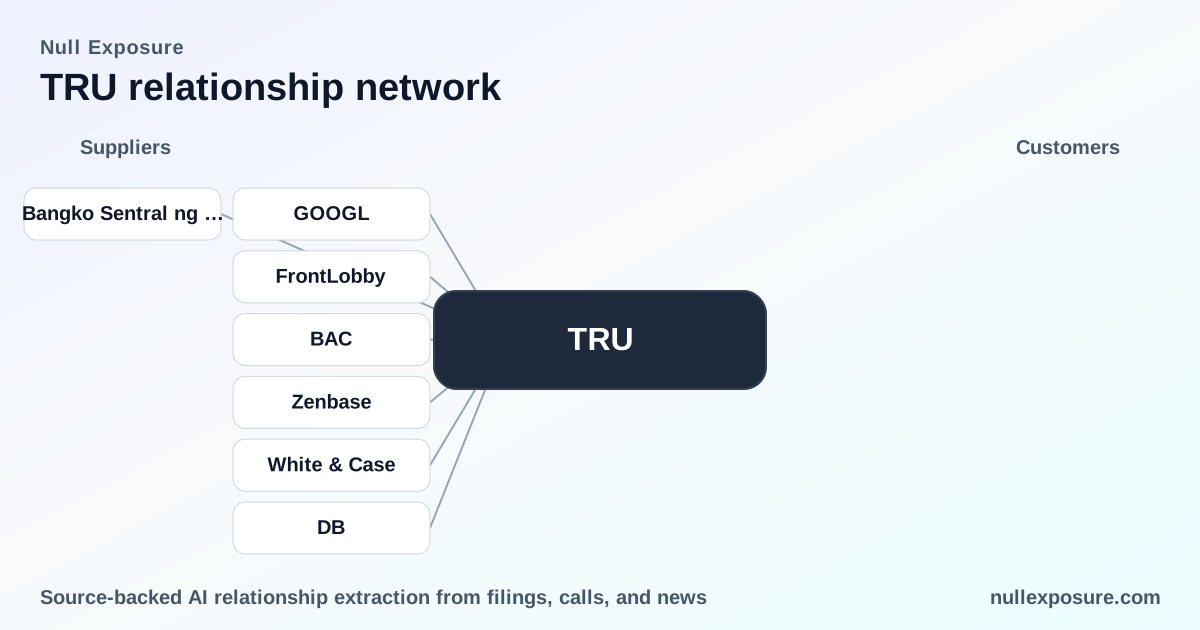
TransUnion (TRU) — Customer Relationships That Drive Revenue Visibility
Thesis: TransUnion monetizes a global portfolio of subscription, usage-based and transaction services that embed into lenders’, insurers’ and marketers’ decisioning workflows; revenue derives from short-duration contracts, recurring subscription fees and per-transaction delivery of credit, identity and fraud signals, giving the company high revenue visibility and sticky cash flows as customers operationalize TransUnion outputs across lending and marketing systems. For deeper relationship mapping and signals, visit https://nullexposure.com/.
How TransUnion’s commercial model converts data into durable revenue
TransUnion sells credit and identity solutions as both stand-ready services (SaaS and online delivery) and per-transaction products (credit reports, scores, fraud decisions). The firm uses a global sales force calibrated by customer size—dedicated teams for very large enterprises, shared teams for mid-market and call-center support for smaller customers—so monetization is a mix of subscription contracts, usage fees and licensed data. This structure produces high retention and revenue visibility because products are embedded in underwriting, fraud screening and marketing workflows that are costly for customers to replace.
Customer relationships: who’s on TransUnion’s roster (evidence-backed)
Below are every customer-relationship result in the source set, grouped by counterparty with source-specific summaries. Each entry reflects the underlying news item.
Denny’s Corporation (DENN)
A GlobeNewswire announcement covering Denny’s acquisition financing notes Truist Securities and law firms as advisors; the item was captured in the TransUnion relationship feed but does not describe a direct commercial product tie—its inclusion signals TransUnion monitoring of corporate activity around a hospitality customer. (GlobeNewswire, Jan 16, 2026) — https://www.globenewswire.com/news-release/2026/01/16/3220519/23968/en/denny-s-corporation-announces-completion-of-acquisition-by-triartisan-capital-advisors-treville-capital-group-and-yadav-enterprises.html
MoneyHero / MoneyHero Group (MNY / MNYWW)
Multiple investor releases from MoneyHero indicate a commercial collaboration: MoneyHero plans to launch Credit Hero Club in collaboration with TransUnion to drive engagement and monetize personalized financial recommendations, with expansion planned beyond Hong Kong. This positions TransUnion as the credit-data backbone for MoneyHero’s subscription/club product and points to an APAC growth footprint. (MoneyHero Q1 & Q2 results, FY2025) — https://macaubusiness.com/moneyhero-group-reports-first-quarter-2025-results and https://macaubusiness.com/moneyhero-group-reports-second-quarter-2025-results
Algebrik AI / Algebrik AI Inc.
Algebrik AI announced a bureau integration partnership with TransUnion to embed TransUnion credit and identity solutions inside Algebrik’s AI-driven loan-origination workflows, enabling banks and fintech lenders access to bureau data directly during underwriting. This is a direct commercial bureau-integration relationship that expands TransUnion’s distribution into loan-origination platforms. (PR Newswire & SimplyWallSt coverage, March–May 2026) — https://www.prnewswire.com/news-releases/algebrik-ai-announces-strategic-bureau-integration-with-transunion-to-power-smarter-more-inclusive-lending-302714608.html and https://simplywall.st/stocks/us/commercial-services/nyse-tru/transunion/news/is-transunions-tru-new-real-estate-and-lending-tools-quietl/amp
MRI-Simmons (majority-owned by NIQ)
MRI-Simmons expanded access to TransUnion’s TruAudience Data Marketplace, widening research-driven psychographic and behavioral audience segments for marketing clients; that extension deepens TransUnion’s role in data-powered marketing and targeted decisioning for advertisers and retailers. (SimplyWallSt & The Fly coverage, FY2026) — https://simplywall.st/stocks/us/commercial-services/nyse-tru/transunion/news/is-transunions-tru-quietly-repositioning-its-data-platform-as and https://www.tipranks.com/news/the-fly/transunion-initiated-with-a-neutral-at-mizuho-thefly-news
Fannie Mae (FNMA)
Fannie Mae has begun accepting VantageScore 4.0, representing a structural distribution channel for TransUnion’s scoring product into mortgage market origination and secondary-market pipelines; TransUnion reported providing free vintage scores and multiyear pricing for credit reports and VantageScore 4.0 through year-end as part of launch economics. (Earnings call transcripts and earnings coverage, Q1 2026) — https://www.insidermonkey.com/blog/transunion-nysetru-q1-2026-earnings-call-transcript-1749934/ and https://www.fool.com/earnings/call-transcripts/2026/04/28/transunion-tru-q1-2026-earnings-transcript/
Freddie Mac (FMCC)
Freddie Mac completed an operational test and took delivery of VantageScore loans, with plans to securitize them—this establishes TransUnion scoring as an input into agency loan flows and mortgage securitization economics. (Earnings call transcripts, Q1 2026) — https://www.insidermonkey.com/blog/transunion-nysetru-q1-2026-earnings-call-transcript-1749934/ and https://www.fool.com/earnings/call-transcripts/2026/04/28/transunion-tru-q1-2026-earnings-transcript/
Figure Technology (FIGR)
After a Figure data compromise, the firm offered complimentary credit monitoring via TransUnion to affected users, a common remediation relationship where TransUnion supplies credit-monitoring services as part of breach response programs. (Top Class Actions coverage, FY2026) — https://topclassactions.com/lawsuit-settlements/lawsuit-news/figure-technology-confirms-data-breach-affecting-nearly-1-million-users/
Note on overlapping notices: several entries are duplicate or near-duplicate press items captured from different outlets; where duplicates appear (MoneyHero, Algebrik, Fannie/Freddie, MRI-Simmons) the multiple sources corroborate the same commercial relationship or product acceptance across channels.
What the relationship signals tell investors about TransUnion’s operating constraints
The evidence set and TransUnion disclosures together sketch a consistent operating posture:
- Contracting posture — short-duration and recurring: TransUnion reports most customer contracts are one year or less, with deferred revenue primarily short-term, which generates steady renewal cadence and frequent pricing touchpoints. This increases revenue visibility but requires continuous sales effort to retain and expand customers.
- Mixed monetization — subscriptions plus usage-based fees: The company sells both subscription-based access and transaction-based products; this hybrid model balances predictable recurring revenue with upside from transaction volumes in periods of higher lending or consumer activity.
- Customer concentration and go-to-market segmentation: TransUnion serves very large enterprises, large and mid-market customers as well as small businesses, with dedicated teams for larger accounts—this indicates a dual focus on enterprise contracts and scale through mid-market distribution.
- Global reach with regional exposure: The company operates across North America, LATAM, EMEA and APAC; international operations contribute materially (~22.8% of revenue in the cited period), so regional macro or regulatory shifts will affect growth asymmetrically.
- Role and criticality: TransUnion functions as a service provider, licensor and seller—its products are often embedded and critical to customer decisioning, which historically produces high retention and revenue visibility.
- Product mix — services and software: The business combines stand-ready SaaS capabilities and data delivery (services) with software offerings for real-time decisioning, supporting both enterprise integrations and developer/platform distribution.
- Materiality of contract obligations: Other performance obligations are reported as not material, suggesting limited hidden future liabilities tied to customer contracts.
Investment implications and risks to watch
- Growth drivers: Expanding bureau integrations (Algebrik), marketing-data marketplace extensions (MRI-Simmons) and mortgage market acceptance of VantageScore 4.0 (Fannie/Freddie) are direct levers to accelerate recurring and transactional revenue.
- Operational risks: Heavy reliance on short-term contracts requires sustained sales and product innovation; international exposure and regulatory changes in data/privacy law are key risk vectors.
- Defensive attributes: Embedded decisioning roles and diversified customer size mix give TransUnion pricing power and resilience; remediation and monitoring services after breaches (Figure) also create predictable ancillary revenue.
For a systematic view of customer relationships and contract signals, explore our platform at https://nullexposure.com/ — subscription access surfaces relationship-level evidence and constraint signals used by institutional research teams.
Bold takeaways: TransUnion’s revenue base is sticky because its products are operationally embedded, yet growth depends on expanding platform integrations and maintaining contract renewals in a short-duration contract environment. Investors should weigh durable demand for credit and fraud signals against short-term contract dynamics and regional regulatory exposure.