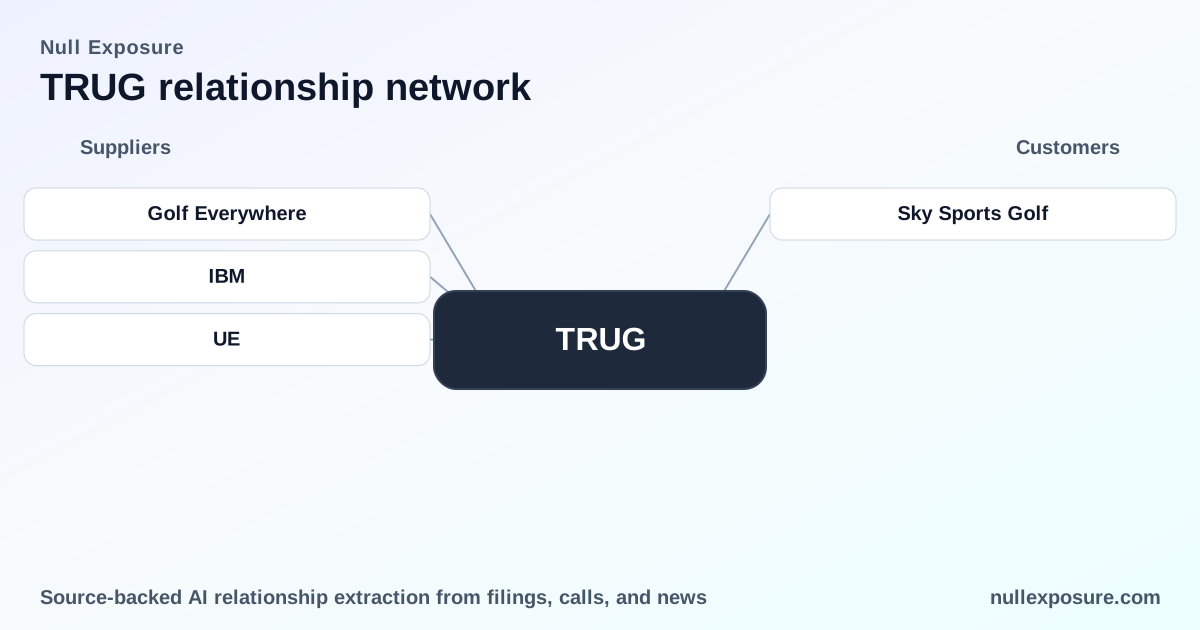
TruGolf (TRUG): Customer Relationships, Revenue Model, and Strategic Constraints
TruGolf monetizes by selling high-margin indoor golf hardware and capturing software economics through a mix of perpetual licenses and recurring content subscriptions, while expanding a global reseller and distributor network to scale hardware distribution and software reach. The company combines direct-to-consumer and channel sales for its TruGolf-branded simulators, licenses its E6 Connect software to third-party hardware partners, and generates recurring revenue from content and services that sit on top of its installed base. For a relationship map and ongoing updates, see Null Exposure.
How TruGolf makes money — hardware sales and embedded software economics
TruGolf’s core monetization is a dual product strategy: sell simulator hardware (one-time, high-ticket items) and capture software value through both perpetual licenses and time-bound subscriptions. Company disclosures describe revenue recognition for perpetual software licenses at installation and customer acceptance, while content software subscriptions are sold in one-month or twelve-month terms and recognized over the subscription period. This mix produces a contracting posture that blends transactional hardware receipts with predictable, recurring software cash flow.
The business model also depends on channel partners. TruGolf sells hardware through a global network of authorized resellers, retail outlets and direct sales, and it is building out a distributor footprint in EMEA and other regions to accelerate coverage. The company’s E6 software integrates with more than twenty-four third-party hardware manufacturers—reported as covering roughly 90% of global golf technology hardware—which converts software into a platform asset and increases the software’s commercial criticality across the market.
Company-level signals that shape customer risk and opportunity
Several operating constraints and disclosures are useful for investor underwriting:
- Contracting posture: The existence of both perpetual licenses and subscription contracts implies mixed revenue recognition timing and potential upsell levers (installation-triggered license revenue plus ongoing subscription churn/renewal monitoring).
- Channel concentration and maturity: TruGolf maintains an established reseller network in North America with EMEA still below 5% of total sales, and a slowly developing presence in Latin America and APAC; this reflects a mid-stage international expansion with incremental near-term upside but limited current contribution.
- Relationship roles: The company explicitly relies on distributors, resellers, and direct sellers, signaling execution risk tied to channel management and the need for investment in sales and marketing to scale internationally.
- Platform criticality: High integration coverage—software interoperable across most hardware—creates a meaningful strategic asset that supports recurring subscription penetration and cross-sell.
- Operational scale: TruGolf reports its software records, on average, over 725,000 indoor golf shots per day, a company-level indicator of active usage and product engagement.
These signals together define a company that is hardware-led but software-enabled, with recurring revenue upside contingent on subscription adoption, channel execution, and international scaling.
The relationships investors should know about
Sky Sports Golf — a high-visibility content and technology partnership
TruGolf provided its simulation engine and ball‑flight rendering technology for Sky Sports Golf’s award-winning broadcast of the 153rd The Open Championship, positioning TruGolf’s rendering and simulation stack in a premium broadcast environment and validating the product for high-end broadcast and event use (QuiverQuant, March 10, 2026: https://www.quiverquant.com/news/TruGolf+Holdings+Inc.+Plays+Key+Role+in+Award-Winning+Sky+Sports+Golf+Broadcast+of+The+Open+Championship). This relationship is primarily a technology showcase rather than a recurring revenue customer contract, but it demonstrates product maturity and opens channels into media, hospitality and experiential customers.
SZOP Opportunities I LLC — a potential capital and shareholder transaction
Shareholders approved a Nasdaq‑related measure to enable the potential sale of 20% or more of outstanding Class A stock to SZOP Opportunities I LLC, creating a pathway for a substantial equity transaction and increased capital flexibility (The Globe and Mail press release, May 4, 2026: https://www.theglobeandmail.com/investing/markets/stocks/TRUG/pressreleases/316597/trugolf-shareholders-approve-proposals-enhancing-capital-flexibility/). This is an investor/financing relationship rather than a customer engagement; however, it materially affects company capital structure and the availability of equity funding to support channel expansion and product development.
What the partner map implies for growth
TruGolf’s integration with third‑party hardware vendors and its channel strategy create a scalable path to convert hardware buyers into recurring software customers. Key growth levers are: increasing subscription attachment rates to new hardware sales, leveraging broadcast and experiential showcases to win enterprise and hospitality contracts, and accelerating distributor-led penetration in EMEA and APAC. The company’s assertion of integration coverage across 24+ manufacturers and near‑universal hardware compatibility is a strategic moat for software monetization if executed.
For investors tracking relationship-driven growth, monitor: subscription renewal rates, software attachment to new hardware revenue, reseller/distributor KPIs in EMEA, and any concrete commercial follow‑ons from high‑profile demonstrations like the Sky Sports broadcast. For continued visibility into relationship developments, visit Null Exposure.
Financial and governance constraints investors must price
Several financial signals are relevant when valuing TRUG:
- Revenue TTM stands at $18.9M with gross profit of $9.52M, but the company is operating with negative EBITDA and a materially negative EPS (Diluted EPS TTM: -55.94), reflecting a path of investment over near-term profitability.
- Operating margin and profit margin are deeply negative (Operating margin TTM: -37.1%; Profit margin: -80.7%), demonstrating that scaling revenue alone will not assure profitability without margin improvement.
- Market capitalization and low institutional ownership (PercentInstitutions: 0.066) signal limited analyst coverage and potential liquidity constraints; governance events that enable large equity placements (e.g., the SZOP transaction) are therefore consequential.
These facts make capital flexibility and the outcome of shareholder-authorized equity transactions central to the equity thesis.
Bottom line for investors
TruGolf offers a clear commercial architecture: a hardware base that drives upfront revenue and a software layer that creates recurring monetization and network effects through third‑party integrations. Relationships like the Sky Sports broadcast function as high-value proof points for enterprise momentum, while shareholder actions enabling a significant equity sale (SZOP Opportunities I LLC) change the capital and dilution calculus for investors. Key risks are execution on channel expansion, subscription conversion economics, and near-term margin recovery.
For ongoing relationship monitoring and structured summaries of counterparties, consult Null Exposure’s relationship intelligence at https://nullexposure.com/.