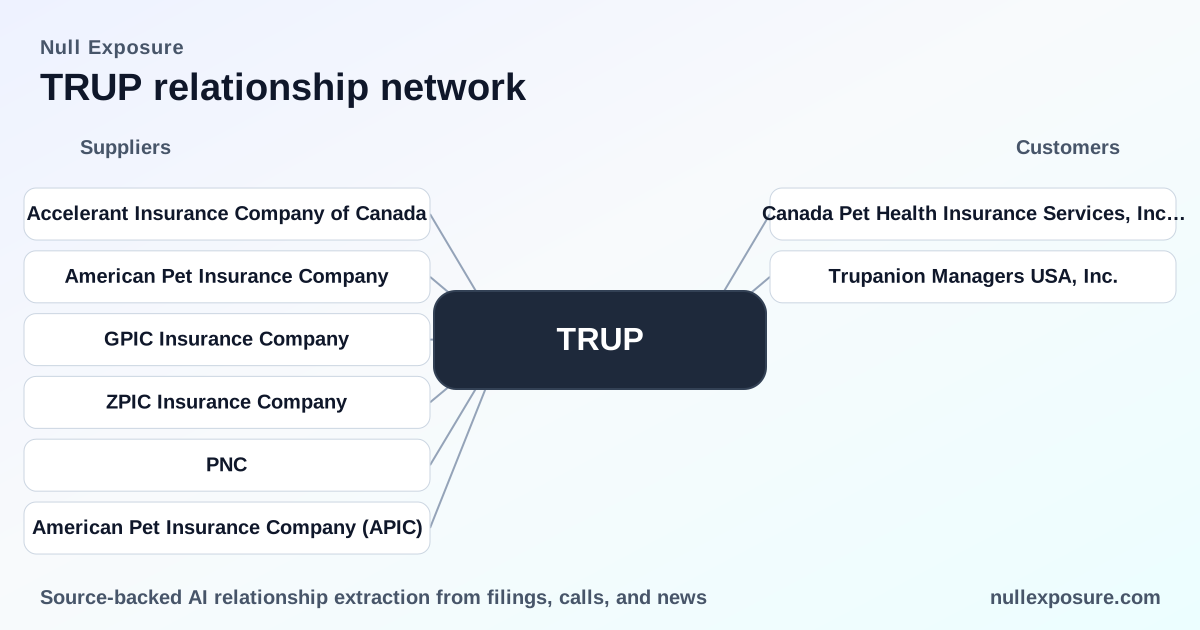
Trupanion’s customer footprint: subscription insurance, vet distribution, and what that means for investors
Trupanion operates a subscription-based veterinary medical insurance business for dogs and cats, monetizing primarily through monthly insurance premiums sold direct-to-consumer and through veterinary referral channels across North America, parts of Europe, and Australia. The company recognizes subscription revenue pro rata over policy terms and manages a distinct pet-acquisition cost profile that drives unit economics. For investors evaluating Trupanion’s customer relationships, the core focus is on recurring premium flows, distribution dependence on veterinarians and pet owners, and the regulatory/operational infrastructure split across legal entities. Learn more on NullExposure if you want a concise vendor view: https://nullexposure.com/
Snapshot: how the business actually makes money and where customers sit
Trupanion sells and administers medical insurance policies for cats and dogs. Revenue is predominantly subscription-based — insurance premiums billed monthly — and the company discloses that subscription activities generated approximately 67.0% of revenue for the year ended December 31, 2024. Trupanion’s go-to-market is a hybrid of veterinary referral (veterinarians educate and refer pet parents) and direct digital/phone enrollment, which places the counterparty squarely at the individual pet owner level rather than corporate buyers.
Financially, Trupanion operates at scale with approximately $1.48 billion in trailing twelve‑month revenue, thin operating margins relative to gross revenue (operating margin TTM ~1.24%), and a capital structure reflected in its market capitalization near $1.15 billion (latest reported figures). These numbers underline a mature recurring-revenue insurer with meaningful scale but tight unit profitability that is sensitive to acquisition cost and claims trends (company financials through the latest quarter ending March 31, 2026).
Customer relationships in plain English
Trupanion’s public reporting references specific legal entities that operate and administer policies by geography. These are not third-party customers of Trupanion; they are operating subsidiaries that hold licenses and run the policy books in the jurisdictions named.
Canada Pet Health Insurance Services, Inc. dba Trupanion
Policies sold and administered in Canada are managed by Canada Pet Health Insurance Services, Inc., doing business as Trupanion. This legal entity is the company’s Canadian operating arm responsible for policy issuance and administration in that country. According to a Finviz summary of Trupanion’s fourth-quarter/full-year 2025 results published March 10, 2026, the company explicitly states this Canadian entity handles Canadian policies. (Finviz summary, March 10, 2026)
Trupanion Managers USA, Inc.
In the United States, policies are sold and administered by Trupanion Managers USA, Inc., which holds the necessary state licensing referenced in public filings and press summaries. The same Finviz coverage of Trupanion’s FY2025 results notes Trupanion Managers USA, Inc. as the U.S. administrator of policies (Finviz summary, March 10, 2026).
What the disclosed constraints say about risk, concentration and operating posture
The collection of company disclosures provides a clear signal about Trupanion’s operating model and business-model constraints. Presenting these as company-level characteristics:
-
Contracting posture — subscription and recurring revenue. Trupanion explicitly runs a subscription business, recognizing premiums pro rata and targeting margins prior to pet-acquisition expense. That structure creates predictable top-line cash flows but obliges the company to manage high customer-acquisition and retention dynamics (company filings, year ended Dec 31, 2024).
-
Counterparty profile — individual retail customers. Distribution depends on pet owners (referred by veterinarians or self-directed to the website/contact center). That places emphasis on consumer marketing, lifetime value, and churn control rather than large enterprise contracting (company disclosures).
-
Geographic footprint — multi-region operations. Trupanion operates in North America, Australia, and certain Continental European countries; these geographies introduce regulatory and licensing complexity and create diversified premium pools but also demand localized underwriting and claims operations (company filings).
-
Concentration and criticality — subscription is material to results. With subscription revenue accounting for ~67% of 2024 revenue, the insurance premium stream is material to company performance; changes in premium pricing, claims frequency, or customer acquisition economics will meaningfully move results (company filings, year ended Dec 31, 2024).
-
Business role and segment maturity — seller of services. The firm categorizes operating activity into a subscription business and an “other” segment; Trupanion acts as seller/insurer and service provider, indicating an operational focus on claims processing, underwriting, and policy servicing rather than pure tech facilitation.
Taken together, these constraints define a business that is recurring-revenue, consumer-facing, geographically diversified, materially concentrated in subscription premiums, and operationally mature but margin-constrained.
Investment implications: what to watch and why it matters
-
Top-line stability but narrow operating leverage. The subscription model produces predictable premium flows, yet operating and profit margins are slim; small changes in claims or acquisition costs have outsized EBIT impact. Monitor pet-acquisition expense trends and retention rates.
-
Distribution dependency. Veterinarian referrals are a strategic asset that reduces pure digital CAC, but they also create a non-contractual commercial relationship that requires continuous relationship management with clinics. Distribution de-risking or consolidation would change economics materially.
-
Regulatory and entity-level complexity. Operating through separate licensed entities by jurisdiction is standard for insurers but raises regulatory, tax, and capital-allocation considerations investors should model explicitly.
-
Geographic expansion is a diversification lever. Growth in Australia and parts of Europe dilutes single-market exposure but requires investment in localized operations and compliance; performance across regions will determine aggregate margin improvement prospects.
If you want a focused investor view of Trupanion’s customer and vendor posture, NullExposure provides concise relationship maps and signals: https://nullexposure.com/
Bottom line
Trupanion is a subscription-first insurance operator selling directly to pet owners and through veterinarian channels, with legal entities handling jurisdictional policy administration. The company’s material reliance on subscription premiums (≈67% of revenue), consumer counterparty profile, and thin operating margins frame both its upside (predictable recurring revenue) and primary risks (acquisition economics and claims variability). For investors, the critical monitoring points are pet-acquisition expense, retention and claims severity trends, distribution health with veterinarians, and jurisdictional regulatory developments — all of which will determine whether Trupanion can convert scale into durable margin expansion.