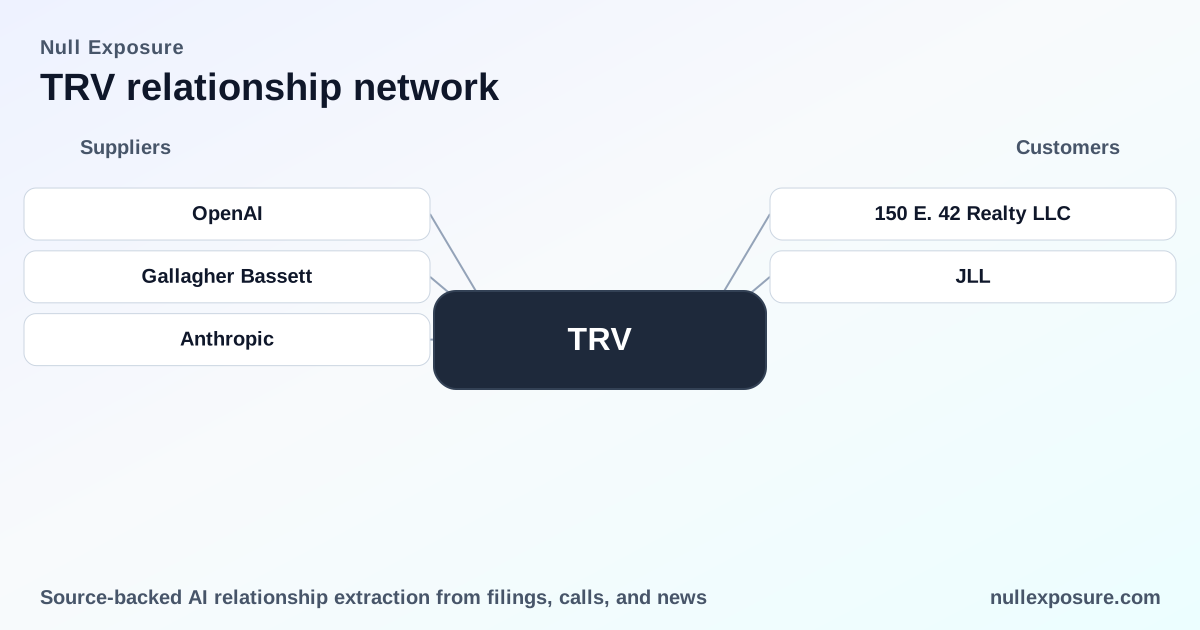
Travelers (TRV) — customer relationships, commercial posture, and investor implications
Travelers is a large, diversified property & casualty insurer that monetizes through underwriting premiums, fee income from risk and claims services, and investment income on a substantial float. The company writes both personal and commercial lines with an emphasis on loss-sensitive products for large accounts, while maintaining a large retail personal-insurance franchise; Travelers’ profitability is driven by underwriting discipline, reserve management and investment returns. For investors evaluating customer relationships, the mix of short-term, renew‑able policies and a broad counterparty base underpins steady premium flows but leaves underwriting outcomes exposed to cyclical claims and litigation dynamics.
Explore the coverage and relationship signals that matter for TRV on the homepage: https://nullexposure.com/
What the public signals show about key customer interactions
Below I catalog each customer relationship surfaced in the public results and summarize what it implies for Travelers’ commercial posture and operational risk.
Definity Financial Corporation (DFY.TO)
Travelers completed a sale of its personal insurance business and the majority of its commercial insurance business to Definity, representing a material redistribution of distribution and policy inventory in FY2026. This is a strategic disposition that changes Travelers’ exposure in retail segments and may shift premium composition going forward. Source: SimplyWallSt coverage of the transaction (May 4, 2026) — https://simplywall.st/stocks/us/insurance/nyse-trv/travelers-companies
150 E. 42 Realty LLC
Travelers is the insurer for 150 Realty and tendered defense obligations to another insurer (Old Republic) through TPA Gallagher Bassett in a dispute over “other insurance” provisions, reflecting active litigation and subrogation/coverage complexity in commercial real estate accounts. This illustrates claim interplay among insurers and the operational work of third‑party administrators. Source: Insurance Business (March 10, 2026) — https://www.insurancebusinessmag.com/us/news/claims/travelers-sues-old-republic-over-years-of-unanswered-additional-insured-tenders-567657.aspx
JLL
Travelers insures JLL under a policy that contains excess “Other Insurance” language and tendered defense duties to Old Republic through Gallagher Bassett, evidencing large-account legal complexity and inter-carrier dispute risk in property-management relationships. This underscores how Travelers manages corporate real-estate exposures via tendering and TPAs. Source: Insurance Business (March 10, 2026) — https://www.insurancebusinessmag.com/us/news/claims/travelers-sues-old-republic-over-years-of-unanswered-additional-insured-tenders-567657.aspx
Jones Lang Lasalle Americas, Inc. (JLL)
A separate item lists Jones Lang Lasalle Americas (JLL) with the same tendering and excess-insurance contention; the repeated reporting highlights multiple public filings and articles referencing the same large-client litigation, reinforcing the visibility of this coverage dispute. Source: Insurance Business (March 10, 2026) — https://www.insurancebusinessmag.com/us/news/claims/travelers-sues-old-republic-over-years-of-unanswered-additional-insured-tenders-567657.aspx
BHFAL (Brighthouse / BHFAL)
Public commentary links certain long‑duration life contracts originally sold by Travelers (and MetLife) now held or serviced by Brighthouse, indicating legacy product transitions and third‑party servicing of formerly underwritten policies. This points to historical product disposition and continuing operational touchpoints as policies move between carriers/servicers. Source: ClassAction.org (May 2, 2026) — https://www.classaction.org/brighthouse-universal-life-lawsuits
What these relationships collectively say about Travelers’ operating model
- Short-term contracting with annual renewal dynamics. Travelers largely sells policies that renew annually, giving the company the ability to reprice and reset underwriting terms each year — a structural lever that supports active portfolio management and underwriting discipline (company-level signal).
- Wide counterparty mix from individuals to large enterprises and government. The customer base spans individual policyholders (several million personal policies), small and mid-market businesses, large national accounts, and government entities, which produces diversified premium sources but requires differentiated underwriting and service models for each cohort (company-level signal).
- Global reach with regional concentrations. Travelers operates principally in North America but maintains EMEA and select LATAM capabilities (e.g., Lloyd’s membership and Brazilian surety via Junto), giving geographic diversification while keeping material exposure in U.S. core markets (company-level signal).
- Fee‑based service franchise alongside underwriting. Fee income from claims management, risk services and policy administration is an increasingly important complement to premium income and ties the company into long‑term client service relationships even when policies renew annually (company-level signal).
- Material reserve concentrations in workers’ comp and general liability. Workers’ compensation and general liability reserves together represent a large share of claims reserves, so outcome volatility in these lines is a primary driver of earnings variability (company-level signal).
Investor-focused risk and concentration considerations
- Litigation and inter-carrier disputes are visible and actionable. Public suits over tendered duties (e.g., JLL/150 E. 42 Realty) demonstrate that Travelers must regularly manage counterparty litigation with other carriers and TPAs — a source of legal expense and reserve pressure.
- Portfolio rebalancing via divestitures changes growth mix. The sale of large blocks to Definity alters exposure in the personal and commercial retail stacks and will affect future premium growth and loss ratios; investors should track how margins contract or expand post-disposition.
- Renewal economics reduce long-term lock‑in but enable pricing responsiveness. Annual policy constructs allow Travelers to tighten pricing rapidly after adverse loss trends, but they also mean customer attrition is possible in hard markets.
- Reserve composition amplifies claims risk. Given that workers’ comp and general liability constitute a substantial share of reserves, adverse development here can move combined ratios materially; reserve adequacy is therefore a leading stability factor.
Actionable reading list for investors
- Review Travelers’ FY2025–FY2026 commentary on policy counts and retention levels to quantify the company’s renewal leverage and recent divestiture effects (company filings).
- Monitor litigation disclosures and loss development for large commercial accounts referenced in March 2026 press reporting for near-term reserve and expense implications.
- Track fee income trends and service‑business margins as indicators of recurring, non-premium revenue resiliency.
For a concise dashboard of these customer relationship signals and how they evolve, visit NullExposure: https://nullexposure.com/
Bottom line: Travelers’ business model balances underwriting leverage with service revenues and a renew‑able policy book, which supports returns in disciplined markets but leaves the company exposed to reserve volatility and the operational complexity of large-account litigation and carve-outs. Investors should focus on reserve development, the financial impact of the Definity transaction, and trends in fee income as primary drivers of earnings quality.