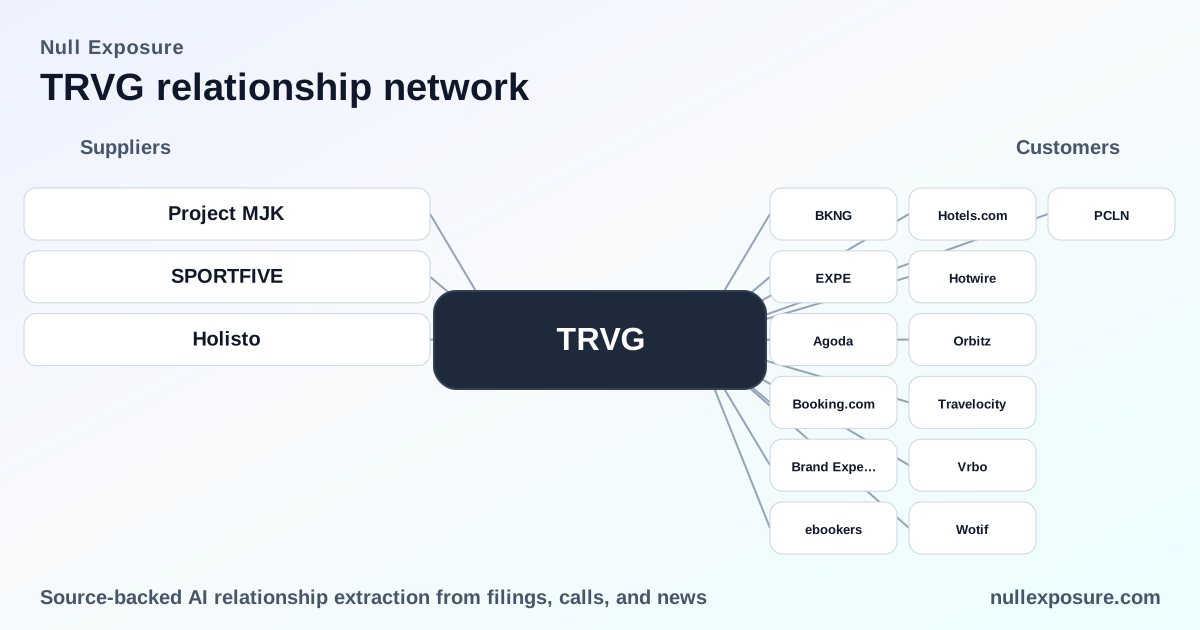
TRVG: Referral economics anchored to Booking and Expedia — what investors need to know
Trivago operates a hotel search and metasearch platform that monetizes primarily through referral revenue from online travel agencies and booking brands; the company drives traffic and sells referral clicks or conversions to partners such as Booking Holdings and Expedia Group and records the resulting fees as its core revenue stream. Investors should read Trivago as a traffic-to-referral business whose profitability and negotiating leverage are tightly linked to two dominant distribution partners. Learn more at https://nullexposure.com/.
The headline: concentrated referral revenue and what it means for valuation
Trivago’s recent filings and press releases show a clear pattern: two platform groups—Booking Holdings and Expedia Group—consistently account for the majority of referral revenue. In its Q4 2025 disclosures, Trivago reported Booking-affiliated brands accounted for roughly 38–40% of referral revenue while Expedia-affiliated brands contributed about 33–34% for the comparable periods, leaving a combined share in the low 70s of referral revenue (source: company Q4 2025 release and press summaries, GlobeNewswire Feb 3, 2026; Yahoo Finance Mar 10, 2026).
That concentration drives several company-level characteristics investors must treat as structural:
- Concentration risk: a small set of partners accounts for the majority of revenue, exposing Trivago to pricing and traffic-policy shifts set by those platforms.
- Contracting posture: Trivago is a channel partner that must optimize traffic-to-conversion economics rather than dictate terms; negotiating leverage is asymmetric.
- Criticality and maturity: relationships with Booking and Expedia are long-established and commercially critical—stable, but not immune to competitive redistribution of traffic. These are company-level signals derived from the revenue breakdown disclosed in recent results (GlobeNewswire, Feb 3, 2026; press summaries March–May 2026).
Relationship ledger: each partner cited in Trivago’s recent reporting
Below I list every partner named in the source materials and what the company stated about their contribution to referral revenue.
-
Booking Holdings (BKNG) — Trivago reported that brands affiliated with Booking Holdings (including Booking.com, Agoda and priceline.com) represented roughly 38–40% of referral revenue in the periods ending December 31, 2025, a slight decline from certain 2024 comparatives. This is taken from Trivago’s Q4 2025 results and related press coverage (GlobeNewswire Feb 3, 2026; Yahoo Finance Mar 10, 2026).
-
Booking.com — As a leading Booking Holdings brand, Booking.com is explicitly included in the Booking-affiliated share that accounted for roughly 38–40% of referral revenue in the FY2026 disclosure (GlobeNewswire Feb 3, 2026).
-
Agoda — Agoda is listed alongside Booking.com and priceline.com in the Booking Holdings bucket; Trivago’s FY2025 and FY2026 statements show Agoda contributing to the ~40% Booking group share (GlobeNewswire Apr 30, 2025; GlobeNewswire Feb 3, 2026).
-
priceline.com — priceline.com is grouped with other Booking Holdings brands in Trivago’s referral-revenue breakdown; the company cites priceline as part of the ~38–44% Booking-affiliated contribution across reported periods (GlobeNewswire Apr 30, 2025; Feb 3, 2026).
-
Brand Expedia / Expedia Group (EXPE) — Trivago reports that brands affiliated with Expedia Group (Brand Expedia, Hotels.com, Orbitz, Travelocity, Hotwire, Wotif, Vrbo and ebookers) contributed approximately 33–35% of referral revenue for periods ending December 31, 2025 and earlier FY2025 quarters (GlobeNewswire Feb 3, 2026; Apr 30, 2025).
-
Hotels.com — Hotels.com is specifically named in the Expedia-affiliated bucket that generated roughly 33–35% of referral revenue in Trivago’s most recent disclosures (GlobeNewswire Feb 3, 2026).
-
Hotwire — Hotwire is included in the Expedia Group brands contributing to the ~33–35% Expedia share of referral revenue per Trivago’s releases (GlobeNewswire Feb 3, 2026).
-
Orbitz — Orbitz appears in the list of Expedia brands that together accounted for about 33–35% of referral revenue in FY2026 disclosures (GlobeNewswire Feb 3, 2026).
-
Travelocity — Travelocity is listed among Expedia’s brands in Trivago’s referral-revenue reporting and is part of the Expedia group share cited for FY2025–FY2026 (GlobeNewswire Feb 3, 2026).
-
Wotif — Wotif is named with Expedia brands contributing to the ~33–35% Expedia share of referral revenues reported by Trivago (GlobeNewswire Feb 3, 2026).
-
Vrbo — Vrbo is included in the Expedia grouping that Trivago reported as contributing roughly one-third of referral revenue in the latest reporting periods (GlobeNewswire Feb 3, 2026).
-
ebookers — ebookers is likewise cited as part of the Expedia-affiliated brands responsible for about 33–35% of referral revenue (GlobeNewswire Feb 3, 2026).
-
Brand Expedia — When Trivago refers to Brand Expedia specifically it is naming one of the Expedia properties included in the ~33–35% Expedia contribution (company releases Feb–Apr 2025–2026).
Note: many of the sources repeating these partner lists are the same financial communications—Trivago’s Q4 2025 press release on GlobeNewswire (Feb 3, 2026) and subsequent press summaries on Yahoo Finance and other outlets in March–May 2026—so the partner roster is consistent across disclosures.
What investors should watch next: catalysts and risk triggers
- Contract renegotiation or traffic repricing from either Booking Holdings or Expedia Group would immediately pressure top-line and could compress Trivago’s already-thin operating margin; these two partner groups collectively account for roughly 70–75% of referral revenue in the latest period (GlobeNewswire Feb 3, 2026; Yahoo Finance Mar 10, 2026). This is the single largest operational risk.
- Diversification of demand sources or improving direct-booking economics would materially reduce partner concentration risk; absent that, the company’s valuation is effectively a function of referral yields and traffic volumes directed through two dominant buyers.
- Operational sensitivity: search relevance, SEO, and marketing spend that sustain traffic are the levers Trivago controls; partners control conversion economics, platform display, and inventory access.
Quick financial context that matters to partnership leverage
Trivago reports annual revenue around the mid-hundreds of millions (Revenue TTM roughly $549M), with modest operating margin and concentrated referral flows into Booking and Expedia channels—facts that underpin the firm’s strategic priorities and limit its bargaining power versus larger online travel agencies (Trivago company data, FY2025–FY2026 filings). Investors should weigh customer concentration alongside capital allocation and growth initiatives when modeling downside scenarios.
For a deeper look at Trivago’s external partner exposure and historical partner-share trends, visit https://nullexposure.com/.
Bottom line
Trivago is a traffic-matching business whose economics are driven by a small set of large travel platforms. Booking Holdings and Expedia Group dominate the referral mix, creating predictable revenue when the relationships are stable but significant downside if either partner changes pricing or distribution policies. Investors must model Trivago not as a standalone hotel tech play but as a channel-dependent referral aggregator with concentrated counterparty exposure (company releases and press coverage, FY2025–FY2026).