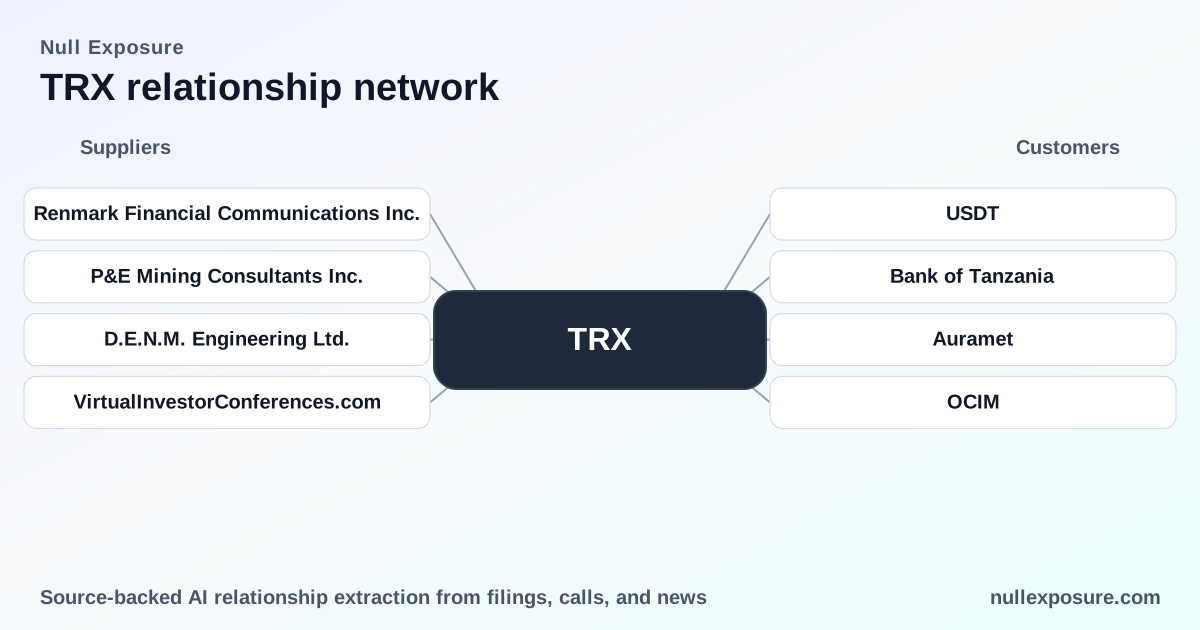
TRX customer map: who buys the gold and what it means for investors
Tanzanian Royalty Exploration Corp (TRX) operates as a mid-tier gold producer and developer in Tanzania, monetizing through sales of doré and refined gold from its Buckreef operations and similar projects, supplemented by prepaid gold purchase agreements that function as hybrid offtake and financing. For investors, TRX’s revenue profile is driven by physical ounces sold, the structure and counterparty credit of prepaid contracts, and local regulatory requirements that force a portion of production into domestic channels.
If you want a concise counterparty exposure dashboard for transaction and credit diligence, see the TRX coverage on our site: https://nullexposure.com/
What the customer list looks like in practice
Below I walk through every counterparty flagged in public mentions and filings. Each relationship is summarized in plain English with the public source referenced.
Auramet — structured prepaid purchaser with interest accounting
TRX records interest and related line items tied to an Auramet gold prepaid purchase agreement, which functions as advance funding against future gold deliveries and affects reported interest expense. See TRX’s Q1 2026 press release on GlobeNewswire for the disclosure of interest recognized under the Auramet prepaid agreement (GlobeNewswire, Jan 15, 2026: https://www.globenewswire.com/news-release/2026/01/15/3219343/0/en/TRX-Gold-Reports-First-Quarter-2026-Results.html). Additional Q2 2026 reporting reiterates the net-of-interest presentation tied to that arrangement (GlobeNewswire, Apr 15, 2026: https://www.globenewswire.com/news-release/2026/04/15/3274260/0/en/trx-gold-reports-second-quarter-2026-results.html).
OCIM — prepaid buyer that drives revenue recognition line items
TRX discloses revenue and ounces sold related to an OCIM prepaid gold purchase agreement, which is presented separately in periodic financial reporting and materially affects the company’s near-term gold sales figures. The Q4 and year-end 2025 results and subsequent quarterly notes include line items showing revenue recognized from the OCIM agreement (TRX press release, Dec 2, 2025: https://www.globenewswire.com/news-release/2025/12/02/3197713/0/en/TRX-Gold-Reports-Q4-and-Year-End-2025-Results.html; Q1/Q2 2026 summaries: https://www.globenewswire.com/news-release/2026/01/15/3219343/0/en/TRX-Gold-Reports-First-Quarter-2026-Results.html and https://www.globenewswire.com/news-release/2026/04/15/3274260/0/en/trx-gold-reports-second-quarter-2026-results.html).
Bank of Tanzania — domestic purchase requirement for a portion of doré
TRX reports that Buckreef Gold signed an agreement with the Bank of Tanzania to set aside a minimum of 20% of doré production for domestic sale, a statutory/contractual obligation that routes a material share of production into the local market rather than to commercial offtakers. This requirement is disclosed in TRX’s year-end reporting and reiterated in independent coverage (Resource World, covering TRX Q4 and year-end 2025 results: https://resourceworld.com/trx-gold-reports-q4-and-year-end-2025-results/; TRX press release, Dec 2, 2025: https://www.globenewswire.com/news-release/2025/12/02/3197713/0/en/TRX-Gold-Reports-Q4-and-Year-End-2025-Results.html).
Tether / USDT — an out-of-sector mention in crypto commentary
A Finviz cryptocurrency piece referenced Tether (USDT) and the scale of stablecoins in March 2026; this mention is unrelated to TRX’s commercial gold buyers and surfaces as topical news overlap rather than a documented gold-purchasing relationship. The Finviz article that included USDT is dated March 10, 2026 (Finviz, Mar 10, 2026: https://finviz.com/news/171377/which-cryptocurrency-could-be-a-millionaire-maker-cardano-vs-tron).
What these counterparties say about TRX’s operating model and commercial posture
- TRX relies materially on prepaid gold purchase agreements as both a revenue mechanism and a source of near-term liquidity. That structure transfers some market-price and timing risk to counterparties while introducing counterparty credit exposure and interest expense that affect reported profitability.
- Concentration risk is present but trackable: a small number of named counterparties—documented prepaid purchasers and a statutory domestic buyer—account for a meaningful portion of short-term sales flow, increasing sensitivity to any single counterparty disruption.
- Contracting posture is defensive and cash-centric: prepaid agreements imply TRX is leveraging offtake arrangements to secure financing against production rather than selling exclusively on spot markets.
- Regulatory and operational criticality is high: the Bank of Tanzania domestic-sale requirement creates a mandatory sales channel that limits free-market disposition of at least 20% of production and increases exposure to local pricing and settlement conditions.
- Maturity profile is mid-short term: the prepaid contracts and doré domestic obligations typically affect quarterly and near-term cash flows rather than representing long-term strategic offtake tied to mine life.
These are company-level operating signals drawn from TRX’s public reporting and press releases; they describe how TRX converts ounces into cash and the commercial levers that underlie reported revenue and interest expense.
Investor implications — what to watch and how to underwrite exposure
- Counterparty credit is a primary risk: prepaid buyers provide liquidity but create credit exposure. Review counterparty financials and the specific contract security (if any) before underwriting TRX revenue streams.
- Revenue volatility is structurally limited but directionally exposed to gold prices: prepaid sales reduce immediate spot exposure but do not eliminate pricing risk over the mine life; the company’s profitability still tracks gold realization and cost per ounce.
- Regulatory flow-through is non-negligible: the 20% Bank of Tanzania requirement is a binding constraint on sale channels and can affect timing and netbacks; monitor local settlement terms and any changes in domestic policy.
- Concentration requires active monitoring: with a short list of named commercial counterparties, any deterioration in relationships or terms will have an outsized impact on quarterly cash generation.
If you evaluate counterparties or need a clearer exposure breakdown for diligence, our TRX customer summaries and counterparty risk matrices are available at https://nullexposure.com/.
Bottom line for investors and operators
TRX monetizes ounces through a mix of prepaid offtake agreements and mandated domestic sales; that mix provides liquidity but introduces counterparty credit and regulatory execution risk. For investors, the most material variables are counterparty credit quality, the structure and duration of prepaid agreements, and domestic-sale mechanics in Tanzania. Operators and credit teams should prioritize contract detail, security, and settlement history when modeling TRX’s near-term cash flows.