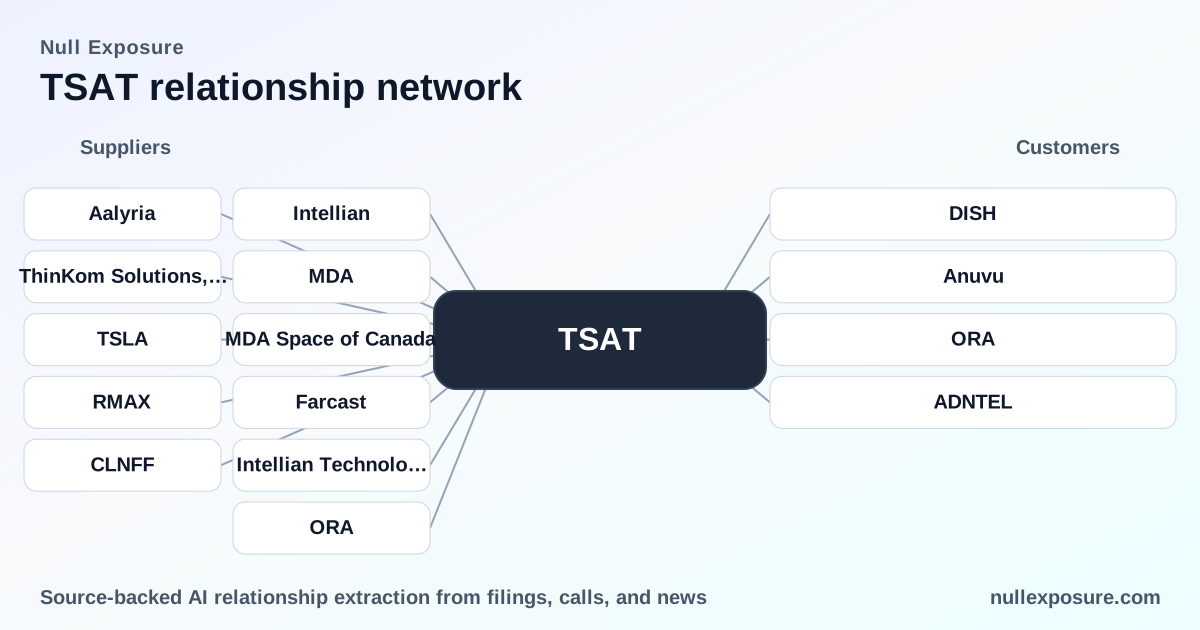
Telesat (TSAT) — Customer relationships that define the Lightspeed opportunity and near-term revenue variability
Telesat monetizes by selling satellite capacity, ground-station services and managed connectivity solutions to carriers, enterprise customers and mobility providers, with a strategic pivot to its Lightspeed Low Earth Orbit (LEO) constellation and Smart VNO offerings that convert capital-intensive infrastructure into recurring capacity and service revenue. Investors should read customer wins and renewals as direct indicators of Lightspeed commercialization and short-term revenue volatility, since a small number of large contracts can swing quarterly results. For additional context on how we source and analyze these relationships, visit https://nullexposure.com/.
What these customer ties tell you about the business model and risk posture
Telesat operates a capital-heavy, network-as-a-service model: it builds and operates satellite capacity and sells that capacity under multi-year contracts or capacity commitments. This produces a mix of recurring revenue and lumpy contract timing risk. Contracting posture is primarily incumbent/partner-led — Telesat sells capacity to operators (telcos, mobility providers, ISPs) who then integrate it into commercial offerings. Concentration risk is material: a handful of large customers and capacity commitments can meaningfully impact quarterly revenue (see DISCUSSION on DISH below). The Lightspeed LEO rollout signals a maturity transition from traditional GEO capacity sales to multi-orbit, service-oriented offerings (VNO, managed services), increasing long‑term addressable market but maintaining near-term execution and capital intensity risk. No company-level constraints were provided in the source set; treat these as portfolio-level operational signals rather than relationship-specific covenants.
Customer-by-customer read — every recorded relationship and what it means for investors
DISH (earnings call, 2025 Q3)
Telesat reported that the Nimiq 5 renewal with DISH was the biggest revenue headwind in the quarter versus Q3 2024, indicating that contract timing or terms with DISH materially reduced near‑term revenue. This underscores the company’s exposure to large contract renewals. (Source: Telesat 2025 Q3 earnings call, reported 7 Mar 2026.)
Anuvu (AviationBusinessNews, FY2023)
Anuvu will lease antennas and ground-station infrastructure from Telesat to support the Anuvu Constellation, making Telesat a supplier of ground and orbital connectivity to mobility-focused operators and reinforcing revenue from infrastructure leasing. (Source: AviationBusinessNews report on Anuvu/Telesat partnership, referenced FY2023.)
Northwestel (Intellectia.ai, FY2026 — item 1)
Northwestel signed a multi‑year contract to use the Telesat Lightspeed LEO network, positioning Telesat as the connectivity provider for northern and remote communities and demonstrating Lightspeed’s addressability for regional incumbent telcos. (Source: Intellectia.ai news item, first seen 4 May 2026.)
Northwestel (Intellectia.ai, FY2026 — item 2)
A second Intellectia.ai story reiterates the multi‑year Lightspeed agreement with Northwestel, amplifying press coverage around Lightspeed commercial adoption in Canada’s remote markets. (Source: Intellectia.ai follow‑up item, first seen 4 May 2026.)
ORA (TechAfricaNews, FY2025)
TechAfricaNews reported that Orange signed a capacity commitment for Telesat Lightspeed LEO service to integrate into its global portfolio, signaling Tier‑1 operator demand and the potential for wholesale scale partnerships. (Source: TechAfricaNews coverage of Orange/Telesat, reported FY2025.)
Orange (TechAfricaNews, FY2025)
The TechAfricaNews item also refers to Orange’s signed capacity commitment for Lightspeed, underscoring multiple press placements for the same operator-level commitment and the strategic importance of Orange as a global distribution partner. (Source: TechAfricaNews, reported FY2025.)
Orange (GlobeNewswire press release, FY2025)
A GlobeNewswire press release confirmed that Orange’s capacity commitment for Lightspeed will be integrated into its services for businesses and telecom operators, providing corporate validation and formal public disclosure of the tie. (Source: GlobeNewswire press release, 11 Mar 2025.)
ORA (GlobeNewswire listing, FY2025)
The GlobeNewswire release indexed under ORA reiterates the same multi‑year partnership and capacity commitment with Orange, which signals repeatable, enterprise-grade wholesale adoption for Lightspeed. (Source: GlobeNewswire press release, 11 Mar 2025.)
ADN Telecom Limited (Telesat press release, FY2025)
Telesat announced that it will provide Lightspeed services and a Smart Virtual Network Operator capability to ADN Telecom, allowing ADN to offer tailored connectivity to enterprise, maritime and government customers — a clear use case for VNO monetization. (Source: Telesat press release announcing ADN Telecom partnership, Mar 2025.)
ADNTEL (Telesat press release, FY2025)
The ADNTEL entry reiterates the multi‑year Lightspeed and Smart VNO agreement, demonstrating Telesat’s go‑to‑market for white‑label and partner-managed service offerings. (Source: Telesat corporate press release, Mar 2025.)
VSAT (InsiderMonkey transcript, FY2026)
A market participant discussed with Telesat the plan to recreate maritime solutions in a multi‑orbit architecture, indicating strategic collaboration with VSAT operators to combine GEO/LEO capabilities for mobility and maritime customers. (Source: InsiderMonkey transcript referencing VSAT/Telesat dialogue, first seen Mar 2026.)
How these relationships translate to value and near-term risks
- Revenue signal: Capacity commitments from Tier‑1 operators (Orange) and multi‑year contracts with regional carriers (Northwestel, ADN/ADNTEL) validate Lightspeed’s commercial traction and create a visible revenue backlog if structured as committed capacity.
- Volatility signal: The DISH Nimiq 5 renewal demonstrates that large contract renewals or non‑renewals have immediate, material P&L impact, producing quarter-to-quarter swings.
- Business model evolution: Partnerships that leverage Smart VNO and ground infrastructure leasing move Telesat from pure capacity seller toward managed services, increasing customer stickiness but requiring service commercialization and partner enablement.
- Concentration and criticality: A small set of large wholesale customers drives outsized revenue impact; those same relationships are critical for scale but concentrate counterparty risk.
What investors should watch next
- Contract renewal cadence and disclosure around the size and duration of Lightspeed capacity commitments (especially from Tier‑1 operators).
- Quarterly commentary on the financial terms of large renewals and any revenue recognition timing that could cause quarter-level volatility.
- Execution on VNO tooling and ground-station leasing to convert signed commitments into recurring service revenue.
Bold takeaway: Lightspeed wins with Tier‑1 and regional partners validate the product-market fit, but revenue remains lumpy until a steady stream of multi‑year, committed capacity is disclosed and recognized.
For a concise view of relationship signals and to track future customer-level disclosures, visit https://nullexposure.com/ for ongoing updates and analysis.