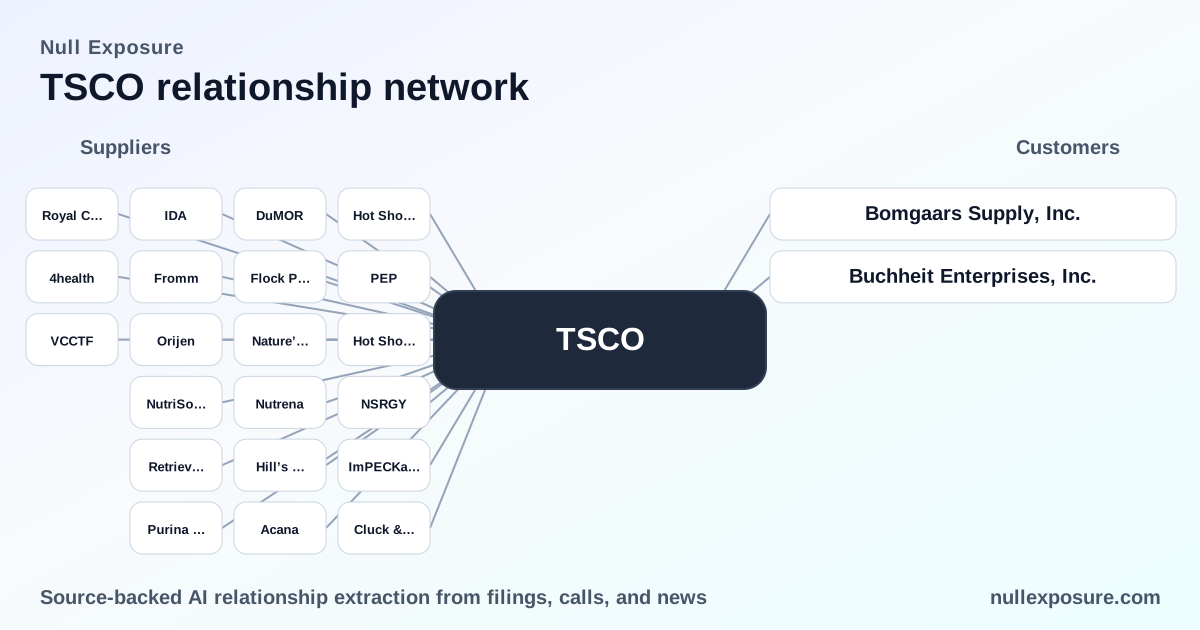
Tractor Supply Company: customer relationships that move the rural retail market
Tractor Supply Company (TSCO) operates as the largest rural lifestyle retailer in the United States, monetizing through retail sales across a broad footprint of physical stores and complementary small-box pet retailing (Petsense), plus online channels; revenue is recognized at the point customers take possession of merchandise. Investors should evaluate TSCO’s customer reach and strategic moves through the lens of retail market consolidation, asset divestitures tied to store acquisitions, and a durable individual-consumer customer base concentrated in North America. For deeper relationship-level intelligence, visit https://nullexposure.com/.
How Tractor Supply’s operating model shapes customer relationships
Tractor Supply runs a high-volume, point-of-sale retail business focused on homeowners, hobby farmers and pet owners. The company recognizes revenue when merchandise transfers to the customer, a contracting posture that is effectively spot sale oriented rather than long-term contracts. The firm’s consumers are predominantly individuals living the “Out Here” lifestyle, and the business footprint is strictly North American — at December 28, 2024 the company operated 2,502 retail stores in 49 states (2,296 Tractor Supply and 206 Petsense), reinforcing scale and mature distribution reach.
This operating model generates several material characteristics for investor underwriting:
- Low counterparty concentration on the demand side: the typical customer is an individual consumer rather than a few large buyers, which stabilizes revenue but exposes same-store sales to demographic and cyclical retail trends.
- Transaction-level revenue recognition limits contractual receivable risk but increases exposure to foot-traffic and inventory-turn dynamics.
- Geographic focus in the U.S. concentrates regulatory and macro exposure domestically while enabling efficient logistics network economics from a large store base.
Strategic signals and risk drivers investors should track
TSCO’s profile shows scale, retail maturity and a core-product concentration in rural lifestyle merchandise. Key observable signals from public filings and market data:
- Retail scale and profitability: trailing revenue of approximately $15.65 billion and operating margins in the mid-single digits (operating margin TTM ~6.5%).
- Institutional ownership is high (about 99% reported) which increases sensitivity to analyst expectations and sector sentiment.
- Retail execution risk: performance depends on same-store sales, inventory management and margins on core product lines rather than large contract backlogs.
Major near-term strategic moves — especially acquisitions and divestitures tied to the Orscheln Farm & Home transaction — are the immediate vector for competitive and asset-level impact; details follow below.
(Explore more company relationship intelligence at https://nullexposure.com/.)
Customer and partner relationships captured in the record
Below are the relationships surfaced in the reviewed materials and the plain-English takeaways investors need to know.
Bomgaars Supply, Inc.
Tractor Supply committed to divest certain Orscheln assets as part of the Orscheln Farm & Home transaction, and an Excelsior Citizen report (March 10, 2026) records that Tractor Supply agreed to sell the Orscheln corporate headquarters and distribution center to Bomgaars for approximately $10 million within 15 months after closing. This is a material asset-transfer arrangement tied to the Orscheln acquisition and impacts the post-close network footprint. (Excelsior Citizen, March 10, 2026)
Buchheit Enterprises, Inc.
As part of the same Orscheln disposition plan, Tractor Supply will retain 81 Orscheln store locations and sell the remaining 85 stores to buyers approved by the FTC — with Buchheit acquiring 12 of those stores and Bomgaars 73; this allocation shapes local competitive footprints and store-level revenue transfer between operators. (Excelsior Citizen, March 10, 2026)
WPP
A scraped news item in the results cites WPP and references Tesco providing closed-loop measurement for Heineken; the cited excerpt references Tesco and Heineken rather than Tractor Supply and does not document a customer relationship between WPP and Tractor Supply. This item is a content-level match in the aggregation but does not manifest a commercial TSCO customer relationship. (InsiderMonkey transcription excerpt, referenced March 2026)
CMG (10‑K excerpt)
A 10‑K style excerpt labeled cmg-2025 includes templated tags and the line “purchases from the supplier were $51,953, $49,323, and $43,555” for the years ended December 31, 2025, 2024 and 2023 respectively; the record in the collection shows these supplier-purchase figures but does not provide a clear direct commercial linkage naming Tractor Supply as the counterparty. Treat this item as an extracted procurement disclosure rather than evidence of an established TSCO customer contract. (cmg‑2025 10‑K excerpt, FY2025)
What these relationship entries mean for investors
The structured outcomes of the Orscheln transaction are the most consequential relationship items in the record: Tractor Supply’s plan to retain 81 Orscheln stores while selling 85 stores and certain real estate to third parties reshapes local market share and distribution-center economics. Selling the Orscheln headquarters and distribution center to Bomgaars for approximately $10 million is significant because it converts an acquired asset into cash and transfers logistics control in a defined geography, directly affecting operating leverage in those trade areas (Excelsior Citizen, March 10, 2026).
Secondary items in the set (WPP, CMG excerpts) are noise or extraction artifacts in the public collection and do not constitute evidence of meaningful TSCO customer relationships; treat them as low-confidence matches in any sourcing of commercial partners.
Investment implications and near-term monitoring checklist
Bold, actionable criteria for investors evaluating TSCO now:
- Monitor post-close integration of retained Orscheln stores for same-store sales uplift or cannibalization; the economics of 81 retained stores versus the 85 sold will determine net incremental revenue.
- Track asset divestiture timing and proceeds, including the ~$10 million transaction noted with Bomgaars, to assess cash flow and capital allocation impact on free cash flow and debt metrics.
- Watch same-store sales and inventory turns given the company’s spot-sale model — retail execution drives margins more than long-term contractual revenue.
- Stay alert to competitive responses in markets where Buchheit and Bomgaars took Orscheln locations; local market dynamics will affect store-level performance.
For a consolidated view of customer-level relationships and how they affect TSCO’s competitive positioning, see our coverage at https://nullexposure.com/.
Investors should use the above relationship map as a baseline and prioritize direct filings and management commentary for confirmation of integration metrics and post-close store economics.