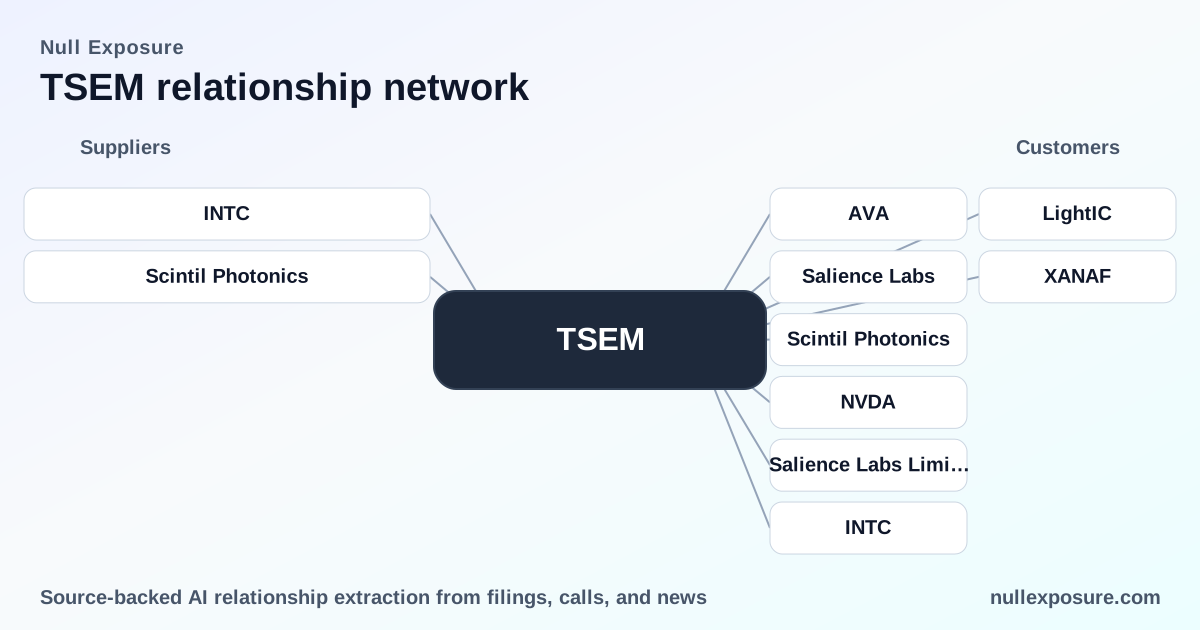
Tower Semiconductor (TSEM): Customer Relationships Driving a Silicon‑Photonics Growth Narrative
Tower Semiconductor is an independent foundry that manufactures mixed‑signal and high‑value analog devices and now monetizes through high‑margin foundry services—notably silicon photonics and SiGe production — by scaling volumes for strategic customers in AI networking, defense, imaging and photonic quantum computing. Revenue comes from wafer fabrication and associated development/tape‑out services as Tower converts early R&D partnerships into pre‑production and volume contracts. For a deeper look at partner signals and market positioning visit https://nullexposure.com/.
Key investment thesis: Tower’s value is increasingly linked to its silicon photonics and SiGe service lines where large OEMs and specialized photonics startups require a foundry able to move from prototype to high‑volume manufacturing. That dependency creates outsized revenue upside when partnerships convert but also concentration and execution risk if a major customer changes course.
How Tower’s operating model reads to investors
Tower runs a classic high‑mix foundry model with strategic verticals. From an operating and business‑model perspective, investors should treat the company as:
- Contracting posture: Tower operates as a capacity partner and co‑engineer — customers contract both engineering runs (tape‑outs, platform validations) and volume wafers. This is a service + manufacturing revenue mix.
- Concentration: The business shows increasing concentration around silicon‑photonics leaders and select high‑value analog customers; a handful of partners drive material revenue and roadmap focus.
- Criticality: For customers building optical modules or defense SiGe ICs, Tower is a critical supplier because it combines process specialization (SiPho, SiGe) with high‑volume lines in the U.S. and Israel.
- Maturity: Silicon photonics and photonic quantum manufacturing are moving from R&D toward pre‑production and early volume — Tower’s role is mature as a foundry but the end markets remain early‑adoption stages, which creates asymmetric upside if platforms scale.
Customer map: relationships called out in FY2026 headlines
NVIDIA (NVDA)
Tower announced a collaboration to scale 1.6‑terabit data‑center optical modules optimized for NVIDIA networking protocols, positioning Tower as the primary supplier of 1.6T silicon photonic PICs for AI networking applications. According to a Globe and Mail press release (Feb 5, 2026), the project targets high‑volume AI data center optics built to NVIDIA’s specs.
Salience Labs
Tower moved Salience Labs’ photonic optical circuit switches from development into pre‑production on Tower PH18DA and TPS45PH platforms, supporting ultra‑low‑latency, high‑bandwidth connectivity for AI clusters. Multiple company releases and industry coverage (GlobeNewswire, Feb 2026) describe Tower as a key manufacturing partner for Salience’s roadmap.
Xanadu (XANAF)
Tower expanded collaboration with Xanadu to co‑engineer production flows for Xanadu’s custom material stack, scaling silicon photonics for photonic quantum computing and fault‑tolerant hardware. Tower and Xanadu issued a joint press release (GlobeNewswire, Feb 19, 2026) announcing the strategic expansion onto Tower’s high‑volume platform.
Scintil Photonics
Scintil’s heterogeneously integrated DWDM lasers have been validated on Tower’s silicon photonics platform, enabling integrated laser sources for AI infrastructure and co‑packaged optical modules. Tower and Scintil announced availability in a GlobeNewswire release (Feb 17, 2026), moving the technology toward manufacturability at scale.
Axiro Semiconductor (Axiro)
Tower’s U.S. fabs are fabricating Axiro’s high‑power SiGe radar beamforming ICs, and the pair are ramping those devices to volume production for defense systems, strengthening domestic supply chains. Sahm Capital and other trade outlets reported the collaboration and volume ramp in late April/early May 2026.
Lightwave Logic (LWLG)
Lightwave Logic signed a development agreement with Tower to integrate its electro‑optic polymer modulators onto Tower’s PH18 silicon photonics platform, providing a commercial path for >100GHz modulators that target HPC and networking. Industry news outlets (Intellectia.ai / Investing.com, May 3, 2026) cited the agreement and 2026 tape‑outs as a clear route to commercialization.
AVA
Tower named AVA among FMCW LIDAR partners collaborating on products ahead of CES, indicating Tower’s role in manufacturing photonics components for automotive and sensing applications. The mention appears in the company’s Q4 2025 earnings call transcript (InsiderMonkey, Mar 10, 2026).
LightIC
LightIC was also cited as an FMCW LIDAR partner in Tower’s earnings call, showing Tower’s involvement in next‑generation LIDAR productization alongside AVA. The earnings transcript (InsiderMonkey, Mar 10, 2026) lists LightIC among partners announcing collaborations.
Intel (INTC)
Intel publicly indicated its intention not to perform under the September 23 Fab 11X agreement, a development Tower disclosed in its earnings commentary and which was reported by Calcalistech and the earnings transcript. The change reflects a contractual and counterparty risk event with a major industry OEM (InsiderMonkey transcript and Calcalistech, March–May 2026).
Nuvoton Technology Corporation Japan
Tower will consolidate higher‑value 300mm operations from TPSCo and transition the remaining 200mm activities to Nuvoton, reshaping the relationship from joint owners to long‑term supplier–customer partners, while Tower retains control of the high‑value capacity. TipRanks covered the strategic reorganization in May 2026.
What these relationships imply for risk and upside
- Upside: Converting silicon‑photonics partnerships with market leaders like NVIDIA and specialized startups into sustained wafer volumes creates meaningful revenue and margin expansion potential. If Tower remains the majority supplier for 1.6T PICs, revenue scalability is material.
- Risk: The Intel Fab 11X development is a reminder that large OEM contractual shifts can materially affect capacity planning and near‑term revenue. Tower’s growing exposure to a small set of strategic customers increases concentration risk.
- Execution sensitivity: Success hinges on Tower’s ability to deliver repeatable yields and to scale complex heterogeneous integrations (lasers, modulators, switches) from pre‑production to volume.
For investors tracking these dynamics, Tower’s FY2026 headlines represent a transition from prototype partnerships toward volume‑dependent revenue streams; monitor cadence of tape‑outs converting to wafer orders and any public disclosure of volume commitments.
If you want a consolidated view of partner signals and market implications, visit https://nullexposure.com/ for our proprietary coverage and alerts.