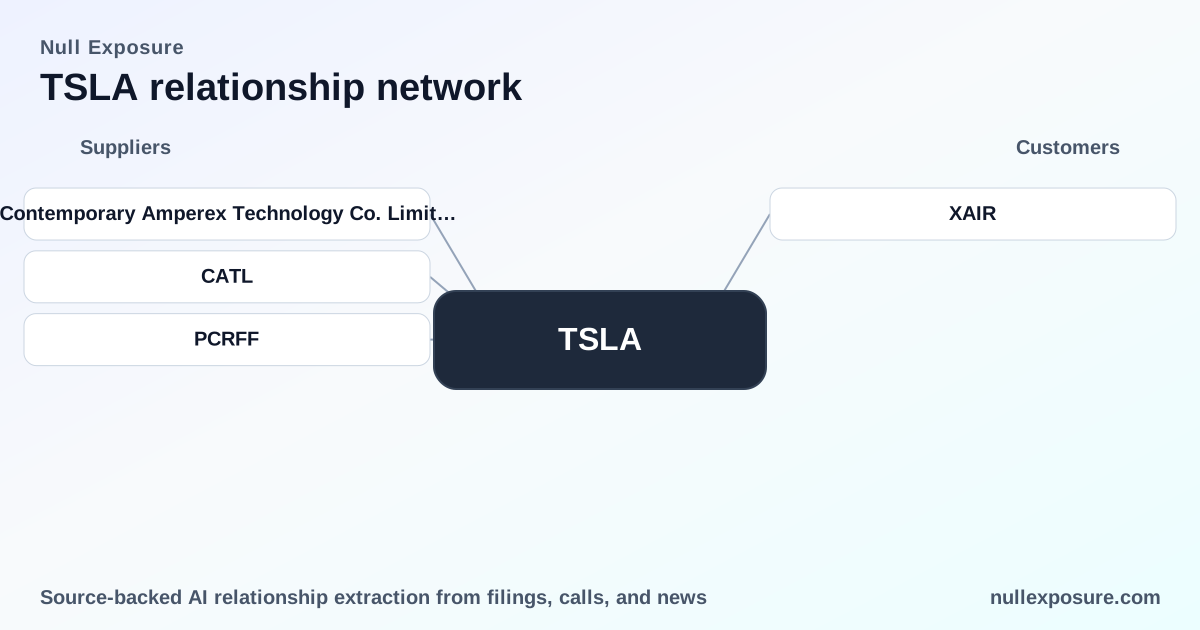
Tesla (TSLA) — Strategic customer relationships that accelerate energy scale and autonomous services
Thesis: Tesla monetizes through a dual hardware-and-software model—vehicle and energy hardware sales and leases, complemented by recurring software and services (FSD subscriptions, premium connectivity, energy services and PPAs, Supercharger access). Its direct sales posture and data-driven product extensions convert customer-installed hardware into long-term revenue streams and optionality across insurance, grid services and utility partnerships. For a concise view of relationship exposure and commercial levers, see https://nullexposure.com/.
Why customers matter: a commercial model that converts ownership into ongoing cash flows
Tesla’s economics are not just built on one-time car or battery sales; its contracts and go-to-market choices convert end-users into annuity-like revenue sources. The company sells and leases vehicles, offers multi-year vehicle financing and takes subscription revenue (notably FSD and premium connectivity), and signs long-term energy contracts and battery tolling agreements with utilities and corporate buyers. That mix implies concentration of strategic value in a handful of large utility and energy customers while also capturing margins and data from millions of individual drivers. The operating model signals are clear: long-term contracting for some products, usage-based revenue where electricity is sold under PPAs, and subscription/recurring monetization for software features.
If you want a deeper mapping of counterparties and commercial terms, visit https://nullexposure.com/ for a structured view.
What each counterparty relationship reveals for investors
Below I walk through every customer-related mention in the coverage set and summarize the commercial implication in plain English.
PCG-P-D (PG&E) — Cybertruck and V2X approval (FY2026)
PG&E approved the Cybertruck with Tesla’s Powershare Gateway and Universal Wall Connector for participation in its residential Vehicle‑to‑Everything program, enabling bidirectional vehicle-grid services. According to Electrive and PR Newswire reporting in May 2026, this represents a step toward EVs as distributed grid assets. (Electrive/PR Newswire, FY2026)
XELLL (Xcel Energy) — Tesla hardware in virtual power plant programs (FY2024)
Xcel’s Renewable Battery Connect program already includes battery equipment from Tesla (and SolarEdge), meaning Tesla supplies behind-the-meter storage that utilities aggregate into VPPs. Utility Dive and Latitude Media noted visibility and communications issues but confirmed Tesla is a deployed vendor. (Utility Dive/Latitude Media, FY2024)
PCG-P-D (PG&E) — Megapack deployment for large BESS project (FY2020)
Tesla’s Megapacks were deployed at a major PG&E battery project, evidencing multi-year utility-scale battery supply and project execution capability. Electrek reported the initial Megapack deployments tied to what would be the world’s largest battery project. (Electrek, FY2020)
CVAC (CureVac) — Non-core partnership mention (FY2021)
A historical note: Elon Musk tweeted about CureVac and Tesla’s involvement in a vaccine printer partnership, which is a peripheral relationship to Tesla’s core commercial model but illustrates occasional cross-industry collaborations. (Fortune, FY2021)
LMND (Lemonade) — Autonomous insurance built on Tesla vehicle telemetry (FY2026)
Lemonade launched an autonomous car insurance product that integrates Tesla’s Fleet API to ingest live telemetry and offer steep discounts for miles driven with FSD engaged, positioning Lemonade to underwrite autonomous risk using Tesla data. Multiple reports in early 2026 describe the technical collaboration and product launch. (InsiderMonkey/Insurance Journal/Morgan Stanley coverage, FY2026)
PCG-P-B (PG&E) — Virtual power plant using Powerwall fleet (FY2022)
PG&E’s Emergency Load Reduction Program enrolled residential Powerwall systems into a virtual power plant to discharge during peak demand, with eligible customers receiving bill credits—an example of Tesla’s residential batteries being monetized via utility demand-response programs. (Sierra News Online, FY2022)
ENB (Enbridge) — Long-term battery tolling contract (FY2026)
Enbridge contracted BESS capacity under a long-term, fixed-price battery tolling agreement; Tesla is supplying and maintaining the batteries, indicating recurring service and O&M economics tied to a large energy infrastructure firm. (Enbridge press release, FY2026)
FFAI (Faraday Future / FF) — Supercharger access licensing (FY2025)
Faraday Future announced that future FF and FX vehicles will have licensed access to Tesla’s Supercharger network, showing Tesla’s Supercharger as a monetizable network asset offered under license to other OEMs. (GlobeNewswire, FY2025)
RUN (Sunrun) — Rooftop solar pairings using Tesla batteries (FY2026)
Sunrun pairs rooftop solar with home batteries such as Tesla Powerwall in some markets, conserving install volume for Tesla and embedding its battery hardware in third-party residential solar offerings. (Ad-Hoc News, FY2026)
XAIR / xAI (xAI) — Megapack sales to affiliated buyer (FY2025)
Tesla’s 2025 10‑K discloses $430 million of revenues and $285 million of cost of revenues from xAI purchases of Megapack products, indicating material, disclosed one‑to‑one sales to an Elon‑founder affiliated entity in FY2025. (Tesla 2025 10‑K, FY2025)
PCG-P-I (PG&E) — 182.5 MW Megapack commissioning; joint design/construct (FY2026/FY2025)
Large-scale Megapack projects were described as designed, constructed and maintained jointly by PG&E and Tesla but owned/operated by PG&E, and earlier PR noted Tesla software (with SPAN) supporting seasonal VPP initiatives—showing integrated project delivery and software enablement for utilities. (DailyEnergyInsider/PR Newswire, FY2025–FY2026)
CWEN (Clearway Energy) — Large energy-storage contract (FY2025)
Clearway signed a large energy-storage contract with Tesla in June 2025, establishing a significant collaboration to grow battery infrastructure within Clearway’s clean-energy platform and reflecting utility/IPP-level demand for Tesla BESS. (TradingView/GuruFocus summary, FY2025)
VPG (Vishay Precision Group) — Component supplier relevance (FY2025)
Coverage flagged Vishay as a critical components supplier enabling Tesla’s humanoid robotics efforts, which implies supply-chain dependency for specialized sensors and picks‑and‑shovels suppliers supporting Tesla hardware initiatives. (StockTwits, FY2025)
LCID (Lucid Motors) — Supercharger roaming access (FY2026)
Lucid announced that its vehicles will gain access to Tesla’s 23,500+ Supercharger stalls, demonstrating Tesla’s strategy of monetizing its charging infrastructure via partner access. (Lucid media release, FY2026)
GPJA (Georgia Power / Plant Hammond project) — Megapack 2 XL BESS specification (FY2026)
Georgia Power’s Plant Hammond project will deploy Tesla Megapack 2 XL units expected to provide ~57.5 MW of service, signaling state‑level utility procurement of Tesla storage capacity. (Northwest Georgia News, FY2026)
TSAT (Satellite / Misc mention) and KVHI (KVH Industries) — incidental mentions (2025Q3)
These earnings‑call extracts appear as incidental cross‑references in the coverage set and do not represent a disclosed, material customer contract with Tesla; they should be treated as peripheral signals in this collection. (TSAT/KVHI earnings calls, 2025 Q3)
Operating constraints and what they say about risk and durability
- Contracting posture: Tesla uses a mix of long‑term contracts (battery tolling and utility-scale BESS), usage‑based PPA arrangements for electricity, and multi‑year vehicle leases and financing; this creates both predictable cash flows and exposure to service delivery risk on long projects.
- Revenue mix and monetization levers: Hardware sales (vehicles, Megapack, Powerwall) feed recurring streams through subscriptions and data-linked services (FSD, premium connectivity) and third‑party monetization (Supercharger licensing, insurance telemetry feeds).
- Counterparty diversity: The company sells to individuals, small businesses, large enterprises and utilities globally; this lowers single‑counterparty concentration but elevates execution complexity at scale.
- Criticality and maturity: Utility and IPP contracts are high‑criticality, longer‑term and require execution discipline; residential subscription and insurance integrations are younger but create high-margin optionality.
Investment takeaway
Tesla’s customer relationships span retail drivers to major utilities and IPPs, converting hardware deployments into recurring service and data monetization opportunities. Utilities and energy partners represent the largest scale contracts and high operational execution risk, while insurance and Supercharger licensing demonstrate how Tesla converts its installed base into new high-margin revenue channels. For targeted exposure mapping and the latest relationship signals, visit https://nullexposure.com/.
Bold, named counterparties like PG&E, Xcel and Enbridge illustrate Tesla’s role as a supplier of grid‑scale flexibility, while partnerships with insurers and EV OEMs show network and data monetization beyond vehicle unit sales.