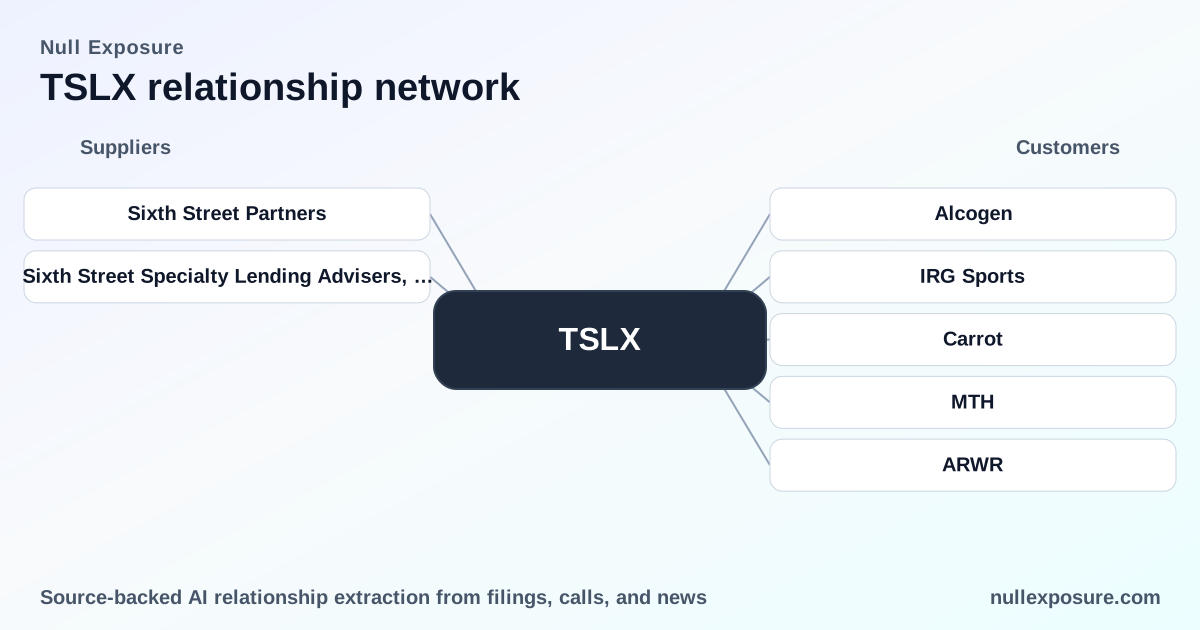
TSLX Customer Relationships: What investors need to know
Sixth Street Specialty Lending Inc. (TSLX) underwrites and holds debt and select equity positions in predominantly private, private-equity‑backed middle‑market companies and structures strategic financing for larger corporates. The company monetizes through interest income on senior‑secured loans, prepayment and origination fees, and selective equity gains; fee income from accelerated amortization and strategic financing deals has become a material incremental revenue stream. TSLX leverages Sixth Street affiliates for co‑investments and structured capital solutions that broaden deal size and underwriting reach. For a consolidated view of coverage and signals, visit https://nullexposure.com/.
How TSLX’s operating model shapes counterparties and risk
TSLX’s commercial footprint reflects a repeatable, balance‑sheet lending model focused on the U.S. middle market. Key operating model characteristics:
- Contracting posture: long‑to‑medium term exposure. Portfolio composition and public filings describe loan maturities in the two‑to‑seven year range and first‑lien debt predominant in fair‑value weighting, consistent with a lending book that realizes returns over multiple years.
- Counterparty profile: mid‑market, US‑domiciled borrowers. The firm defines middle‑market counterparties as companies with EBITDA roughly $10M–$250M and targets U.S.‑domiciled credits for primary income generation.
- Concentration and spend profile: large aggregate book with mid‑sized ticketing. TSLX reports total invested assets in the billions while average investment sizes are roughly $23.4M — meaning the platform scales risk through many mid‑sized positions rather than a handful of outsized single obligors.
- Role and criticality: both lender and structured financing provider. Company materials highlight a service‑provider posture — ability to co‑invest with Sixth Street affiliates and provide “one‑stop” capital — while filings also list some positions acquired in the role of investor/seller.
- Sector tilt and geography: services heavy and US‑centric. Internet and business services are large portfolio industries, and disclosures emphasize U.S. domicile for primary income generation.
These signals drive how counterparties influence liquidity, covenant structures, and prepayment fee income — factors investors should track alongside credit metrics and underwriting vintage.
Transaction-level relationships: line‑by‑line from public mentions
Below are all relationships surfaced in public transcripts and press coverage during FY2026 and the Q4 2025 commentary, summarized in plain English with source context.
-
Alcogen — TSLX disclosed that a small second‑lien term loan in Alcogen was moved to non‑accrual status and represented 0.01% of the portfolio by fair value, signaling a de minimis credit workout rather than material exposure. Source: Q4 2025 earnings call transcript (InsiderMonkey, Mar 10, 2026).
-
IRG Sports — Management noted a long‑standing investment in IRG Sports, describing it as a business the firm has owned for eight to nine years, indicating legacy, actively managed exposure. Source: Q4 2025 earnings call transcript (Investing.com, May 4, 2026) and repeating commentary on the same earnings call (InsiderMonkey, Mar 10, 2026).
-
Carret — The firm holds a public equity position in Carret; TSLX reported that market price moves between quarter‑ends produced reversals of previously recognized unrealized gains. Source: Q4 2025 earnings call transcript (Investing.com, May 4, 2026).
-
Olkagen — A very limited second‑lien term loan in Olkagen was placed on non‑accrual during the quarter and was disclosed as 0.01% of total portfolio by fair value, mirroring the treatment of similar small second‑lien exposures. Source: Q4 2025 earnings call transcript (Investing.com, May 4, 2026).
-
Carrot — TSLX confirmed ownership of Carrot as a public equity holding during the call, again highlighting mark‑to‑market volatility in the equity sleeve of the portfolio. Source: Q4 2025 earnings call transcript (InsiderMonkey, Mar 10, 2026).
-
Arrowhead — Prepayment and accelerated amortization fees increased during the quarter, driven primarily by prepayment fees earned on investments in Merit and Arrowhead, indicating realized cash inflows from unscheduled paydowns on these credits. Source: Q4 2025 earnings call transcript (Investing.com, May 4, 2026).
-
BEAM (Beam Therapeutics Inc.) — Sixth Street (affiliates of TSLX’s parent ecosystem) provided a $500 million non‑dilutive senior credit facility to Beam to fund potential product launch activities; press releases emphasize long‑term strategic financing rather than equity dilution. Source: Beam press release and Sixth Street announcement (SixthStreet.com / GlobeNewswire / multiple outlets, Feb–Mar 2026).
-
MTH — Management attributed a portion of higher other fees to prepayment fees earned on investments such as Merit (MTH listed in disclosures), reinforcing that prepayment economics are a recurring contributor to fee income. Source: Q4 2025 earnings call transcript (InsiderMonkey, Mar 10, 2026).
-
Merit — Merit generated prepayment fees that materially lifted other fees in the quarter, a direct illustration of how unscheduled paydowns translate to near‑term revenue bumps for the lending business. Source: Q4 2025 earnings call transcript (Investing.com, May 4, 2026; InsiderMonkey, Mar 10, 2026).
-
Arrowhead (second mention / driver of fees) — A repeat note that prepayment fees from Arrowhead contributed to the quarter’s increased other fee line, showing that Arrowhead paydown activity had real earnings impact. Source: Q4 2025 earnings call transcript (InsiderMonkey, Mar 10, 2026).
(Each of the above entries is drawn from Q4 2025 earnings call transcripts and public press announcements in FY2026; specific source pages include Investing.com (May 2026), InsiderMonkey (Mar 2026), Sixth Street press releases and GlobeNewswire (Feb–Mar 2026).)
Why these relationships matter for valuation and risk
- Credit seasoning and concentration: The handful of named credits that generated prepayment fees demonstrates an active secondary market and borrower optionality; prepayment dynamics are a real earnings lever but can be lumpy.
- Small non‑accruals don’t move the needle today: The disclosed non‑accrual second‑lien positions (Alcogen/Olkagen) are explicitly de minimis (0.01% each), which is consistent with a broadly senior‑secured, first‑lien portfolio where downside is limited in size.
- Strategic financings expand the addressable market: The $500M financing to Beam via Sixth Street affiliates illustrates the firm's capacity to provide large, non‑dilutive capital solutions that generate fee and interest income without equity dilution to the borrower — a complementary revenue source to middle‑market lending.
- Portfolio composition drives sensitivity: With ~89% first‑lien debt by fair value and average ticket sizes around $23M, TSLX is exposed to borrower credit cycles at scale but diversified across many mid‑sized obligors, which supports steady income but requires underwriting vigilance.
Investment implications and next steps
For investors and operators evaluating TSLX customer relationships, the takeaways are clear: TSLX runs a diversified, US‑centric middle‑market lending book that monetizes through interest, prepayment and strategic financing fees; headline risks to monitor are credit migration in lower‑secured pockets and the lumpy nature of prepayment fee income. Track quarterly disclosures for changes in non‑accruals, first‑lien weighting, and the pipeline of strategic financings.
If you want a consolidated signals feed and relationship map for due diligence, visit https://nullexposure.com/ for more curated coverage.