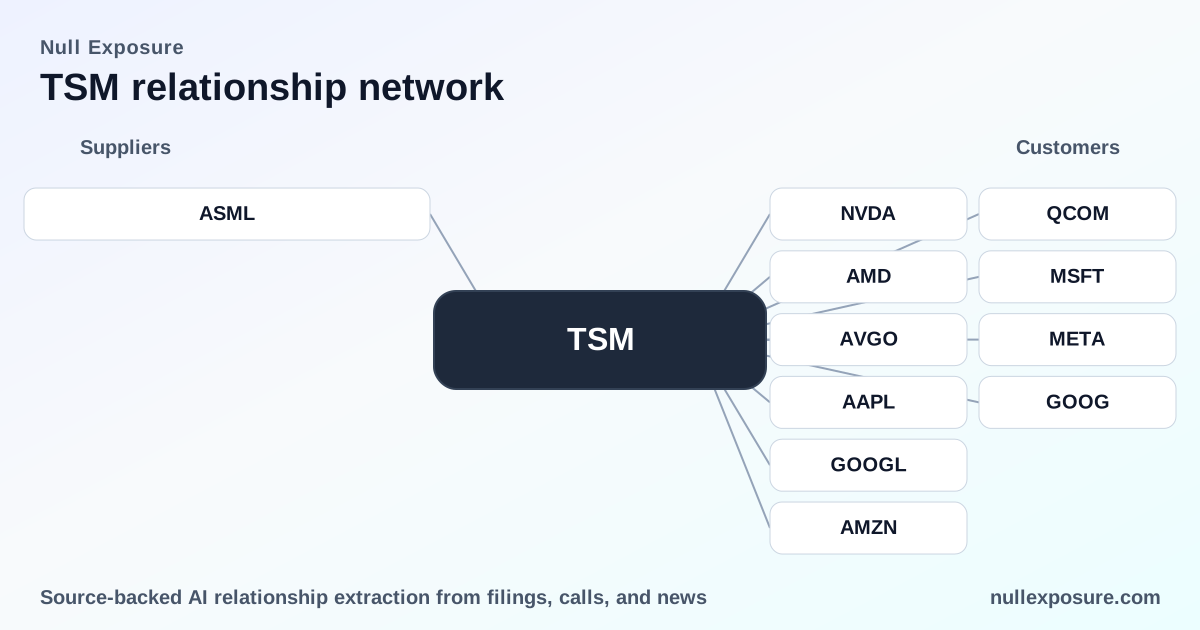
TSMC’s customer fabric: why the foundry is the fulcrum of modern silicon economics
Thesis — Taiwan Semiconductor Manufacturing Company (TSMC) runs a pure‑play foundry that monetizes by fabricating wafers and advanced packaging for design houses, hyperscalers and integrated device manufacturers; revenue derives from node‑led pricing, long‑cycle capacity allocation and large, recurring wafer orders that convert capital intensity and scale into premium margins. For investors tracking counterparty risk and concentration, these customer ties are the principal operational signal for TSMC’s top‑line durability and execution risk. Learn more at https://nullexposure.com/.
What the customer map tells investors about TSMC’s business model
TSMC’s relationships across the ecosystem create four company‑level signals that matter to premium finance and operations teams. First, contracting posture is long‑term and allocation‑driven: customers compete for committed capacity and priority at leading nodes. Second, customer concentration is high, with a handful of clients accounting for a material share of wafer revenue and therefore revenue volatility. Third, criticality is systemic: TSMC’s capability at the bleeding edge is central to customers’ product roadmaps and to AI data‑center supply chains. Fourth, maturity and capital intensity define the model — advanced‑node leadership requires sustained CAPEX and multi‑year capacity planning. These are company‑level signals that shape pricing power, execution risk and counterparty exposure.
Customer relationships — one‑line snapshots (complete coverage)
Below are concise, plain‑English summaries for every customer relationship recorded in our results. Each entry cites the public source that documents the tie.
Nvidia (NVDA)
Nvidia is now TSMC’s largest AI‑chip customer, relying on TSMC for advanced nodes and packaging for GPUs and accelerators; recent coverage links Nvidia’s growth and roadmap to TSMC capacity and expansion plans. According to CNBC (Apr 24, 2026), Nvidia is the foundry’s largest customer in the AI cycle.
Apple (AAPL)
Apple sources a large portion of its application processors and custom silicon from TSMC, including planned volumes from U.S. fabs; Apple orders are material to TSMC’s revenue mix. CNBC and MarketBeat reporting (2026 Q1–Q2) document Apple’s large purchase commitments to Arizona production.
AMD (AMD)
AMD competes with other fabless designers for premium node allocation at TSMC and confirmed capacity discussions on earnings calls around sourcing incremental TSMC supply. AMD referenced TSMC capacity on its 2025 Q4 earnings call (March 7, 2026).
Broadcom (AVGO)
Broadcom is a major customer that uses TSMC for high‑performance ASICs and accelerators; public commentary highlights Broadcom’s reliance on TSMC during tight capacity conditions. Reuters and coverage compiled in InsiderMonkey (Mar–May 2026) underscore that dependency.
Microchip (MCHPP)
Microchip expanded cooperation with TSMC to secure 40nm capacity at TSMC’s Japanese fabs, reflecting a targeted supply relationship for legacy nodes. Taipei Times reporting (Apr 10, 2024; referenced in 2026 coverage) documents Microchip’s deepened partnership.
GlobalFoundries (GFS)
GlobalFoundries signed licensing and technology agreements with TSMC for specific GaN voltage processes, indicating non‑competitive technology transfers across foundries. GlobalFoundries reported the TSMC technology agreement on its 2025 Q3 earnings call (covered in March 2026).
Cadence (CDNS)
Cadence expanded collaborations with TSMC to optimize AI design flows for TSMC’s N2 and A16 technologies, reflecting EDA‑to‑foundry alignment for next‑gen products. Cadence referenced the collaboration on its 2025 Q4 earnings call (March 2026).
Marvell (MRVL)
Marvell operates as a fabless vendor that outsources leading nodes to TSMC, relying on TSMC’s nodes for its connectivity and AI‑infrastructure silicon. FinancialContent research (March 2026) cites Marvell’s foundry relationship.
Silicon Motion (SIMO)
Silicon Motion’s SM8008 SSD controller is manufactured on TSMC’s 6nm process, illustrating TSMC’s role in supply for storage controller vendors. Company press releases and StorageNewsletter coverage (Mar–May 2026) cite TSMC N6 use.
Everspin / MRAM (MRAM)
Everspin confirmed tape‑out plans for MRAM devices on a 16nm FinFET node at TSMC, demonstrating TSMC’s support for specialty memory implementations. Everspin’s earnings disclosures (2026) referenced the TSMC tape‑out.
Mobileye (MBLY)
Mobileye struck a supply agreement with TSMC to manufacture imaging radar and EyeQ chips, marking TSMC’s entry into ADAS SoC supply for the auto sector. Mobileye disclosures and news reports (2026) document the deal.
Ambiq (AMBQ)
Ambiq built its SPOT family SoCs on a TSMC FinFET process, enabling ultra‑low voltage operation that the company highlighted on its Q4 2025 earnings call. Ambiq’s earnings call transcript (2025Q4) notes TSMC as the manufacturing partner.
SiTime (SITM)
SiTime cited TSMC as a key supplier in its supply‑chain commentary, signalling reliance on TSMC for timing‑device components. SiTime’s 2025–2026 reporting referenced the supplier relationship (InsiderMonkey coverage, 2026).
Impinj (PI)
Impinj outsources wafer manufacturing for endpoint and reader ICs to TSMC, underscoring product‑level dependence on the foundry. Impinj’s SEC filing and TradingView summary (2026) mention TSMC manufacturing.
Astera Labs (ALAB)
Astera Labs operates a fabless model and uses TSMC for IC fabrication and assembly/test partners, aligning its product roadmap with TSMC process availability. Company SEC materials summarized on TradingView (2026) describe the partnership.
LAES / LAESV
IC‑design/service vendors listed LAES/LAESV point to TSMC among partners for full‑turnkey and secure ASIC production, reflecting ecosystem integration with the foundry. Company press releases (2026) and GlobeNewswire cite TSMC in partner lists.
Ansys (ANSS)
Ansys was discussed in industry commentary as a tool vendor whose products are important for foundry node ramp success — linking EDA/physics software vendors into the TSMC ecosystem. FinancialContent reporting (2026) referenced the role.
Ciena (CIEN)
Ciena’s component roadmap references dependency on high‑end foundry capacity for 3nm chips, identifying TSMC as the relevant supply node in research coverage. Finterra / FinancialContent analysis (2026) mentions the dependency.
Butterfly Network (BFLY)
Butterfly Network’s next‑generation system uses a P4.3 chip developed with TSMC, showing the medtech segment’s reliance on TSMC for key custom silicon. Company product coverage (DICardiology, 2024–2026 reporting) notes the TSMC partnership.
Ansys / EDA ecosystem (reiterated)
EDA and IP providers were repeatedly referenced across coverage as partners in node maturation and customer yields; these vendors are operationally tied to TSMC’s node ramps. Market commentary (FinancialContent, 2026) documents that linkage.
Amazon (AMZN), Google / Alphabet (GOOGL), Microsoft (MSFT), Meta (META)
Major cloud and hyperscale customers are named broadly as end‑users of systems built around GPUs and accelerators that TSMC manufactures, implying indirect but significant demand flow to the foundry. Sector reporting (247WallStreet, Mar–Apr 2026) links hyperscaler capex to TSMC node demand.
Qualcomm (QCOM)
Qualcomm is listed among key U.S. customers that TSMC supports out of Arizona and other fabs, particularly for mobile and edge silicon. NIST and SimplyWall coverage (2024–2026) mention Qualcomm in U.S. fab visibility.
Intel (INTC)
Intel has used advanced packaging to combine in‑house silicon with chips manufactured at TSMC, reflecting cross‑foundry integration on advanced packaging platforms. The Register coverage (Mar 2026) documents Intel’s packaging interoperability.
Tesla (TSLA), SpaceX, xAI (XAIL), Anthropic
Emerging AI and vertical OEMs are discussed as potential new sources of custom‑silicon demand that could divert or expand the foundry market; investor commentary links those projects to potential competitive sourcing impacts. SimplyWall and sector pieces (2026) outline the scenario.
Credo (CRDO)
Credo announced SerDes IP and product availability on TSMC N3 and 5nm processes, a signal of IP vendors’ reliance on TSMC nodes for next‑gen connectivity silicon. Credo investor communications (May 2026) reference TSMC node availability.
Operating risks, concentration and what to watch next
- Capacity execution risk is principal: market reports flagged 2nm/advanced node bottlenecks and customer roadmap adjustments as immediate operational concerns (TradingKey, March 2026).
- Concentration is material: multiple sources quantify Apple and Nvidia as large wafer revenue contributors and emphasize the revenue sensitivity that creates for TSMC (FinancialContent, SimplyWall, 2026).
- Geopolitics and dispersion strategy: TSMC’s global fab expansion (U.S., Japan, Taiwan, Europe) is a direct response to customer demand concentration and geopolitical risk; watch U.S. fab execution as a revenue‑visibility lever.
- Contracting posture: customers lock capacity and negotiate node priority; this allocation model supports pricing power but raises settlement and backlog risk during surges.
If you want transaction‑level exposure and counterparty mapping for TSM’s customer set, explore how these relationships translate to contractual capacity and credit exposure at https://nullexposure.com/.
Conclusion — For investors and operators, the customer map is both TSMC’s moat and its stress test: premium margins from node leadership flow from concentrated, long‑term customer commitments, while execution on CAPEX and capacity expansion will determine whether those commitments translate into sustained revenue growth.