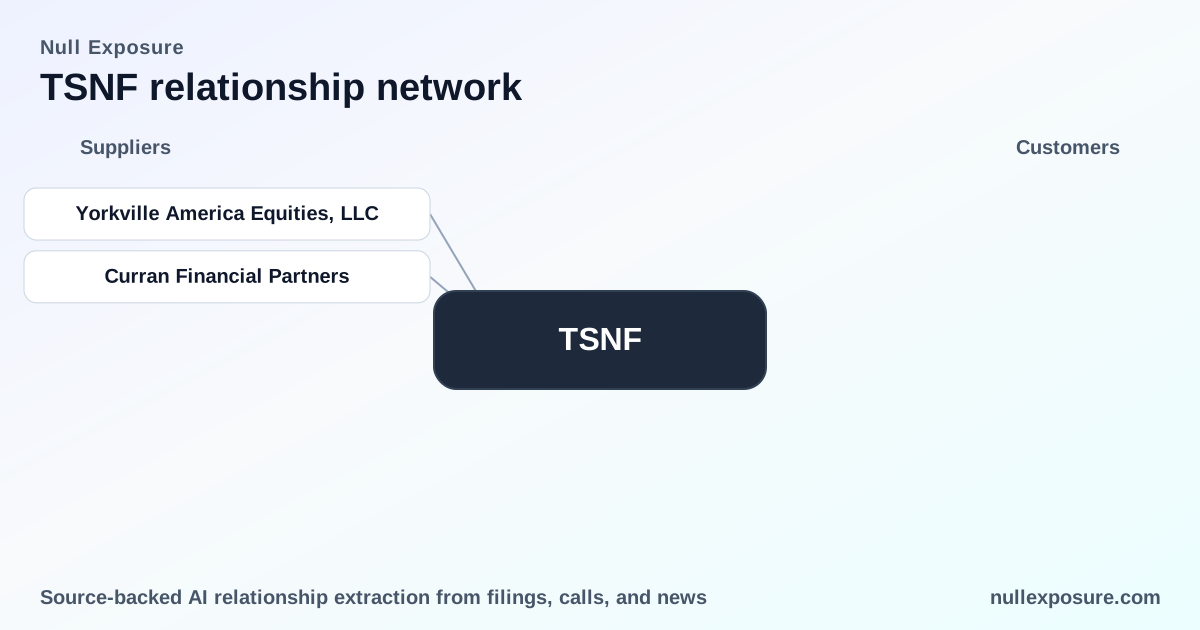
TSNF customer relationships: what investors should know
TSNF sells enterprise-grade services to other companies and captures value primarily through contract revenue—recurring subscriptions and related professional services that embed TSNF into customer workflows. Its customer footprint matters for revenue predictability and renewal dynamics: customer identity, contract criticality, and disclosure frequency drive investor views of concentration and operational risk. For readers who evaluate counterparty exposure and revenue durability, this note isolates the known customer ties and company-level signals that affect TSNF’s commercial posture. If you want a concise dashboard view of customers for diligence, visit https://nullexposure.com/ for a quick entry point.
What the public record actually shows today
TSNF’s public customer trail is light: our review turned up a single reported relationship in public news sources tied to FY2025 activity. That limited visibility is itself a material company-level signal—low public disclosure of customer contract detail increases the importance of qualitative diligence on contract terms, renewal cadence, and revenue concentration.
- Disclosure posture: No explicit contractual constraints or granular customer metrics were found in the available records, which indicates a restrained external disclosure approach by the company.
- Concentration signal: With few named customers in the public record, investors should treat customer concentration as an open variable until company filings or management comment clarify revenue splits.
- Contracting posture: The presence of enterprise customers in public references suggests TSNF engages in B2B, enterprise-selling motions rather than anonymous volume channels, implying longer sales cycles but higher per-customer revenue potential.
Customer map: the one reported relationship and why it matters
FiscalNote Holdings Inc. (NOTE)
FiscalNote (listed as NOTE) is the sole customer-related name surfaced in the FY2025 coverage we reviewed. Press coverage describes features that scan real-time discussions across platforms (X, Truth Social, Bluesky, CQ News) and apply AI to extract mentions and sentiment shifts among lawmakers ahead of policy finalization, which aligns with enterprise information services used by government affairs teams. According to a March 2026 Yahoo Finance article, FiscalNote highlighted a feature leveraging real-time social and niche publisher signals to pre-empt legislative outcomes, indicating FiscalNote’s product set integrates near-real-time signals and AI processing for policy intelligence (Yahoo Finance, March 10, 2026).
Why this matters for TSNF investors:
- If TSNF supplies technology, data, or services to customers like FiscalNote, those contracts are likely enterprise-grade and tied to mission-critical workflows for government affairs and policy teams. That raises both renewal value and the bar for parity replacements.
- Enterprise nature implies longer contractual duration and higher switching costs, which supports revenue durability if confirmations of contract length and share follow in formal filings or management commentary.
Source: Yahoo Finance coverage of FiscalNote product features, FY2025/FY2026 press timeline (article published March 10, 2026).
Commercial implications and risk factors investors need to weigh
TSNF’s business risk profile for investors hinges on a few force multipliers tied to customers:
- Concentration risk: The public record lists only one named customer relationship; until company-level disclosures quantify revenue by customer, assume concentration is unresolved and could be material.
- Revenue predictability: Enterprise customers like FiscalNote indicate subscription and service revenue potential; however, the absence of contract detail in filings reduces near-term visibility into renewal rates and churn.
- Operational criticality: If TSNF provides core signal-processing or data services embedded in policy intelligence products, the customer relationship would be high criticality—supporting sticky revenue—yet also increasing dependency on a narrow set of clients.
- Maturity and adoption: Public references to FY2025/FY2026 product integrations are consistent with mid-stage commercial adoption rather than rollouts to broad markets; investors should seek ARR breakouts and customer lifetime metrics to confirm scale.
Due diligence checklist for investors and operators
Focus your next diligence steps on the following items to convert the public visibility gap into actionable intelligence:
- Request customer revenue breakdowns (top 10 customers, percent of revenue) and contract tenure for the last three fiscal years.
- Obtain typical SOWs and renewal schedules for enterprise clients to verify recurring revenue conversion.
- Validate product embedding: are services mission-critical to the customer’s end-product, or peripheral add-ons?
- Assess concentration mitigation: pipeline intensity, new logo wins, and geographic diversification.
If you want a concise executive summary and a commercial risk dashboard to take to management calls, see https://nullexposure.com/.
Bottom line: an actionable investor read
Public evidence shows a link between TSNF and at least one enterprise customer in the policy intelligence space—FiscalNote—through FY2025/early FY2026 press. The key investor takeaway is not the single name itself but the disclosure vacuum: limited public customer detail elevates the importance of direct diligence on contract concentration, renewal economics, and product criticality. For TSNF, converting opaque customer mention into verified contract economics is the fastest path to reducing investor uncertainty.
Bold, simple measures—ask for revenue-by-customer detail and sample contracts—resolve most open questions and materially change the investment thesis.